
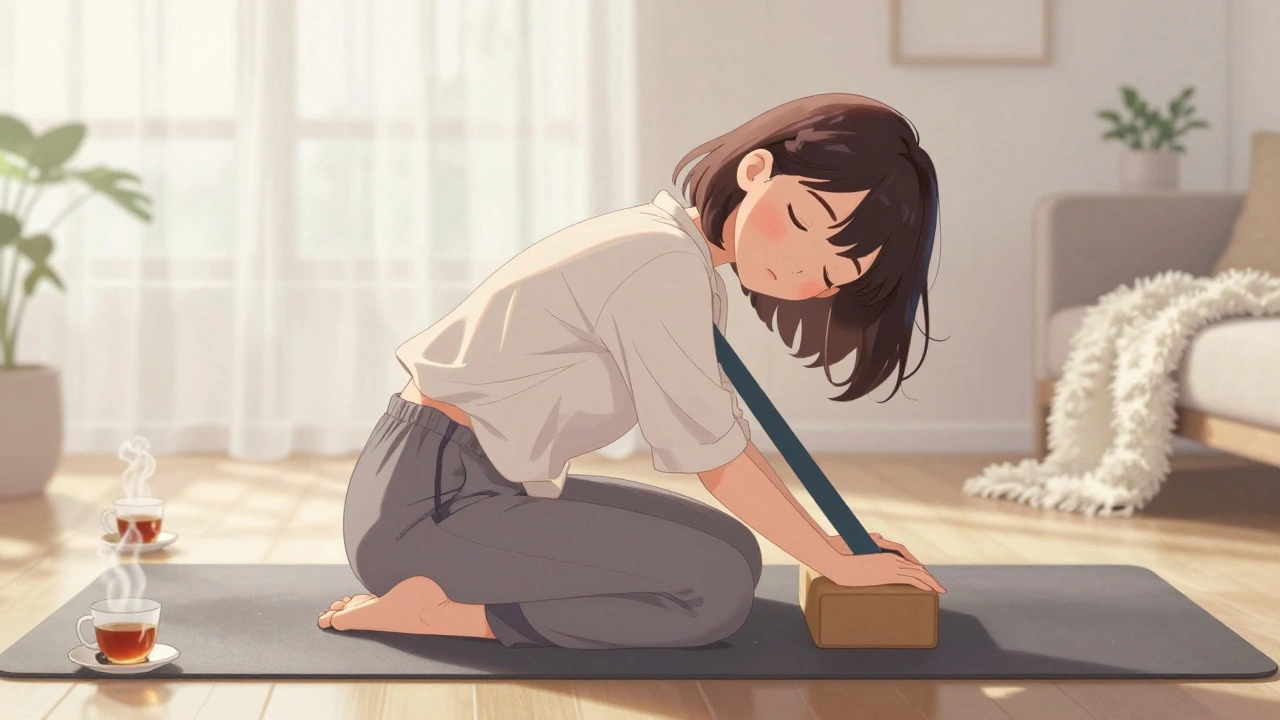
Chronic pain doesn’t just hurt-it drains your energy, ruins your sleep, and makes even simple movements feel like a battle. If you’ve tried medications, physical therapy, or injections and still feel stuck, you’re not alone. Millions of people are turning to something quieter, slower, and surprisingly powerful: yoga and tai chi.
Why These Two Practices Work for Pain
Yoga and tai chi aren’t just stretches or dances. They’re movement-based mind-body therapies backed by real science. Both practices combine slow, controlled motion with focused breathing and mental awareness. This combo does something few pain treatments can: it calms your nervous system while gently rebuilding strength and flexibility. A 2018 study in the New England Journal of Medicine followed 66 people with fibromyalgia. After 12 weeks of tai chi, they reported 27% less pain, 31% fewer symptoms of depression, and better sleep than those doing regular stretching. Yoga showed similar results in a 2022 review of 2,702 participants-especially for lower back pain and neck pain. One 2024 study found that yoga combined with hot sand fomentation improved neck mobility by 37% compared to standard care. The magic isn’t just in the movements. It’s in how they change your brain. Chronic pain often makes your body hypersensitive. Yoga and tai chi teach your nervous system to stop overreacting. You learn to notice discomfort without panicking. That shift alone can reduce pain intensity over time.How Tai Chi Helps-Especially for Older Adults
Tai chi looks like a slow-motion dance. But don’t be fooled. It’s a precision tool for pain relief. Originating in China over 800 years ago, it’s now used in VA hospitals, clinics, and community centers across the U.S. Tai chi focuses on weight shifting, balance, and flowing movements. This makes it ideal for people with knee osteoarthritis, lower back pain, or balance issues. A 2021 review of 16 studies found tai chi improved balance by 18-25% compared to control groups. That’s huge for older adults who fear falling. It’s also low-risk. Unlike high-impact workouts, tai chi doesn’t slam your joints. You can do it standing, seated, or even lying down. Veterans using VA programs report 68% reduced opioid use after six months of regular tai chi. One man in his 60s with severe knee pain told me, “I thought I’d never walk without a cane. After three months of tai chi, I walked to the mailbox without help.” The most common style for beginners is Yang-style tai chi. It’s gentle, rhythmic, and easy to learn. Sessions usually last 30-60 minutes, done 2-4 times a week. Most people start feeling better after 6-8 weeks. Maximum benefits show up around 12 weeks.How Yoga Helps-And Which Styles Work Best
Yoga is older than tai chi-dating back over 5,000 years. But modern pain-focused yoga isn’t about twisting into impossible poses. It’s about mindful movement that meets your body where it is. For chronic pain, not all yoga is created equal. Avoid fast-paced styles like Vinyasa or Power Yoga. Instead, look for Hatha, Restorative, or Yin yoga. These styles use long holds, props like blocks and straps, and gentle transitions. A 2022 review of 27 studies found yoga sessions lasting 45-90 minutes, done 2-3 times a week, delivered the best results for back, neck, and joint pain. One woman with rheumatoid arthritis shared on Reddit: “I can’t do standing poses on bad days. But I do seated yoga with a chair. It keeps my shoulders and spine from locking up.” Chair yoga is now recommended by the Arthritis Foundation and widely used in pain clinics. Yoga also helps with the mental side of pain. Stress tightens muscles, which makes pain worse. Yoga teaches you to breathe through discomfort instead of fighting it. That reduces muscle tension and lowers cortisol levels-the stress hormone that fuels inflammation.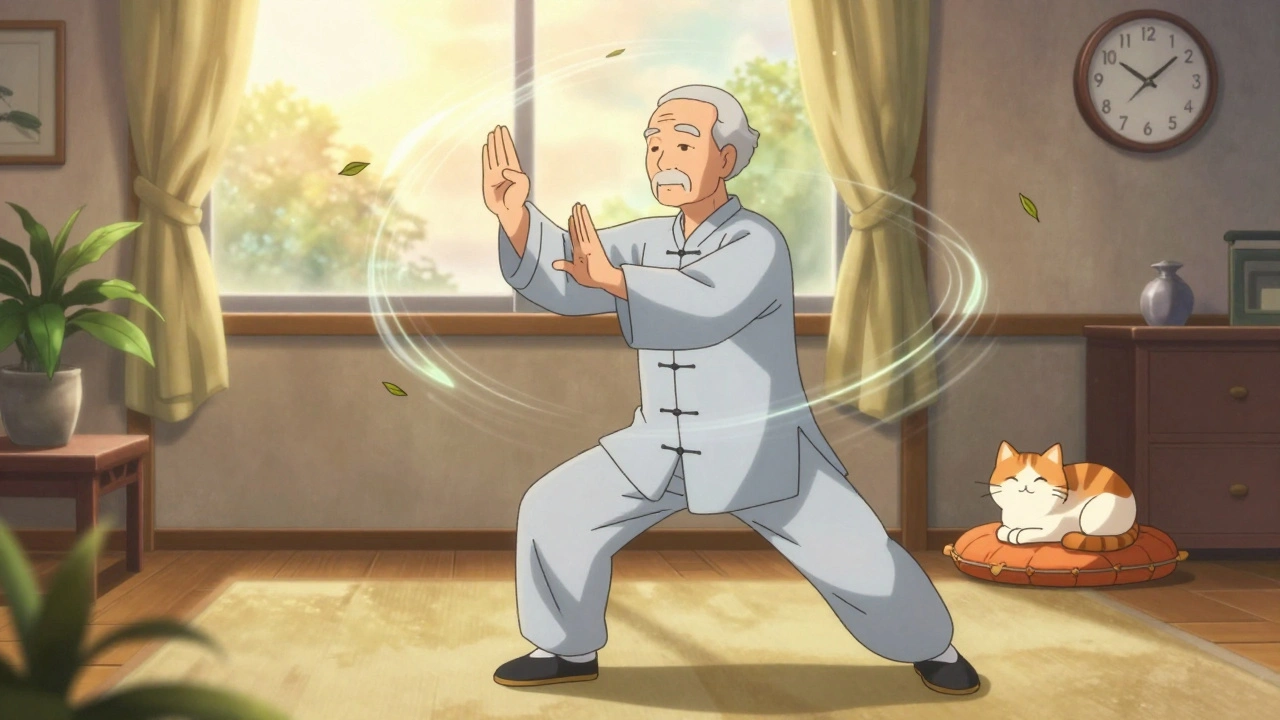
Yoga vs. Tai Chi: Which One Should You Choose?
There’s no “better” option. It depends on your body and what you need.| Feature | Yoga | Tai Chi |
|---|---|---|
| Primary Focus | Static postures + gentle flows | Continuous, flowing movements |
| Best For | Back pain, neck pain, flexibility | Knee osteoarthritis, balance, lower back pain |
| Session Length | 45-90 minutes | 30-60 minutes |
| Frequency | 2-3 times/week | 2-4 times/week |
| Best Styles for Beginners | Hatha, Restorative, Yin | Yang, Sun |
| Equipment Needed | Mat, blocks, straps | Comfortable clothes, flat surface |
| Adaptability | High-chair, wall, and bed versions available | Very high-can be done seated or standing |
What the Experts Say
The American College of Physicians recommends both yoga and tai chi as first-line, non-drug treatments for chronic low back pain. That’s the same level of recommendation they give to cognitive behavioral therapy. Dr. Chenchen Wang at Tufts Medical Center says, “The evidence for tai chi in fibromyalgia is now robust enough to recommend it as a first-line non-pharmacological intervention.” But experts also warn: not all classes are created equal. A 2023 study found that 34% of negative reviews came from people who had instructors who didn’t know how to modify movements for pain conditions. One man with knee osteoarthritis said his first tai chi class made his pain worse because the teacher didn’t adjust his stance. Look for instructors certified by Yoga Alliance (for yoga) or the National Certification Commission for Acupuncture and Oriental Medicine (NCCAOM) for tai chi. Ask if they’ve trained in pain management or work with older adults or people with arthritis.How to Start Without Getting Hurt
You don’t need expensive gear or a gym membership. Here’s how to begin safely:- Start small. Do 10-15 minutes a day for the first week. Don’t push to “get it right.”
- Use props. A chair, wall, or yoga block can support you. No one expects you to touch your toes.
- Listen to your body. If something hurts, stop. Discomfort is normal. Sharp pain is not.
- Choose the right class. Search for “yoga for chronic pain” or “tai chi for arthritis.” Avoid “advanced” or “power” labels.
- Combine with your current care. These practices work best alongside meds or PT-not instead of them. One study showed 30-40% better results when used together.
Real People, Real Results
On Reddit’s r/ChronicPain community, 78% of users who tried tai chi reported moderate to significant pain reduction. One woman with lupus wrote: “I used to cry just getting out of bed. Now I do 20 minutes of tai chi every morning. I still have pain, but I don’t feel defeated by it anymore.” A 2023 survey found that 62% of users relied on apps like “Tai Chi for Arthritis” or “Yoga for Chronic Pain” to supplement in-person classes. These apps are affordable, often under $10/month, and let you practice at your own pace. For people with severe mobility limits, seated versions of both practices are just as effective. You don’t need to stand to benefit.What’s Changing in 2025
The biggest shift? Insurance coverage. Starting January 2025, doctors in the U.S. can officially bill for referring patients to yoga and tai chi programs. That’s because the American Medical Association added them to their new coding system for non-drug pain treatments. The VA now offers tai chi at 92 of its 170 medical centers, serving 45,000 veterans yearly. Blue Cross Blue Shield covers these programs in 12 states. More insurers are following. Researchers are also testing virtual reality tai chi programs. Early results show 28% better adherence because users get real-time feedback on their form-no instructor needed.Final Thought: Movement Is Medicine
Pain makes you want to stop moving. But stopping makes pain worse. Yoga and tai chi break that cycle. They don’t promise a cure. But they give you back control. You don’t have to be flexible. You don’t have to be young. You don’t even have to be pain-free to start. You just have to be willing to move-slowly, gently, and without judgment. The body remembers how to heal. Sometimes, all it needs is a quiet space, a few minutes, and the permission to move without fear.Can yoga or tai chi make my pain worse?
Yes-if done incorrectly or pushed too hard. Sharp pain, joint clicking, or increased discomfort during or after practice are red flags. Always start with beginner-friendly styles, use props, and work with an instructor trained in pain conditions. If you’re unsure, ask your doctor or physical therapist for recommendations.
How long until I feel less pain?
Most people notice small improvements in 4-6 weeks. Meaningful changes-like reduced pain intensity or better sleep-typically show up after 8-12 weeks of consistent practice. Patience is key. These aren’t quick fixes; they’re long-term tools.
Do I need special equipment?
For yoga, a non-slip mat is helpful, and blocks or straps can make poses easier. For tai chi, you just need comfortable clothes and flat, stable flooring. You don’t need expensive gear. Many people use chairs, walls, or even beds to adapt movements.
Can I do this if I’m over 70 or have arthritis?
Absolutely. Both yoga and tai chi are among the safest exercises for older adults and people with arthritis. Seated versions are widely available and just as effective. The Arthritis Foundation and VA both recommend them. Start slow, focus on comfort, and avoid forcing any movement.
Is it covered by insurance?
Some plans cover it now-especially if it’s part of a medically supervised program. Blue Cross Blue Shield covers it in 12 states. Starting in 2025, doctors can bill for referring patients to these programs, which will make coverage more common. Check with your insurer or ask your provider if they offer a covered program.
Should I stop my pain meds if I start yoga or tai chi?
No. These practices are meant to complement-not replace-your current treatment. Many people reduce their medication over time as pain improves, but never do this without talking to your doctor. Studies show the best results come from combining movement therapy with other care.
Let’s be clear: yoga and tai chi aren’t ‘alternatives’-they’re neuroplasticity hacks. The 2018 NEJM study? That’s not anecdotal-it’s Level 1 evidence. You’re not ‘stretching’; you’re rewiring your amygdala’s overactive threat response. And the fact that 68% of VA veterans reduced opioid use? That’s not wellness woo-it’s public health policy waiting to happen. Stop calling it ‘gentle movement.’ It’s somatic re-education, and the data is irrefutable.
Okay but have you heard about the secret government program that uses tai chi to control civilian pain perception? I read it on a forum-there’s a 2024 DARPA study where they synced brainwaves with slow movements to ‘calm the masses.’ That’s why insurance is suddenly covering it. They’re not helping you-they’re pacifying you. And don’t get me started on the yoga mats being laced with microchips. I saw a guy in a hoodie at the park doing downward dog… and his mat glowed. Coincidence? I think not.
My aunt tried yoga after her hip surgery and now she’s like, ‘I’m one with the universe’ and refuses to take her meds. It’s wild. She’s on a 10-day juice cleanse and says pain is ‘just a mindset.’ I just want her to walk without screaming, not become a guru. Why does everyone turn into a new-age cult member when they find something that helps?
I’ve been doing restorative yoga for 14 months now-seated, with pillows, no pressure-and I can finally tie my shoes without crying. I had two spinal fusions, and nothing worked until I stopped trying to ‘do it right’ and just let my body move at its own pace. The key? Consistency over intensity. You don’t need to touch your toes. You just need to breathe through the discomfort. And please-find a teacher who’s actually trained in pain science. I had one who made me do a full wheel pose with a herniated disc. It was a disaster. Don’t be that person.
Ha! Westerners think they invented ‘mindfulness’-but we’ve had this for 5,000 years in India! Yoga? It’s from the Vedas, not some Silicon Valley app. And tai chi? That’s just a watered-down version of Qigong, which we perfected in the Tang Dynasty! You people pay $25 for a ‘yoga for pain’ class? We had monks doing this in Himalayan caves while you were still hunting mammoths! Why are you so proud of rediscovering what your ancestors ignored? And why do you need a mat? A woven rug and a tree trunk worked fine for centuries!
Everyone’s acting like this is magic. I did tai chi for 6 months. My back hurt worse. My knees clicked like a broken hinge. The instructor told me to ‘go with the flow.’ What flow? The flow of agony? I think these practices are just expensive placebo therapy for people who don’t want to face real medicine. Also, why is everyone on Reddit suddenly a physical therapist? You don’t get to diagnose my pain because you watched a YouTube video.
The empirical support for both modalities is substantial, particularly in the context of central sensitization syndromes. The neurophysiological mechanisms-namely, downregulation of the sympathetic nervous system and modulation of the default mode network-are well-documented in fMRI studies. That said, adherence rates remain suboptimal in populations with low health literacy. The challenge lies not in efficacy, but in accessibility and instructor qualification. The 34% negative feedback rate cited in the 2023 study underscores systemic issues in instructor training.
I’ve been doing Yin yoga since my autoimmune flare-up three years ago-seated, with a bolster under my knees, breathing like I’m trying to convince my body not to eat itself. It’s not about flexibility. It’s about learning to sit with the discomfort without turning it into a horror movie. One day, I realized I wasn’t flinching when my shoulder clicked anymore. I didn’t fix my pain. I changed my relationship with it. And honestly? That’s the only kind of healing I’ve ever had that didn’t come with a prescription bottle and a side of guilt.
What fascinates me is how these practices embody a paradox: they demand total surrender to movement, yet require absolute awareness of sensation. It’s not passive-it’s an active surrender. The body, in chronic pain, becomes a prison of reflexive fear. Yoga and tai chi don’t erase the pain; they dissolve the narrative around it. You stop being a victim of your nervous system and become its observer. That’s not therapy. That’s epistemological revolution. And yet, we reduce it to ‘stretching’ and ‘balance.’ We commodify the sacred. I wonder if we’re ready for what these practices truly ask of us.
Just started tai chi last week. Sat in a chair. Did the hand movements. Felt weird. Felt calm. Didn’t cry when I stood up. That’s new. I’m not gonna lie-I thought it was gonna be cheesy. But honestly? It’s like my body finally got a hug. No hype. No magic. Just slow movement and quiet breath. If you’re skeptical? Try it for 10 minutes. No mat. No fancy clothes. Just sit. Move slow. Breathe. You don’t have to believe in it. Just let it happen.