

Blood Thinner Vaccine Safety Calculator
Vaccine Safety Assessment
Your Safety Assessment
Getting a vaccine while on blood thinners doesn’t mean you should skip it-far from it. In fact, people taking anticoagulants like warfarin, Eliquis, or Xarelto are often at higher risk for serious infections like flu, pneumonia, or COVID-19 because of heart conditions, past clots, or other chronic illnesses. Skipping vaccines because you’re worried about bruising or bleeding is a dangerous mistake. The real issue isn’t whether to get vaccinated-it’s how to do it safely so you avoid complications.
Why Blood Thinners Make Vaccines Riskier
Most vaccines, including flu shots, pneumococcal vaccines, and all current COVID-19 vaccines, are given as intramuscular (IM) injections. That means the needle goes deep into muscle tissue, where there are lots of small blood vessels. For someone on blood thinners, those vessels don’t clot as quickly. That’s not a dealbreaker, but it does mean even a normal injection can lead to bruising, swelling, or a hematoma-a collection of blood under the skin. The good news? Severe bleeding is rare. CDC data from 2022 shows only 1.2% of anticoagulated patients had complications serious enough to need medical care after vaccination. But that still means tens of thousands of people every year experience pain, swelling, or extended discomfort. And nearly a third of those cases happened because the provider didn’t adjust their technique.What You Need to Know About Different Blood Thinners
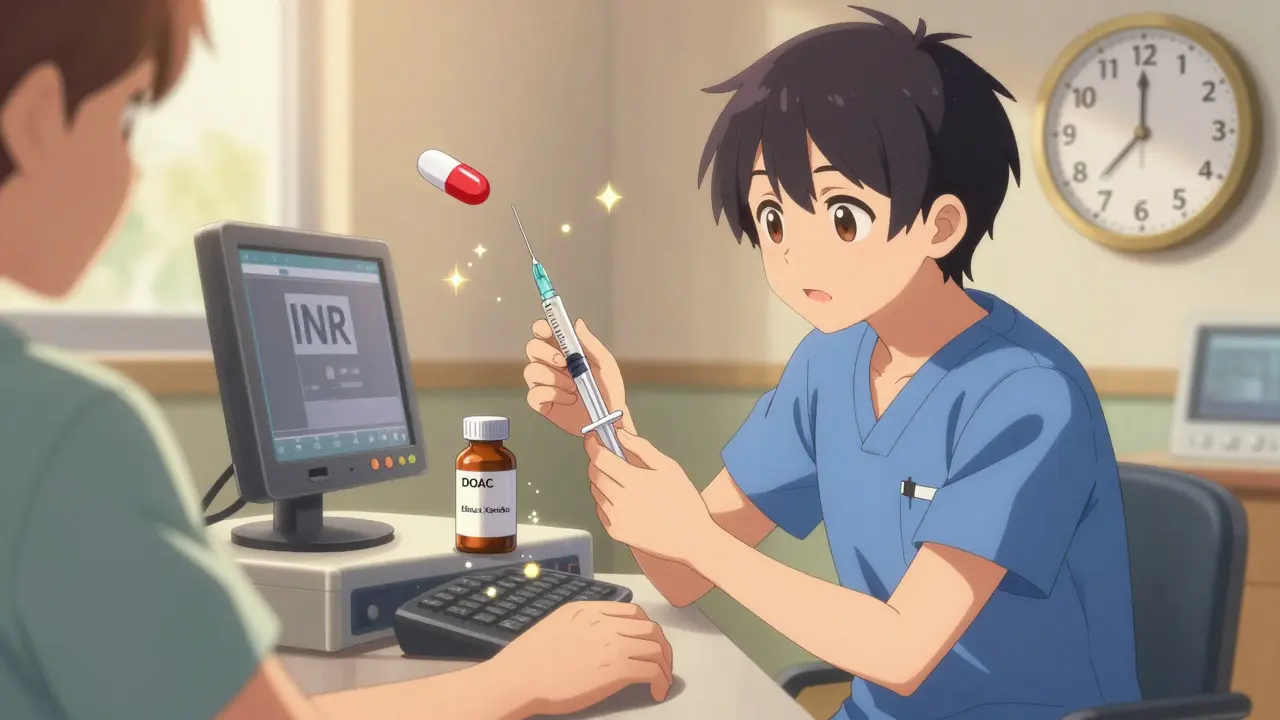
Not all anticoagulants are the same. The type you’re on changes how you prepare for a vaccine.- Warfarin (Coumadin): This one needs monitoring. Your INR (International Normalized Ratio) should be checked before vaccination. If your INR is above 4.0, your risk of bleeding jumps by 37%. Most guidelines say aim for an INR below 4.0, or below your personal therapeutic range if your doctor set a lower target. Some patients see their INR spike after a flu shot-sometimes up to 28 days later. That’s rare, but it’s why checking your INR a day or two before the vaccine matters.
- DOACs (Eliquis, Xarelto, Pradaxa, Savaysa): These don’t require blood tests before vaccination. No INR check needed. But timing can still matter. Some experts suggest scheduling your shot a few hours after your last dose, especially if you take it twice daily. This gives your body a little more time to clear the drug from your system. It’s not required, but it’s a smart precaution.
- Heparin (Lovenox, Fragmin): If you’re on injectable heparin, you’re likely managing a recent clot or surgery. Talk to your doctor about timing. Some providers recommend waiting 4-6 hours after your last injection before getting vaccinated, especially if you’re on high doses.
The Right Way to Give the Shot
Here’s where most mistakes happen. The needle size, pressure, and aftercare make all the difference.- Needle size: Use a 23-gauge or smaller needle. Thinner needles (like 25-gauge) cause less tissue damage and reduce bleeding risk. Avoid needles larger than 23-gauge-they’re too thick and increase trauma.
- Injection site: The deltoid (upper arm) is fine for most people. But if you’re on high-dose anticoagulants or have a history of bruising easily, the thigh (vastus lateralis) is a safer option. It’s thicker, has fewer major vessels, and absorbs pressure better.
- Pressure after the shot: This is the #1 rule. Don’t rub. Don’t massage. Just hold firm, direct pressure on the injection site for at least 2-5 minutes. For patients with severe bleeding disorders like hemophilia, 10 minutes is standard. A simple cotton ball or gauze pad works. No need for fancy bandages. Just keep pressing.
- No aspirin or NSAIDs: Don’t take ibuprofen, naproxen, or aspirin before or after the shot unless your doctor says so. These drugs interfere with platelet function and can make bleeding worse.
What Happens If You Don’t Follow the Rules
When providers skip the basics, complications spike. A 2023 survey by the National Blood Clot Alliance found that patients whose providers didn’t adjust technique had a 63% higher rate of bruising or hematoma. One patient reported a golf-ball-sized bruise that lasted six weeks. Another needed emergency care after a flu shot because the nurse used a 21-gauge needle and rubbed the site. Worse, 18% of patients forget to tell their provider they’re on blood thinners. That’s why some clinics now use wristbands labeled “Blood Thinner” or digital alerts in electronic records. UCLA Health’s system cut missed disclosures by 62% after rolling out the wristband program in early 2022.What to Do After the Shot
Even with perfect technique, you might still get a small bruise. That’s normal. But if you notice:- Swelling that keeps growing after 24 hours
- Pain that gets worse instead of better
- Significant numbness or tingling in your arm or hand
- Bruising that spreads beyond the injection site
Why Vaccination Isn’t Optional
People on blood thinners are often older or have heart disease, diabetes, or lung problems. These conditions make them more likely to end up in the hospital-and die-from flu or pneumonia. The CDC estimates that flu vaccines reduce hospitalizations by 40-60% in high-risk groups. For someone on anticoagulants, that’s not just a statistic-it’s life-saving. The American College of Physicians, the American Heart Association, and the Anticoagulation Forum all agree: do not delay or refuse vaccines because you’re on blood thinners. The risk of getting sick far outweighs the small chance of a bruise.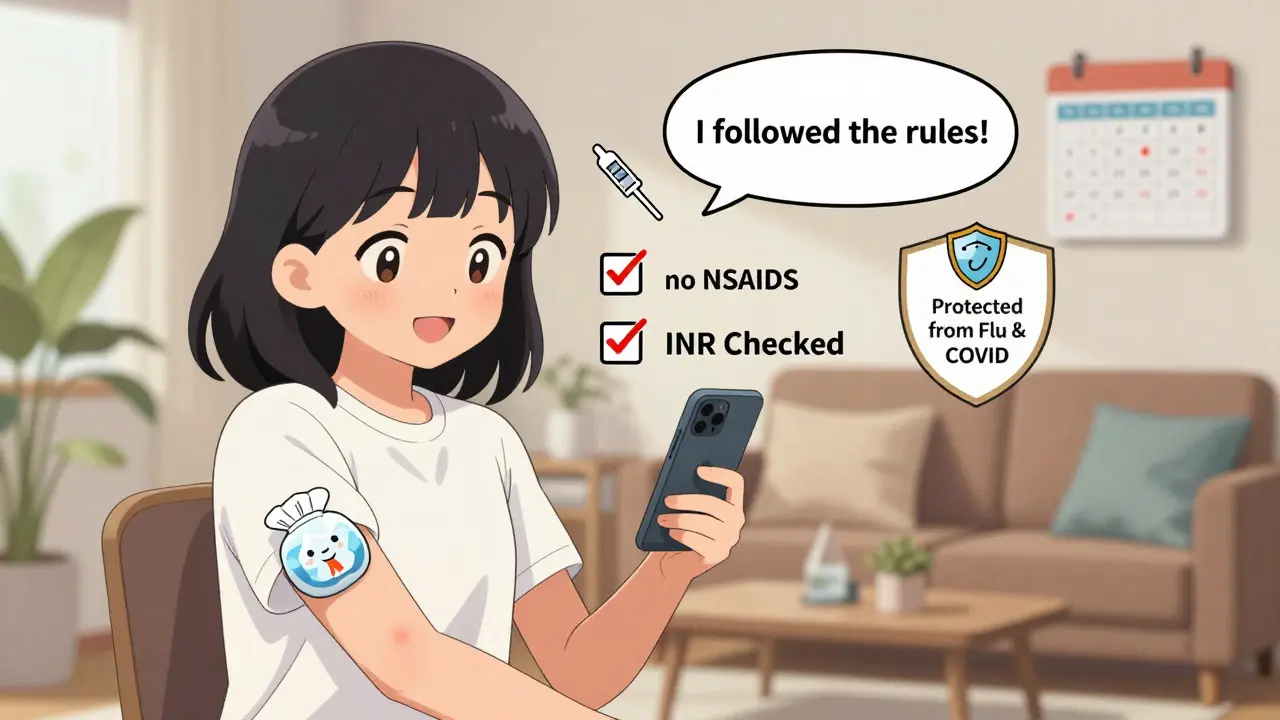
What Providers Need to Do
Health systems are catching on. In 2020, only 42% of hospitals had written protocols for vaccinating anticoagulated patients. By 2023, that number jumped to 87%. Kaiser Permanente cut complications by 54% after standardizing their process in 2020. Their protocol? Simple:- Check medication list before vaccination
- Use 23-gauge or smaller needle
- Apply 5 minutes of firm pressure
- Document anticoagulant use in the record
Final Checklist for Patients
Before your next vaccine:- Know your medication and dose
- Know your INR if you take warfarin
- Tell the vaccinator you’re on a blood thinner-even if they don’t ask
- Ask: “Will you use a small needle and apply pressure for at least 5 minutes?”
- Don’t take NSAIDs before or after
- Watch for swelling or pain that worsens after 24 hours
Frequently Asked Questions
Can I get vaccinated if my INR is above 4.0?
It’s safer to wait until your INR is below 4.0, or at least within your therapeutic range. If you’re due for a vaccine and your INR is too high, talk to your anticoagulation clinic. They may adjust your dose temporarily. Don’t skip the vaccine-just delay it by a few days if needed. The risk of infection is much higher than the risk of a bruise.
Do I need to stop my blood thinner before the shot?
Never stop your blood thinner without talking to your doctor. Stopping warfarin or a DOAC even for a day can increase your risk of a deadly clot. The goal is to vaccinate safely, not to stop treatment. Use a smaller needle, apply firm pressure, and avoid NSAIDs. Those steps are enough.
I had a big bruise after my last vaccine. Should I skip the next one?
No. Bruising is uncomfortable but not dangerous. The next time, make sure the provider uses a 25-gauge needle and applies pressure for at least 5 minutes. If they’re unsure, ask them to follow CDC guidelines. You’re still at high risk for serious infections. Vaccination is worth the minor bruise.
Is there a vaccine I should avoid if I’m on blood thinners?
No. All approved vaccines-including flu, COVID-19, pneumococcal, shingles, and hepatitis-are safe for people on anticoagulants. The only exception is live vaccines like the nasal flu spray (FluMist), but those aren’t recommended for most adults on blood thinners anyway because they’re not as effective. Stick to the injectable versions.
My nurse didn’t use pressure after the shot. Should I be worried?
If you notice swelling, warmth, or pain spreading after 24 hours, call your doctor. Apply ice and keep the arm elevated. Monitor for signs of a hematoma-increasing size, numbness, or tightness. In the future, ask for pressure before you leave. Most nurses know the protocol. If they don’t, ask for someone who does.
Look, I get it-people are scared of needles and bruising. But if you’re on blood thinners and skipping the flu shot because you don’t want a black arm, you’re playing Russian roulette with your lungs.
The math is simple: one bruise that fades in two weeks vs. a 60% higher chance of ending up on a ventilator. I’ve seen it firsthand. My dad’s on warfarin, had a hematoma after his last shot, and still got the next one. He didn’t miss a single vaccine since 2018. He’s 78 and still walks his dog every morning. That’s the difference between fear and informed action.
And yes, the pressure thing? Non-negotiable. I used to rub mine like I was polishing a car. Learned the hard way. Now I sit there like a statue for five minutes. No drama. No panic. Just pressure. It works.
Also-tell the nurse. Don’t assume they know. I had one who didn’t even ask. I had to say, ‘Hey, I’m on Eliquis. Small needle. No rubbing.’ She looked at me like I was speaking Klingon. But she did it. And I didn’t turn into a human bruise. Simple. Effective. Repeatable.
Man, this post is like a love letter to common sense wrapped in medical jargon. I’ve been on Xarelto for five years and I never knew about the 23-gauge needle thing. I thought all shots were the same. Turns out, I’ve been getting treated like a caveman with a 21-gauge spear.
Also, the thigh thing? Genius. My deltoid’s basically a canvas for tattoos and bruises. Switching to the thigh feels like upgrading from a tricycle to a Tesla. No more ‘I can’t lift my coffee cup’ days.
And NO NSAIDs? I used to pop ibuprofen like M&Ms after every shot. Whoops. That’s like pouring gasoline on a fire. Time to rethink my post-vax ritual. Maybe just a nap and a smoothie now.
Let’s be real-this whole thing is a public health theater piece. The CDC says 1.2% complication rate? That’s not ‘rare,’ that’s ‘acceptable collateral damage.’
And ‘don’t stop your blood thinner’? What about the guy who had a stroke because he got a flu shot and his INR spiked to 7.2? You think that’s accounted for? No. You think he was warned? No.
Also, ‘ask your provider’-yeah, right. Most clinics are understaffed, overworked, and have no clue. I had a nurse ask me ‘what’s warfarin?’ last year. So now I carry a laminated card. Because apparently, I’m responsible for training the people who are supposed to be trained.
And don’t get me started on the ‘golf-ball-sized bruise’ anecdote. That’s not ‘normal.’ That’s negligence dressed up as a guideline.
omg i just read this and i’m crying a little??
i’ve been on lovenox since my surgery last year and i’ve been so scared of shots. i thought bruising = bad = dangerous. turns out it’s just… annoying? and fixable?
i told my nurse i was on blood thinners and she just said ‘oh cool’ and gave me a normal needle. i didn’t know to ask for pressure. i felt so dumb.
so next time i’m going in with a printed copy of this and a ruler. ‘yes, 5 minutes. no rubbing. 23 gauge. no ibuprofen.’
thank you. seriously. this saved me from being a scaredy-cat.
I just want to say-this is the kind of information that should be handed out at every pharmacy, every clinic, every doctor’s office. Not buried in a 5,000-word post.
I’ve been on warfarin for 12 years. I’ve had two bad bruises. One lasted six weeks. I didn’t tell anyone because I didn’t know it was preventable.
Now I carry a small notebook. One page: ‘I’m on warfarin. Need: small needle. 5 minutes pressure. No NSAIDs.’ I hand it to them. Sometimes they look confused. Sometimes they thank me.
It’s not about being difficult. It’s about being alive.
Thank you for writing this. I wish I’d seen it years ago.
As an Aussie who’s been on Eliquis for a while, I’ve gotta say-this is spot on. We don’t have the same level of structured protocols here, but I’ve started asking for the thigh injection. My GP was surprised, but she loved the idea.
Also, the ‘no rubbing’ thing? I thought it was just old wives’ tales. Turns out, my bruise last year was way worse because I massaged it like I was giving myself a massage after a workout. Dumb. So dumb.
Now I sit there like a statue. No phone. No fidgeting. Just pressure. And honestly? It’s kind of meditative. I’ve turned vaccine day into a little ritual. Breathe. Press. Wait. Walk out feeling like I did something smart.
Also-no aspirin. I used to take it for the soreness. Now I just ice it. Feels better. Less risk. Win-win.
bloody brilliant post 😊
been on rivaroxaban for 3 years. never knew about the needle size or thigh option. i’ve been getting the shot in my arm like a chump. now i’m gonna ask for the thigh next time. feels like a tiny rebellion against medical laziness.
also-no NSAIDs? i’ve been popping naproxen like candy after shots. whoops. that’s like inviting a bear into your tent. not cool.
and pressure? i thought 30 seconds was enough. now i’m doing 5 minutes like i’m holding back the tide. weirdly satisfying.
ps: i told my nurse and she said ‘oh yeah, we do that here.’ i said ‘you do?!’ she looked confused. turns out she’d never heard of the protocol. we’re both learning.
thanks for the clarity. this is the kind of info that saves lives. not stats. real talk.
As a clinical pharmacist with 18 years in anticoagulation management, I can confirm: this is the most accurate, evidence-based summary I’ve seen in a public forum. The 23-gauge recommendation, the 5-minute pressure protocol, the avoidance of NSAIDs-all align with ASH, ACCP, and AHA guidelines. The fact that 18% of patients don’t disclose their anticoagulant use? That’s not ignorance. It’s systemic failure. Clinics still don’t have automated alerts. Pharmacists aren’t integrated into vaccine workflows. We’re treating this like a minor inconvenience, not a high-risk procedure.
And yes-INR spikes post-vaccine? Real. Documented. Underreported. I’ve had patients with INRs jump from 2.8 to 5.1 within 72 hours. No symptoms. No bleeding. Just a number. That’s why I tell every patient: ‘Check your INR 72 hours after vaccination.’ It’s not paranoia. It’s precaution.
Also: the thigh. Yes. Especially for those on high-dose anticoagulants. The vastus lateralis has lower vascular density. Less trauma. Fewer complications. It’s not ‘alternative.’ It’s optimal.
Thank you for elevating this conversation beyond fear. This is public health literacy in action.
Wow. This whole thing is just a marketing brochure for Big Pharma. You’re telling people to get vaccinated so they don’t get sick… but you’re ignoring the fact that vaccines can cause bleeding complications too. Why isn’t anyone talking about that?
And who says you can’t stop your blood thinner? What if you’re on it for a reason that’s no longer valid? What if you’re just on it because your doctor didn’t bother to reevaluate?
Also, ‘don’t skip vaccines because of bruising’-that’s not advice. That’s coercion. Bruising hurts. It’s not ‘minor.’ It’s a warning sign.
And why are you blaming nurses? Maybe they don’t know because they weren’t trained. Maybe the system is broken. Maybe we should fix the system instead of telling patients to be more assertive.
This post reads like a corporate pamphlet. Not medicine.