

Tetracycline-Isotretinoin Timing Calculator
Safe Timing Calculator
This calculator determines the safe waiting period between stopping tetracycline antibiotics (doxycycline, minocycline, etc.) and starting isotretinoin. The American Academy of Dermatology recommends waiting at least 1 week, with many experts suggesting 2 weeks to minimize risk of pseudotumor cerebri.
Important Safety Information:
Never restart tetracycline antibiotics while on isotretinoin. Even short overlaps increase risk of pseudotumor cerebri. If you experience severe headaches, vision changes, or ringing in ears, seek emergency medical care immediately.
When treating severe acne, doctors often turn to two powerful tools: isotretinoin and tetracycline-class antibiotics like doxycycline or minocycline. It seems logical-attack the acne from two angles. But here’s the harsh truth: tetracyclines and isotretinoin shouldn’t be used together. Not even for a few days. Not even if you think you’re being careful. The risk isn’t just theoretical-it’s real, documented, and can leave you permanently blind.
Pseudotumor cerebri, also called idiopathic intracranial hypertension, sounds like a mouthful. But it’s simple: your brain is under too much pressure. Not from a tumor. Not from an infection. Just from fluid buildup. Symptoms? Crushing headaches, vision blurring, ringing in the ears that pulses with your heartbeat, and in the worst cases, permanent vision loss. This isn’t a rare side effect you’ll read about in fine print. It’s a known, preventable disaster that’s happened to hundreds of people-many of them teenagers.
Why This Combination Is Dangerous
Isotretinoin (sold as Accutane, Claravis, Amnesteem) works by shrinking oil glands and calming inflammation. It’s one of the most effective acne treatments ever made. But it doesn’t come without risks. Even alone, it can raise pressure inside the skull in about 1 in 5,000 users. That’s low. But add a tetracycline-doxycycline, minocycline, tetracycline, or even the newer sarecycline-and the risk doesn’t just double. It multiplies.
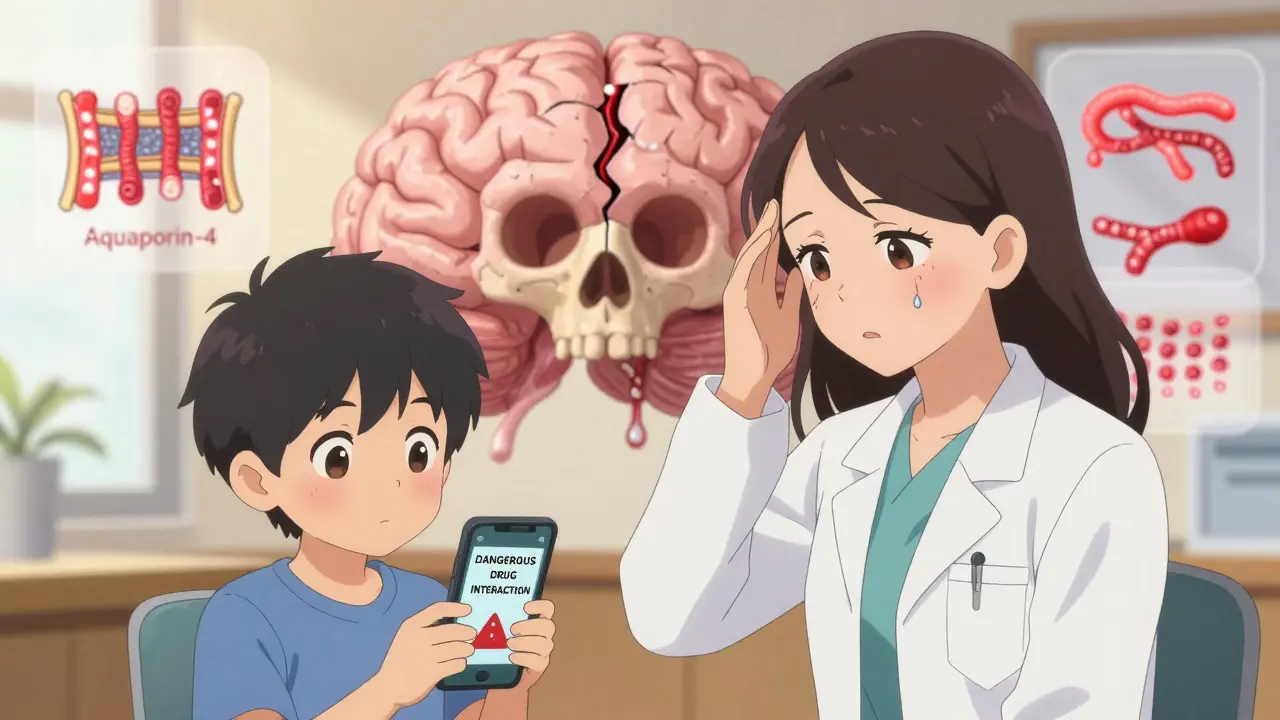
Why? We don’t have all the answers, but research points to a dangerous synergy. Both drugs affect how cerebrospinal fluid moves in and out of the brain. Isotretinoin alters fluid production. Tetracyclines, especially the lipophilic ones like doxycycline, slip easily through the blood-brain barrier. Together, they overwhelm the brain’s natural drainage system. A 2023 study in the Journal of Investigative Dermatology found the combination spikes a protein called aquaporin-4 in brain cells, which likely traps fluid where it shouldn’t be. The effect isn’t additive-it’s explosive.
The FDA first warned about this in 1998. Since then, over 127 confirmed cases have been reported to the FDA’s adverse event system. But experts believe fewer than 10% of cases are ever reported. One 2019 study estimated that for every case documented, 9 more go unnoticed. That means thousands of people may have been affected without ever knowing why.
Who’s at Risk-and How Often It Happens
This isn’t just about adults. Teens are the most vulnerable. A 2019 study of over 1,200 acne patients found that nearly 5% of those aged 12 to 17 were prescribed both drugs within 30 days. That’s one in every 20 teenagers. Why? Often because dermatologists didn’t realize the interaction. Or because the patient was already on doxycycline for acne and the doctor didn’t pause it before starting isotretinoin.
Case reports tell the real story. A 16-year-old girl developed blurred vision and double vision after just 18 days of taking doxycycline and isotretinoin together. Her vision never fully recovered. A Reddit user in 2022 described waking up with a headache so bad he thought he was having a stroke. He lost peripheral vision. Only a spinal tap to drain fluid saved him from permanent damage.
Compare that to other acne treatments. Isotretinoin with topical retinoids? That might dry out your skin. Isotretinoin with vitamin A supplements? That raises birth defect risks. But neither causes brain pressure. Only the tetracycline combo does. And the risk is so high that the American Academy of Dermatology, the European Academy of Dermatology, and the American Acne & Rosacea Society all say: never combine them.
What Doctors Are Doing About It
Thankfully, the medical community is waking up. Electronic health record systems like Epic and Cerner now have hard stops. If a doctor tries to prescribe isotretinoin while a tetracycline is active in the system, the computer blocks it. A 2022 study showed this cut co-prescribing from 3.7% down to just 0.4% in clinics using these alerts.
Pharmacies are catching up too. CVS Health ran a pilot program that blocked dispensing of this combination 98% of the time by flagging it at the pharmacy counter. The iPledge program-the FDA’s mandatory system for prescribing isotretinoin-now includes warnings about tetracyclines in its patient education materials. But it doesn’t automatically stop the prescription. That’s why electronic alerts are the real game-changer.
Board-certified dermatologists have changed their practices too. In 2010, 72% avoided this combo. By 2023, that number jumped to 89%. Residency programs now teach this interaction in detail. The American Board of Dermatology includes it in every certification exam. This isn’t an old warning-it’s a core part of modern dermatology training.

What You Should Do If You’re on One of These Drugs
If you’re currently taking a tetracycline-doxycycline, minocycline, tetracycline, or sarecycline-and your doctor wants to start isotretinoin, here’s what you need to do:
- Stop the tetracycline at least one week before starting isotretinoin. Some experts recommend two weeks.
- Don’t restart the tetracycline while on isotretinoin. Not even for a flare-up. The risk doesn’t go away after a few days.
- If you’ve already taken both together, watch for symptoms: intense headaches (worse in the morning), vision changes, ringing in the ears, nausea, or dizziness. Go to the ER immediately if they appear.
- Ask your dermatologist if they use an electronic alert system. If they don’t, insist on it. Your safety depends on it.
And if you’re on isotretinoin and need an antibiotic for another reason (like a sinus infection), don’t reach for doxycycline. Talk to your doctor about alternatives like azithromycin or amoxicillin. Neither carries this risk.
The Bigger Picture: Why This Matters
This isn’t just about acne. It’s about how we manage medications in the real world. We assume doctors know all the risks. We assume systems catch dangerous combinations. But for decades, this interaction flew under the radar. Patients were told to take both because “it’s common.”
Now, we know better. The shift away from tetracyclines for acne has been dramatic. Since 2010, prescriptions for these antibiotics in acne patients have dropped by 27%. At the same time, isotretinoin use has grown by 18% annually-not because it’s more common, but because doctors are using it alone, safely.
And new alternatives are rising. Dapsone gel, a non-antibiotic anti-inflammatory, has seen a 34% jump in prescriptions since 2018. It works for inflammatory acne without the brain pressure risk. The future of acne treatment isn’t about stacking drugs. It’s about using the right one, the right way.
The bottom line? If you’re on isotretinoin, avoid all tetracycline-class antibiotics. Period. No exceptions. No gray areas. The consequences aren’t just unpleasant-they’re irreversible. And every doctor, every pharmacist, every patient needs to know it.
Can I take doxycycline and isotretinoin if I stop one for a few days?
No. Even a short overlap increases the risk of pseudotumor cerebri. The interaction begins immediately and doesn’t have a "safe window." Experts recommend at least a one-week gap between stopping a tetracycline and starting isotretinoin, but many centers use two weeks. Never restart a tetracycline while on isotretinoin.
What if I already took both drugs together? Should I panic?
Don’t panic, but act fast. Stop both medications immediately and contact your doctor. Watch for symptoms like severe headaches (especially in the morning), blurred vision, double vision, ringing in the ears, or nausea. If any of these appear, go to the emergency room. A lumbar puncture can measure and relieve pressure, preventing permanent damage. Most cases are reversible if caught early.
Are all tetracycline antibiotics equally risky?
Yes. This risk applies to all drugs in the tetracycline class: tetracycline, doxycycline, minocycline, and sarecycline. It’s not about one specific drug-it’s about the whole class. Even newer tetracyclines like sarecycline carry the same warning. Don’t assume one is safer.
Why don’t pharmacies automatically block this combination?
Many do now, but not all. Systems like Epic and Cerner have hard stops built in. Pharmacies like CVS have implemented screening tools that block this combo 98% of the time. However, smaller clinics or older systems may still allow it. Always double-check with your pharmacist and ask if they have a safety alert for this interaction.
Is there a safe alternative to tetracyclines for acne while on isotretinoin?
Yes. If you need an antibiotic for acne while on isotretinoin, azithromycin or amoxicillin are safe options. Neither has been linked to pseudotumor cerebri. For inflammatory acne, non-antibiotic options like dapsone gel are increasingly used and have no brain pressure risk. Talk to your dermatologist about switching to one of these.
I just found out my niece was on both of these and had to get a spinal tap. She's 15. No one warned us. I'm so glad this post exists. Please, if you're a parent, read this twice.
They say 'never combine' but I've seen 3 people on both. All fine. Coincidence? Maybe. Or maybe the system's overreacting again.
This is the kind of post that makes me trust medicine again. Not because it's flashy, but because it's quiet, detailed, and actually helps. Someone took the time to lay out the science, the stats, the real-world impact. No hype. Just facts. Thank you.
I'm a nurse in dermatology and this is exactly why I double-check every script. I've seen the scans of those swollen brains. It's not dramatic. It's silent. And by the time you notice, it's already too late. Please, if you're on isotretinoin, don't even think about grabbing a doxycycline for a cold. It's not worth it.
As someone from Australia, I'm glad to see this getting attention. Our guidelines here are similar, but awareness is still patchy in rural clinics. I've had patients come in confused because their GP prescribed doxy alongside Accutane. We had to go back and redo the whole script. Education matters.
LOL so now we're scared of antibiotics? Next they'll say sunlight causes cancer. They're just trying to sell you more expensive 'non-antibiotic' gels. Dapsone? That's just a cheap knockoff of bleach. Wake up.
It's funny how we treat acne like it's trivial. But the body doesn't care about our priorities. The brain doesn't know if you're 16 or 46. It just reacts. And when it reacts wrong, it doesn't ask for consent. This isn't about acne. It's about how we forget that medicine isn't a menu. It's a symphony. One wrong note, and the whole thing collapses.
The data here is compelling. The FDA warning from 1998, the 127 documented cases, the underreporting estimates-all point to a systemic failure in communication. It's not that doctors are negligent. It's that the information never reached them, or they assumed it was outdated. This isn't about blame. It's about systems that need to catch what humans miss.
As a board-certified dermatologist, I want to say thank you for writing this. The shift from 72% to 89% avoidance since 2010? That's us. The residency training. The EHR alerts. The pharmacy flags. We're getting better. But we need patients to demand it. Ask your doctor: 'Do you have an automated alert for tetracycline-isotretinoin interaction?' If they say no, find someone who does. Your vision matters more than convenience.
I was on minocycline for 4 months for acne. Then my dermatologist switched me to isotretinoin without telling me to stop the doxy. I didn't know there was a problem. I had headaches for weeks. Thought it was stress. Then I lost peripheral vision in my left eye. I spent 3 days in the hospital getting spinal taps. They said I was lucky I didn't go blind. I'm 22. I still get migraines. I still have blurry spots. And no one ever warned me. This isn't a rare side effect. It's a silent epidemic. And the system still doesn't get it.
So let me get this straight. We're banning antibiotics for acne because of one rare brain condition? What's next? Banning Tylenol because someone once overdosed? This is medical fearmongering dressed up as science. I'm not taking your advice.
Oh great. Another 'science' post that cites 'studies' without linking them. Where's the PubMed ID? The JID paper? The 2023 study? You say 'aquaporin-4' like it's a magic word. Prove it. Or this is just another clickbait scare tactic from a med blogger trying to look smart.
They're lying. The real reason they don't want you on tetracyclines is because Big Pharma owns the isotretinoin patents. They killed off the cheap antibiotics to force you into $1000/month treatments. The 'risk' is a cover. Look at the stock prices. Coincidence? I think not.
When the body is under pressure it seeks balance. The brain is not a machine. It is a living organism that responds to the rhythm of chemicals. When you force two forces into one vessel you disrupt the natural flow. The fluid rises not because of chemistry alone but because the soul of the system is disturbed. We are not just cells. We are echoes of deeper patterns. This is not a side effect. It is a warning from the body itself.
This is why I love medicine when it's done right. Not because it's perfect, but because it evolves. The fact that EHRs now block this combo? That's progress. The fact that residency programs teach it? That's culture change. The fact that patients are finally hearing this? That's power. We don't need more drugs. We need better awareness. And this post? It's a step. A quiet, important step.