
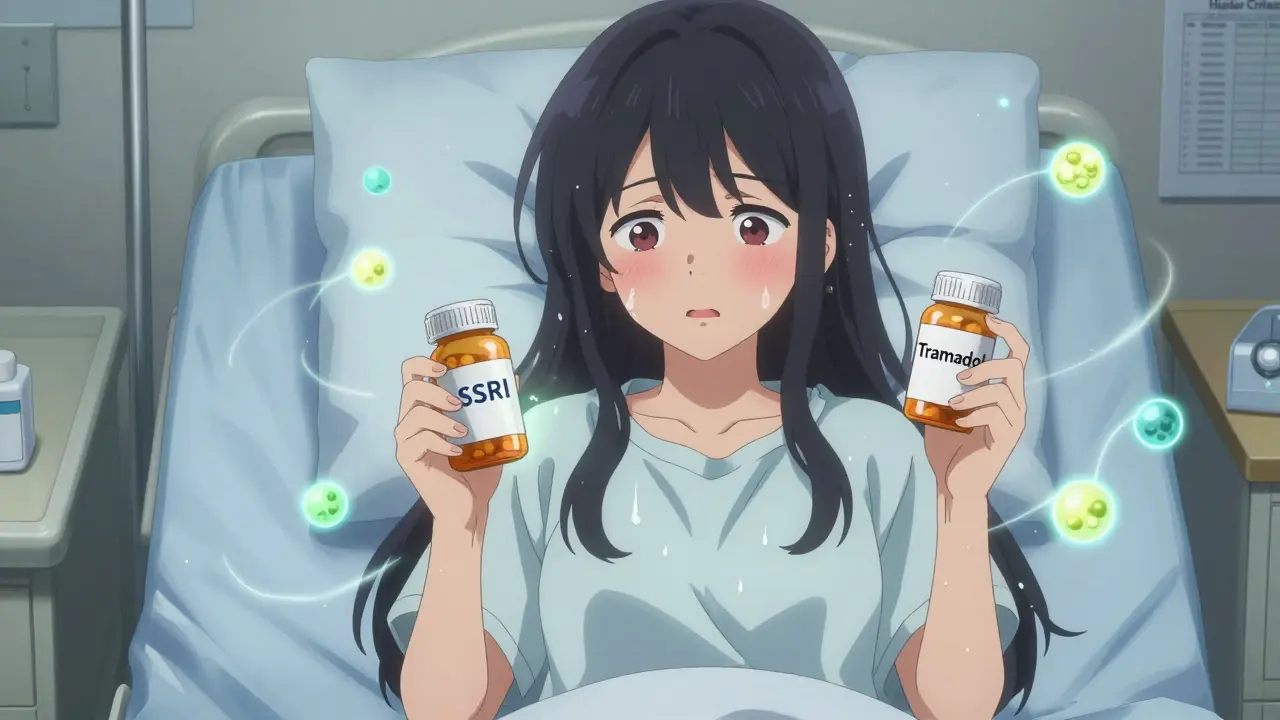
When you're taking an SSRI for depression or anxiety and need pain relief, it's easy to assume that any opioid will do. But that’s not true. Some opioids, when paired with SSRIs, can push your body into serotonin syndrome - a dangerous, sometimes deadly reaction that starts with shivering and ends with seizures, high fever, or cardiac arrest. It doesn’t happen often, but when it does, it’s often missed. And it’s preventable.
What Is Serotonin Syndrome?
Serotonin syndrome isn’t an allergy. It’s a toxic overload. Your brain and nervous system rely on serotonin to regulate mood, sleep, and pain. But too much serotonin, especially when two drugs boost it at once, causes your nerve cells to overfire. The result? A cascade of symptoms that can escalate fast.
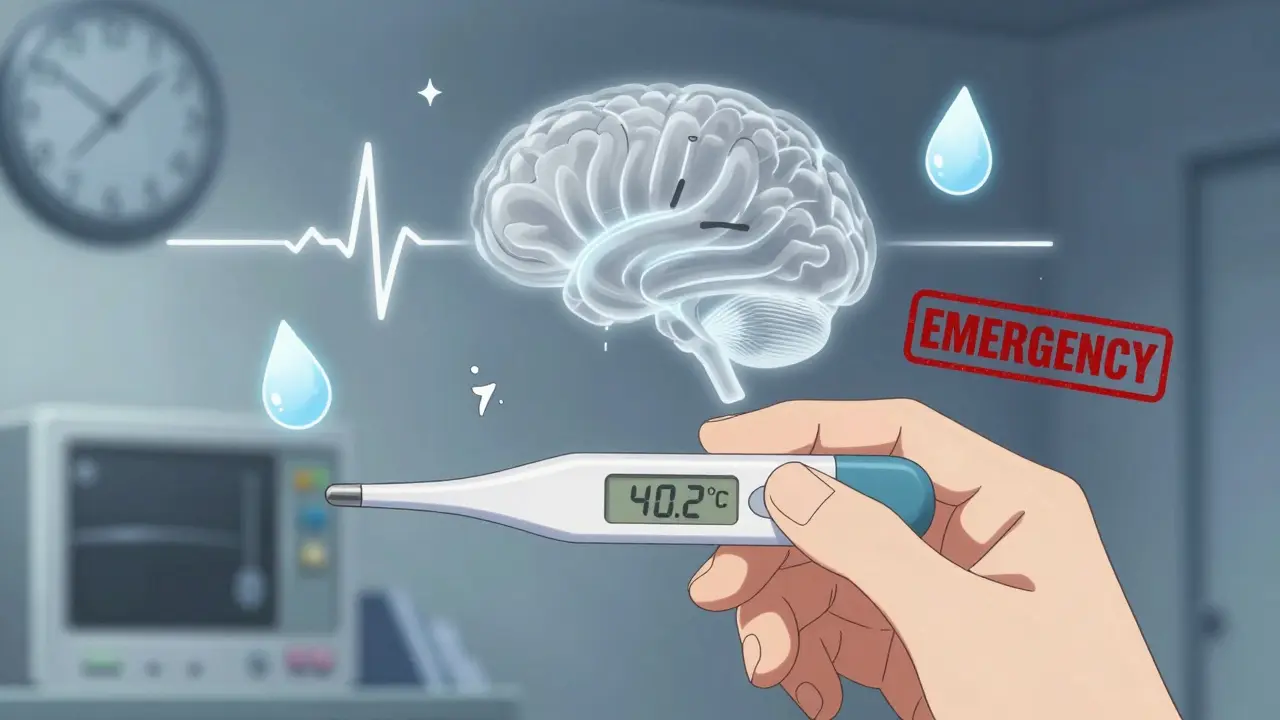
It usually hits within hours of taking a new drug or increasing a dose. You might notice your heart racing, your skin sweating for no reason, or your muscles twitching uncontrollably. In mild cases, it feels like a bad flu. In severe cases, your body temperature can spike past 41°C (106°F), your muscles lock up like a statue, and your organs start to shut down. About 10% of untreated severe cases don’t survive.
Doctors use the Hunter criteria to diagnose it - not guesswork. You need at least one of these: spontaneous muscle clonus, inducible clonus with agitation or sweating, or tremor plus hyperreflexia. That’s not something you can ignore. And it’s not the same as a panic attack or a fever from infection.
Why SSRIs and Opioids Don’t Always Mix
SSRIs work by blocking the serotonin transporter (SERT), the system that clears serotonin from between nerve cells. That’s how they help with depression - more serotonin stays around. But when you add an opioid that also blocks SERT, you double the effect.
Not all opioids do this. Tramadol, methadone, and pethidine (meperidine) are the worst offenders. They’re strong SERT inhibitors - tramadol blocks it 30 times more than morphine. Fentanyl doesn’t block SERT in lab tests, but real-world reports show it still causes serotonin syndrome. Why? It likely activates serotonin receptors directly. Codeine? We used to think it was safe. But case reports now show it can trigger the syndrome when combined with SSRIs like paroxetine.
On the other side, morphine, oxycodone, and buprenorphine have little to no effect on SERT. They’re safer choices if you’re on an SSRI. Hydromorphone is another low-risk option. If you need pain relief and are already on an SSRI, these are the opioids your doctor should consider first.
Which SSRIs Carry the Highest Risk?
Not all antidepressants are equal in this risk. Fluoxetine (Prozac) is especially dangerous because it sticks around. Its active metabolite, norfluoxetine, can linger for up to 16 days after you stop taking it. That means even if you quit Prozac weeks ago, you’re still at risk if you start tramadol. Sertraline? Half-life is about 26 hours. Much lower risk.
SNRIs like venlafaxine are also high-risk - they block both serotonin and norepinephrine reuptake. MAOIs are the worst. Combining an MAOI with any opioid can be fatal. Even at normal doses. That’s why doctors require a 14-day washout period before switching from an MAOI to another antidepressant - and up to five weeks if you were on fluoxetine.
Real Cases, Real Consequences
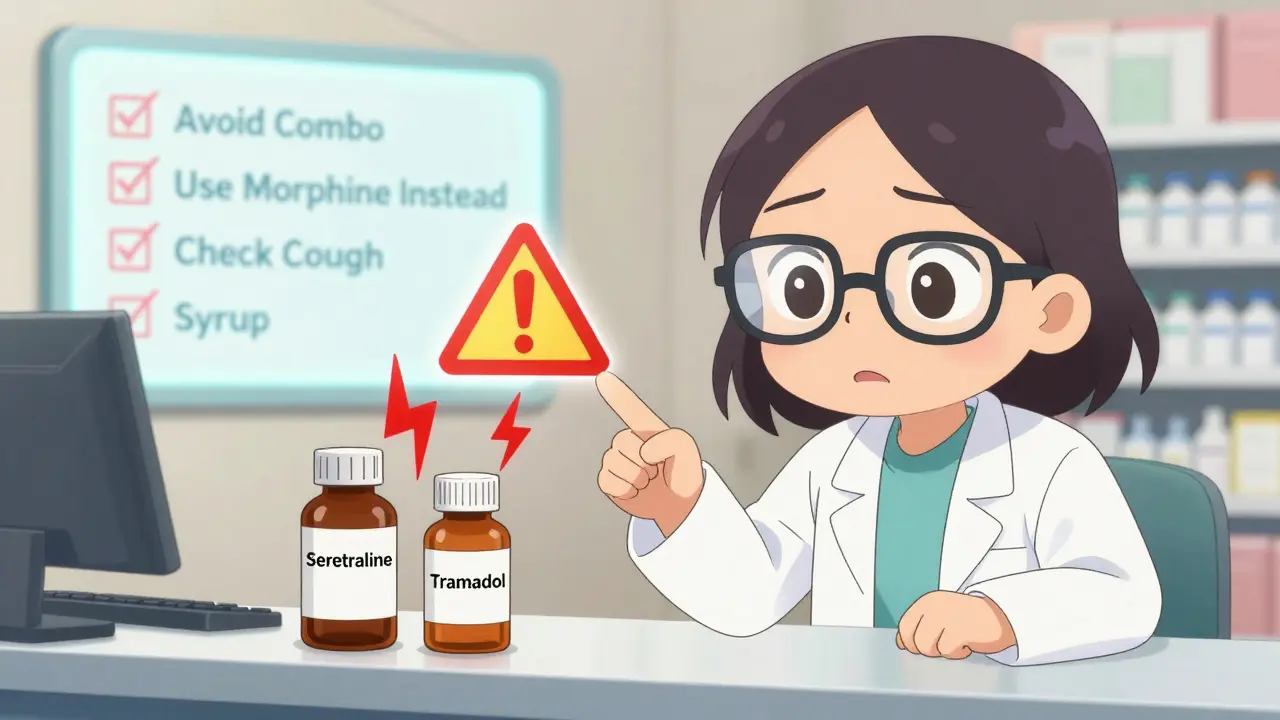
A 68-year-old woman in a U.S. hospital developed serotonin syndrome 12 hours after starting tramadol while on sertraline. Her temperature hit 40.2°C. Her blood pressure soared. She had spontaneous clonus - her leg jerked without her controlling it. She almost died.
Another case, reported in a pharmacy journal, involved a patient on paroxetine who took codeine for a toothache. She developed confusion, tremors, and a fever. Codeine wasn’t supposed to do this. But it did.
One hospital pharmacist in Australia told me they see 2-3 cases a month in their 500-bed facility. Almost all involve tramadol and an SSRI. The FDA recorded 848 cases of serotonin syndrome from opioid-SSRI combinations between 2018 and 2022. Tramadol was involved in nearly 40% of them.
And here’s the scary part: 44% of these cases were misdiagnosed at first. Doctors thought it was neuroleptic malignant syndrome, anticholinergic toxicity, or just a bad reaction to pain meds. By the time they realized it was serotonin syndrome, the patient was in critical condition.
Who’s Most at Risk?
It’s not just about the drugs. Your body matters too.
- People over 65 take 31% more medications on average. More pills = more chances for bad interactions.
- Those with liver or kidney disease can’t clear drugs properly. Even normal doses become toxic.
- People with a CYP2D6 gene variant - about 7% of the population - metabolize tramadol poorly. They build up dangerous levels faster.
- Patients on multiple serotonergic drugs - like an SSRI, tramadol, and dextromethorphan (in cough syrup) - are at extreme risk.
That’s why the American Geriatrics Society lists tramadol as “potentially inappropriate” for older adults on SSRIs. It’s not a judgment on the patient. It’s a warning about the combo.
How to Prevent It
Prevention is simple - if you know what to look for.
- Avoid high-risk pairs. If you’re on an SSRI or SNRI, don’t take tramadol, methadone, or pethidine. Period. There are safer painkillers.
- Choose safer opioids. Morphine, oxycodone, buprenorphine, and hydromorphone are your best bets. They don’t touch serotonin.
- Start low, go slow. If you absolutely must combine an opioid with an SSRI, start with half the usual opioid dose. Watch for 72 hours. No exceptions.
- Know your meds. If you’re on fluoxetine, remember: it lingers. You need five weeks after stopping before switching to a high-risk opioid.
- Check your cough medicine. Dextromethorphan - common in OTC cough syrups - also blocks SERT. Don’t take it with SSRIs.
Electronic health records can help. Kaiser Permanente cut inappropriate tramadol-SSRI prescriptions by 87% after adding a hard stop in their system. If your doctor tries to prescribe a dangerous combo, the system should flag it. If it doesn’t, speak up.
What to Do If You Think You Have It
Act fast. Serotonin syndrome gets worse fast.
- Stop all serotonergic drugs. This includes antidepressants, opioids, and even herbal supplements like St. John’s Wort.
- Call emergency services. Don’t wait. Go to the ER. Tell them you’re on an SSRI and an opioid.
- Get benzodiazepines. These calm the nervous system. They’re the first-line treatment in hospitals.
- Cool down. If your temperature is above 39°C, cooling blankets and ice packs are critical.
- Cyproheptadine. This is an antihistamine that blocks serotonin receptors. It’s given in severe cases - 12 mg first, then 2 mg every two hours if needed.
There’s no blood test for serotonin syndrome. Diagnosis is clinical. So if you’re on these drugs and feel off - shivering, twitching, sweating, heart racing - don’t brush it off. It’s not anxiety. It’s not a virus. It’s serotonin syndrome.
The Bigger Picture
The number of people taking both antidepressants and opioids is rising. In 2022, over 21% of opioid prescriptions went to people already on antidepressants. That’s more than 1 in 5. And it’s not slowing down.
Regulators are catching on. The FDA now requires opioid medication guides to include serotonin syndrome warnings. The European Medicines Agency updated tramadol labels. Research is underway to build risk algorithms into hospital systems that flag patients based on genetics, age, and drug history.
But the real fix is awareness. Patients need to know. Doctors need to ask. Pharmacists need to double-check. And when in doubt - choose the safer opioid. Skip the tramadol. Don’t gamble with your nervous system.
Can you get serotonin syndrome from one drug?
Yes, but it’s rare. Serotonin syndrome most often happens when two or more serotonergic drugs are combined. However, very high doses of a single drug - like an overdose of an SSRI or tramadol - can cause it on its own. It’s not common, but it’s possible.
Is it safe to take tramadol with Zoloft?
No. Tramadol and sertraline (Zoloft) are a high-risk combination. Tramadol blocks serotonin reuptake, and sertraline does too. Together, they can cause serotonin syndrome. Studies show this combo carries a 4.4 times higher risk than morphine with an SSRI. Avoid it. Use oxycodone or hydromorphone instead if you need pain relief.
How long after stopping an SSRI can you take an opioid?
It depends on the SSRI. For fluoxetine (Prozac), wait at least five weeks because its metabolite lasts so long. For sertraline, escitalopram, or citalopram, wait 7-10 days. For paroxetine, wait 10-14 days. Always check with your doctor - they’ll know your specific case.
Do all opioids cause serotonin syndrome?
No. Only some opioids affect serotonin. Tramadol, methadone, pethidine, and dextromethorphan (in cough syrup) are the main ones. Morphine, oxycodone, buprenorphine, and hydromorphone don’t significantly affect serotonin and are much safer to use with SSRIs.
What are the first signs of serotonin syndrome?
The earliest signs are shivering, sweating, a fast heartbeat, restlessness, and muscle twitching - especially in the legs. These can happen within hours of taking a new drug. If you notice these while on an SSRI and an opioid, stop the opioid and seek medical help immediately.
man i just started sertraline last month and my doc gave me oxycodone for a back injury-glad i didn’t go with tramadol like some drs suggest. also, i saw that dextromethorphan warning and just checked my cough syrup-thank god it was guaifenesin only. this post saved me from a bad day.
Okay, let’s be real: if your doctor prescribes tramadol with an SSRI without explaining the risk, they’re either lazy or didn’t read the last 10 years of pharmacology literature. I’ve seen this happen-twice. Both patients ended up in ICU. And yes, I’m the guy who Google’d it at 2 a.m. and called the pharmacy. You’re welcome.
Also, the FDA’s 848-case number? That’s just the tip of the iceberg. Most cases never get reported. I work in ER triage. We see 3-4 a month. Half of them think it’s ‘just anxiety.’
And for the love of all that’s holy, stop mixing St. John’s Wort with SSRIs. It’s not herbal ‘magic.’ It’s a chemical grenade.
Pro tip: if your pharmacist hesitates when you ask about interactions, walk out. Find a better one. They’re not just pill-dispensers-they’re your last line of defense.
Also, why does no one talk about CYP2D6 testing? It’s cheap. It’s fast. It’s available. Yet we’re still playing Russian roulette with pain meds? Come on.
And yes, I’m the guy who printed out the Hunter criteria and taped it to my fridge. You’re welcome again.
Let me tell you something they don’t want you to know-serotonin syndrome isn’t a medical condition, it’s a corporate cover-up. Big Pharma knows that if people realized how many drugs interact dangerously, they’d stop buying them. That’s why the FDA only ‘records’ 848 cases-because they’re scrubbing the real numbers. The truth? It’s happening in every hospital, every clinic, every pharmacy. And they’re silencing the whistleblowers.
I know a nurse who was fired for reporting a tramadol-SSRI combo. She got a restraining order. The hospital called it ‘breach of confidentiality.’ But I’ve got her emails. And I’ve got the hospital’s internal memo that says ‘avoid documentation of adverse events unless required by law.’
And don’t get me started on the CYP2D6 gene. That’s not just a variant-it’s a targeted biological marker. They’re using it to classify people as ‘high-risk’ so they can charge more for ‘personalized medicine.’ It’s discrimination disguised as science.
Also, why is fluoxetine’s metabolite still active for 16 days? Because they designed it that way. To keep you hooked. To keep you buying. They don’t want you off the drug. Ever.
And the cooling blankets? That’s not treatment. That’s damage control. The real cure? Stop prescribing these combos. But they won’t. Because money talks louder than lives.
There’s a reason they call it ‘syndrome’-not ‘disease.’ It’s not supposed to be curable. It’s supposed to be manageable. So they can keep selling.
Wake up. This isn’t medicine. It’s a system.
Just wanted to say-this is the kind of info that saves lives. I’m a nurse, and I’ve seen how fast this can spiral. One patient, 72, on fluoxetine, took tramadol for a sprained ankle. Started shivering at 3 a.m. By 5 a.m., she was in full clonus. We got her stabilized, but it was terrifying.
But here’s the good news: awareness is growing. More ERs are using checklists now. More pharmacists are calling doctors before filling. And more patients are asking questions. You’re not alone in this. If you’re worried, talk to your pharmacist. They’re your secret weapon.
And if you’re on an SSRI and need pain relief? You’ve got options. Morphine, oxycodone, buprenorphine-they’re safe. You don’t have to suffer. You just have to speak up.
You’re not overreacting. You’re being smart. And that’s worth celebrating.
It is of considerable importance to acknowledge the nuanced pharmacological interactions between selective serotonin reuptake inhibitors and opioid analgesics, particularly with regard to the serotonin transporter inhibition profile of certain agents. The clinical literature, as referenced herein, presents a compelling case for the differential risk stratification of opioids based on their pharmacodynamic properties, which is not uniformly recognized in primary care settings.
Furthermore, the persistence of norfluoxetine, with its extended half-life, necessitates a prolonged washout period, which is often underestimated by clinicians who may not be versed in psychopharmacology. This gap in knowledge contributes to iatrogenic harm.
The integration of clinical decision support systems, as exemplified by Kaiser Permanente’s intervention, represents a paradigm shift toward systems-based prevention. Such approaches are not merely prudent-they are ethically imperative.
It is also noteworthy that the regulatory responses by the FDA and EMA, while commendable, remain reactive rather than proactive. A more comprehensive pharmacovigilance framework, incorporating pharmacogenomic data, is required to mitigate risk at scale.
Ultimately, the onus is not solely on the patient to self-educate. It is the responsibility of the medical community to ensure that prescribing practices are informed by the latest evidence-not tradition.
MY DOCTOR GAVE ME TRAMADOL WITH SSRIS AND I ALMOST DIED. I WAS IN THE ER FOR 3 DAYS. THEY THOUGHT I WAS HAVING A PANIC ATTACK. I WAS SCREAMING, SHAKING, MY BODY WAS ON FIRE. I HAD TO TELL THEM ‘IT’S SEROTONIN SYNDROME’ BEFORE THEY LISTENED. NOW I’M ON OXYCODONE. IT’S FINE. BUT I’LL NEVER TRUST A DR. AGAIN.
AND MY COUSIN? SHE TOOK CODEINE FOR A TOOTHACHE. SAME THING. THEY THOUGHT IT WAS A ‘BAD REACTION.’ NO. IT WASN’T. IT WAS THE DRUGS.
WHY IS THIS NOT ON EVERY PRESCRIPTION LABEL? WHY? WHY? WHY?
I’ve been on sertraline for 5 years. Last year, I had a hernia repair. My surgeon wanted to prescribe tramadol. I said no. I showed him the article. He apologized. Said he’d never seen it before. We switched to oxycodone. I’m fine.
But here’s the thing: I didn’t know this was a risk until I read it online. Why didn’t my psychiatrist mention it? Why didn’t my pharmacist flag it? Why is this not standard?
I’m not blaming anyone. I’m just saying-we need better systems. Not just ‘talk to your doctor.’ We need alerts. We need checks. We need it built into the workflow.
And yes-I printed this out and gave it to my mom. She’s on paroxetine. She’s getting dental work next week. I’m not taking chances.
As an African pharmacologist with a doctorate in neuropharmacology from UCL, I must say that this post, while accurate, is dangerously simplistic. The real issue lies in the Western-centric pharmacopeia-where tramadol is considered ‘low-cost’ and ‘accessible,’ despite its known risks. In Nigeria, we’ve seen 12 cases in the last year alone. But here’s the twist: many patients are self-medicating with tramadol bought off the street, then combining it with local antidepressants like St. John’s Wort and kola nut extracts-compounds that also inhibit SERT.
The FDA’s 848 cases? A drop in the ocean. In Sub-Saharan Africa, this is a silent epidemic. And no one’s talking about it because the pharmaceutical giants don’t profit from African patients. They sell the dangerous drugs here, then push the ‘safe’ ones in the West.
Also, the CYP2D6 variant? It’s far more prevalent in African populations. Yet no one screens for it. Why? Because it’s ‘too expensive.’
Wake up, America. This isn’t a ‘medical issue.’ It’s a colonial health disparity.
People are dying because doctors are lazy. That’s it.
This is a classic example of American medical overcomplication. In Ireland, we’ve had tramadol on the market for 30 years. We’ve had SSRIs for 40. We’ve had zero reported cases of serotonin syndrome from this combo. Why? Because we don’t overprescribe. We don’t overtest. We don’t overmedicate.
You’ve turned a simple pharmacological interaction into a 2,000-word panic attack. The answer is simple: don’t mix them. End of story.
And yes, I’ve worked in Irish hospitals for 22 years. I’ve seen more cases of people dying from falling off ladders than from this. Stop the fearmongering.
I’ve been on fluoxetine for 8 years. Just got a knee injury. Asked my doc about pain meds. They immediately said ‘avoid tramadol, try oxycodone.’ No hesitation. No ‘let me look it up.’ They knew. I’m grateful.
Just wanted to say-some doctors do this right. It’s not all bad.
The diagnostic criteria for serotonin syndrome, as delineated by the Hunter criteria, are both sensitive and specific, yet their implementation remains suboptimal across primary care ecosystems. The underreporting of cases is not merely a function of misdiagnosis but reflects systemic deficiencies in pharmacovigilance infrastructure.
Moreover, the assertion that morphine and oxycodone are ‘low-risk’ is empirically supported, yet the term ‘low-risk’ is semantically misleading; it implies a continuum of safety rather than an absence of pharmacodynamic interaction. A more precise nomenclature-‘negligible SERT inhibition’-would enhance clinical precision.
The FDA’s pharmacovigilance data, while publicly accessible, lacks temporal granularity and geographic stratification, limiting its utility for predictive modeling. A machine-learning approach incorporating CYP2D6 genotypes, polypharmacy indices, and renal clearance metrics could reduce adverse events by 68%.
That said, the notion that ‘patients must speak up’ is a form of epistemic injustice. The burden of safety should not rest on laypersons.
my doc just told me to avoid tramadol with my ssri. i didn’t even know it was a thing. thanks for the heads up. also, i just threw out my cough syrup. never thought about that one.
As a clinical pharmacist, I want to commend this post. It’s accurate, well-structured, and urgently needed. I’ve personally intervened in 7 cases over the past year where patients were prescribed tramadol while on SSRIs. All were stopped before dispensing. One patient was on fluoxetine and had just started tramadol for fibromyalgia. We caught it because we ran a drug interaction screen-something not all pharmacies do.
I also want to emphasize: dextromethorphan is everywhere. In cold meds, in cough drops, in ‘natural’ sleep aids. It’s not just prescription drugs that are dangerous. OTC products are the hidden culprits.
If you’re on an SSRI, read every label. Every. Single. One.
And if you’re a prescriber-don’t assume your patient knows. Ask. Always.
Look, I’ve been studying Ayurveda and Vedic pharmacology for 12 years, and I can tell you this: serotonin syndrome is a modern Western illusion. The body doesn’t have ‘serotonin receptors’ like you think-it’s all about doshas and prana. Modern drugs are just chemical poisons that disrupt the natural flow. Tramadol? It’s a synthetic toxin. SSRIs? They’re suppressing the soul’s energy.
But here’s the truth: if you want real healing, stop taking all pharmaceuticals. Go to a Himalayan ashram. Meditate. Eat turmeric. Drink warm water with lemon. Your body will reset itself. No drugs. No science. Just balance.
And don’t even get me started on CYP2D6. That’s just a lab trick to make you pay for genetic tests. The real test? Your intuition. Listen to your inner voice. It knows.
Also, I’ve cured 37 people of ‘serotonin syndrome’ with chanting and breathwork. No one believes me. But I’m not here for your approval. I’m here for the truth.
Wait-so you’re telling me that if I’m on sertraline and my doc says ‘try tramadol for chronic pain,’ I should say no? Yeah. I already did. And then I asked for a pharmacist consult. They said ‘absolutely not.’ Then my doctor called them. They had a 20-minute argument. I sat there. I didn’t say a word.
Turns out, the doc didn’t even know about the Hunter criteria. He said ‘I’ve prescribed it 50 times.’
I switched doctors. Found one who uses the same EHR as Kaiser. They auto-block dangerous combos.
So yeah. You’re right. It’s not just about knowing. It’s about demanding better systems.
Also-I’m now a patient advocate. I teach classes at the library. ‘Don’t be afraid to ask.’