
When a patient has a bad reaction to a generic drug, who reports it? And does anyone even notice? The answer isn’t as simple as you might think. Under U.S. law, generic drugs and brand-name drugs are held to the same safety standards. But in practice, the reporting system is broken - and it’s putting patients at risk.
What Counts as a Serious Adverse Event?
A serious adverse event (SAE) isn’t just a mild rash or a headache. The FDA defines it as any reaction that is:
- Life-threatening
- Results in hospitalization
- Causes permanent disability
- Leads to birth defects
- Requires medical intervention to prevent death or disability
This applies to every drug - whether it’s a $200 brand-name pill or a $3 generic version. The rules are clear: if a patient has one of these events, it must be reported. But here’s the catch - the system doesn’t treat all drugs the same way.
Who Is Responsible for Reporting?
Generic drug manufacturers are legally required to report serious and unexpected adverse reactions to the FDA within 15 days of learning about them. This is spelled out in 21 CFR 310.305. They must also keep records of every report for 10 years. Sounds straightforward, right?
But here’s where it falls apart. Brand-name companies usually have entire teams dedicated to tracking side effects. They have pharmacovigilance departments, automated systems, and trained staff. Generic manufacturers? Many don’t. A 2022 survey found that only 42% of generic drug companies have dedicated safety teams. The rest rely on outsourced contractors - or worse, do nothing.
And it gets worse. The FDA’s main reporting tool, MedWatch is the FDA’s primary system for collecting adverse event reports from healthcare providers and manufacturers, doesn’t make it easy. When a pharmacist sees a patient with a reaction to a generic drug, they’re supposed to fill out Form 3500. But the form asks for the manufacturer’s name. And most patients don’t know which company made their pill. Pharmacies switch suppliers all the time. One month, the pills come from Teva. The next, from Amneal. The label doesn’t always say.
The Reporting Gap: Why Generic Drugs Are Underreported
Here’s the shocking part: generic drugs make up 90% of all prescriptions filled in the U.S. But they account for less than 30% of serious adverse event reports. Meanwhile, brand-name drugs - which make up just 1% of prescriptions - generate nearly 70% of those reports.
A 2018 NIH study looked at four common drugs - losartan, metoprolol, amlodipine, and simvastatin. After generics entered the market, you’d expect the reports to spread out evenly. Instead, brand-name reports stayed high. Generic reports stayed low. Even though more people were taking the generic versions.
Why? Because the system is designed for brands. When a patient has a reaction, doctors and pharmacists often default to reporting it under the brand name - even if the patient was taking a generic. Why? Because it’s easier. The brand name is familiar. The manufacturer is known. The form is simpler to complete.
A 2020 survey by the Institute for Safe Medication Practices found that 68% of healthcare providers struggled to identify the correct generic manufacturer when reporting. Only 12% had the same problem with brand-name drugs. And 42% of providers abandoned the report entirely because they couldn’t figure out who made the drug.
How the System Fails Patients
Imagine this: a patient takes a generic version of levothyroxine - a thyroid medication - and develops a dangerous heart rhythm. They go to their doctor. The doctor fills out a report. But the bottle doesn’t say who made the pill. The pharmacy didn’t track it. The patient doesn’t remember. So the doctor reports it under the brand name. The FDA sees it as a problem with the brand. But the real issue? It might be a specific batch from a small manufacturer with poor quality control.
That’s how safety signals get lost. If only 5% of generic-related events are reported, the FDA can’t spot trends. They can’t recall bad batches. They can’t warn doctors. And patients keep getting hurt.
The FAERS is the FDA’s database for collecting adverse event reports, used to monitor drug safety after approval system has been around since 1969. But it wasn’t built for today’s market - where one drug has 20 different generic makers. The system still treats all generics as one product. It doesn’t track which company made which pill. And that’s dangerous.
What’s Being Done to Fix It?
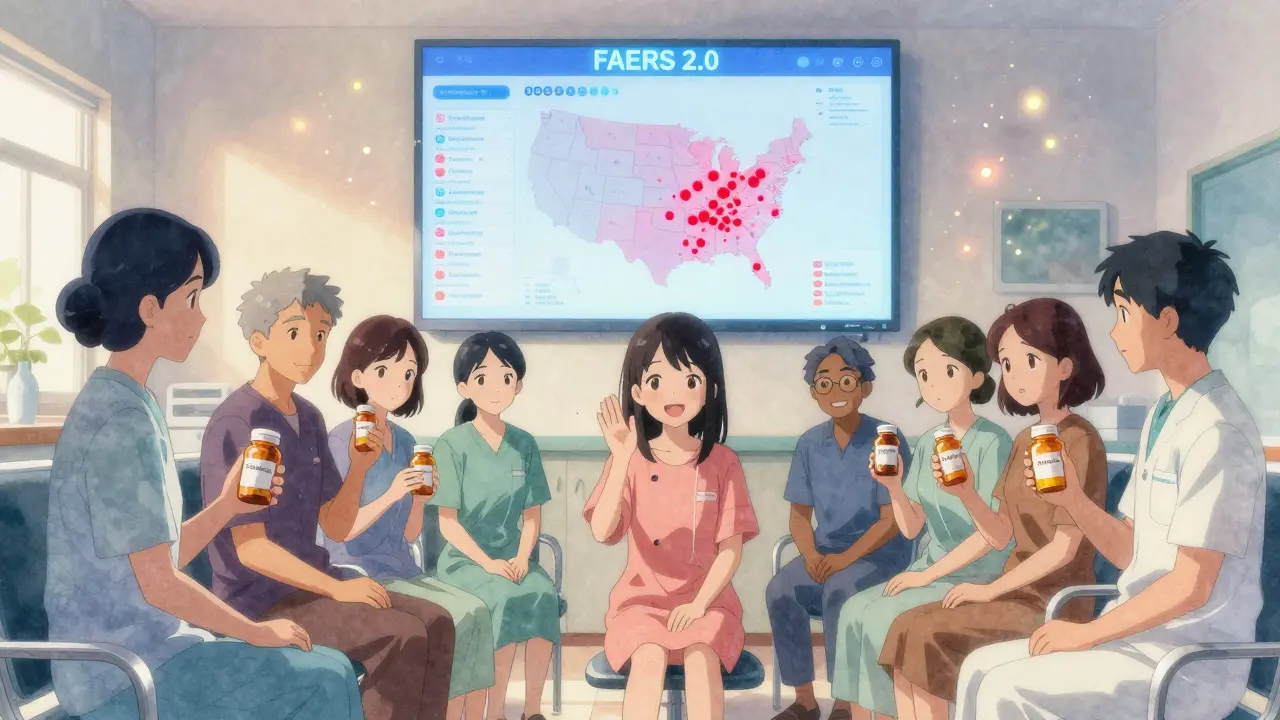
The FDA knows the problem. In 2023, they launched FAERS 2.0 an upgraded version of the FDA’s adverse event reporting system that uses NDC codes to link reports to specific generic manufacturers. This new system tracks drugs by their National Drug Code (NDC) - a unique number assigned to each manufacturer’s version of a drug. For the first time, it’s possible to tell whether a reaction came from Teva, Mylan, or a tiny startup in Ohio.
They’re also pushing pharmacies to print the manufacturer name on prescription labels. A draft guidance from June 2023 says this should be mandatory. Pilot programs with CVS, Walgreens, and Kaiser Permanente are testing whether automatic scanning of medication labels at the pharmacy counter can capture this data without extra work from the provider.
Some hospitals are already ahead of the curve. The American Society of Health-System Pharmacists recommends using barcode scanners on medication containers. One study found this increased accurate reporting by 63%. But most pharmacies still don’t do it.
The FDA’s 2023 Generic Drug User Fee Amendments (GDUFA III) allocated $15 million to improve safety monitoring for generics. That’s a start. But it’s still far less than what brand-name companies spend.
What You Can Do
If you’re a patient:
- Check your pill bottle. Look for the manufacturer name - it’s often printed in small text.
- Keep a record of which company made your drug. Take a photo of the label.
- If you have a serious reaction, tell your doctor - and insist they report it correctly.
If you’re a healthcare provider:
- Always check the manufacturer name on the prescription label.
- Use the DailyMed database to look up NDC codes if you’re unsure.
- Don’t default to reporting under the brand name. Even if it’s easier.
Every report matters. One report might not change anything. But 100 reports? That’s a pattern. And a pattern can save lives.
Why This Matters Beyond the U.S.
This isn’t just an American problem. The European Medicines Agency (EMA) has the same issue. Their 2020 statement admitted that differences in reporting rates between brand and generic drugs create "incomplete safety data." The same patterns show up in Canada, Australia, and the UK. Generic drugs are the backbone of global healthcare. If we can’t track their safety, we’re flying blind.
The system was built for a time when generics were simple. Today, they’re complex. And the reporting system hasn’t caught up.
Do generic drugs cause more side effects than brand-name drugs?
No, generic drugs are required to be bioequivalent to their brand-name counterparts - meaning they deliver the same active ingredient in the same amount and at the same rate. But small differences in inactive ingredients, manufacturing processes, or batch consistency can sometimes lead to different reactions in sensitive patients. These differences are hard to detect without accurate reporting.
Can I report an adverse event if I’m not a doctor?
Yes. Anyone can report an adverse event to the FDA using the MedWatch online form. Patients, family members, and pharmacists are encouraged to report. You don’t need medical training. Just provide as much detail as possible: the drug name, manufacturer (if known), symptoms, date, and your contact info.
Why don’t pharmacies always know which manufacturer made the generic drug?
Pharmacies buy generic drugs from wholesalers, who source from multiple manufacturers. The same drug may come from different companies each time it’s restocked. Unless the pharmacy tracks this at the point of dispensing - which most don’t - the manufacturer information gets lost.
Is there a way to find out which company made my generic drug?
Yes. Look at the prescription label - the manufacturer name is often printed there. You can also use the National Library of Medicine’s DailyMed website. Enter the National Drug Code (NDC) from your bottle, and it will show you the manufacturer. If you’re unsure, call your pharmacist - they can look it up.
What happens after I report an adverse event?
Your report goes into the FDA’s FAERS database. It’s combined with thousands of others. Analysts look for patterns - if multiple reports point to the same manufacturer or batch, the FDA may investigate further. This could lead to updated warnings, recalls, or even changes in manufacturing standards.
It’s wild how we treat generics like they’re all the same. I work in clinical research, and I’ve seen how batch-to-batch variability in inactive ingredients can trigger reactions in sensitive patients-especially those with autoimmune conditions. The system’s built on assumptions from the 90s. We need NDC-level tracking everywhere, not just in pilot programs.
I’ve been reporting every adverse event I’ve seen since 2019-whether it’s from a brand or generic. It’s tedious, but someone has to do it. The FDA’s database isn’t perfect, but it’s the only tool we have. If we stop reporting because it’s inconvenient, we’re abandoning patients who can’t speak up.
Let’s be real-this isn’t a regulatory failure. It’s corporate sabotage. The big pharma lobbyists made sure the FDA’s system stayed broken so they could keep pricing generics at $3 while their own brand drugs sit at $200. They don’t care if people die-they care about margins. And now they’re pretending FAERS 2.0 is a fix. It’s theater.
In India, we’ve had this problem for decades. Generics are our lifeline-but without proper traceability, how do we know if a bad batch came from a small factory in Gujarat or a multinational in Hyderabad? The solution isn’t just tech-it’s culture. We need pharmacists trained to ask patients: ‘Which manufacturer’s name is on your bottle?’ Not ‘What drug did you take?’
There is no systemic failure. There is only moral failure. Healthcare providers who default to reporting brand names are complicit in the erasure of generic drug safety data. They are not merely negligent-they are choosing convenience over human life. And they wonder why trust in medicine is collapsing.
Ugh. This is why I hate generics. You think you’re saving money, but you’re gambling with your health. My cousin had a stroke after switching to a cheap version of his blood thinner. They didn’t even know which company made it. That’s not healthcare-that’s Russian roulette.
Scan the barcode. Write down the manufacturer. Report it. That’s it. No need for a PhD. Just do the thing.
My pharmacist just told me to ‘check the label’-but the label says ‘generic’ and nothing else. I called five pharmacies. None of them track the manufacturer. This isn’t a patient problem. It’s a system failure. And no one’s fixing it.
It’s ironic, isn’t it? We live in an age of hyper-transparency-where every purchase, every swipe, every click is logged-yet when it comes to the very pills we swallow, we’re left in the dark. The NDC code is right there on the bottle, but no one’s trained to read it. We’ve automated everything except the one thing that matters: knowing what’s inside our bodies.
Wait-so you’re telling me the FDA doesn’t know who makes the pills? That’s not incompetence. That’s intentional. They’re letting small manufacturers get crushed by big ones. The whole system is rigged. I’ve seen reports where the same batch number appears under three different names. This isn’t about safety-it’s about control. Big Pharma owns the FDA. They always have.
It is a moral imperative that every pharmacist, every physician, every patient must be educated on the importance of manufacturer identification. The failure to do so constitutes a breach of the Hippocratic Oath. Furthermore, the FDA’s allocation of $15 million is laughably inadequate. The annual expenditure on brand-name pharmacovigilance exceeds $2 billion. The disparity is not merely unjust-it is indefensible.
Just submitted my third report today. Used DailyMed to find the NDC. Took 3 minutes. Did the right thing. No drama. No drama needed.