
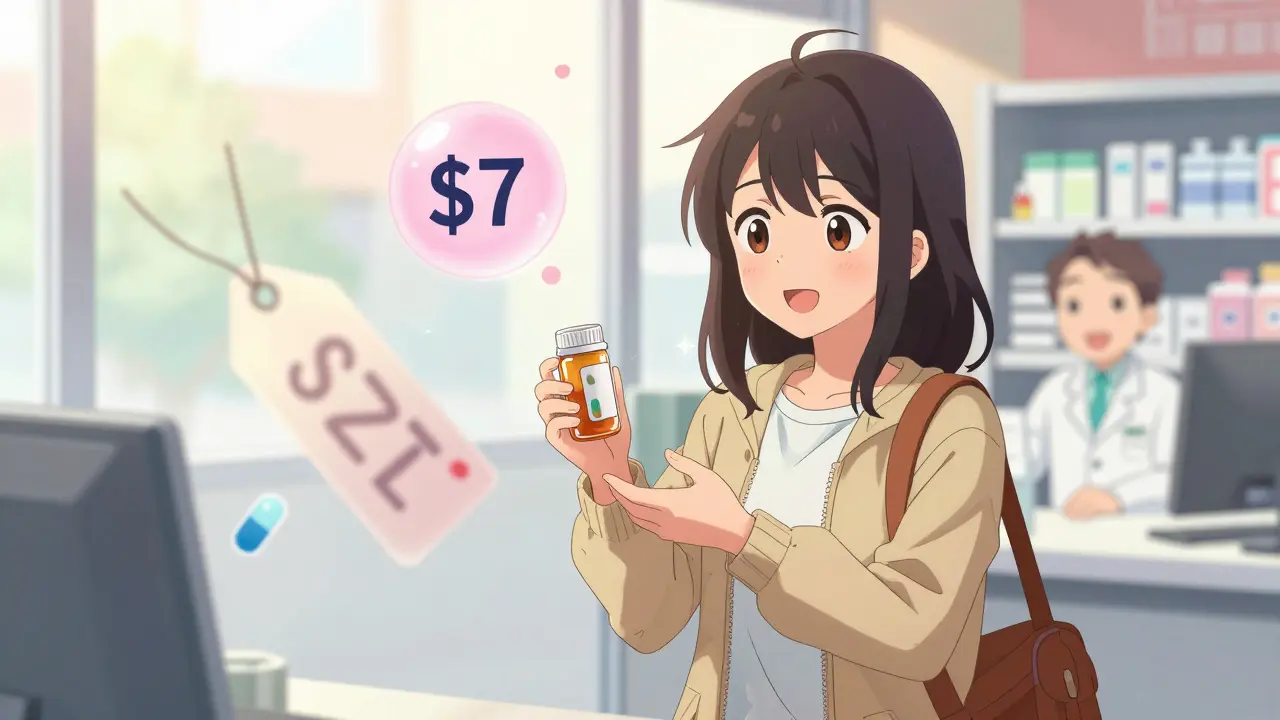
Imagine filling a prescription for a medication you need every day. You hand over your insurance card, wait a few minutes, and the pharmacist hands you a small bottle. The total? $27. Now imagine the exact same pill, same manufacturer, same active ingredient - but it’s the generic version. The price? $7. That’s not a sale. That’s the reality for millions of Americans.
Generics Are the Hidden Hero of Affordable Care
Over 90% of all prescriptions filled in the U.S. are for generic drugs. Yet most people don’t realize how much they’re saving - or how much they’re overpaying when they don’t choose them. The difference isn’t subtle. In 2023, the average out-of-pocket cost for a brand-name drug was $27.10. For the generic version? Just $7.05. That’s nearly four times cheaper.
It’s not a fluke. Since 2017, generic copays have barely moved - from $6.06 to $7.05. Meanwhile, brand-name prices climbed past $56. That gap isn’t shrinking. It’s widening. And the reason is simple: generics are chemically identical to brand-name drugs. They work the same. They’re made in the same factories. The only difference? No marketing budget. No patent. No middlemen lining up to charge you extra.
What Happens When a Drug Goes Generic?
When a brand-name drug loses its patent, the market flips. Take efavirenz, emtricitabine, and tenofovir - the combo pill used to treat HIV. Before generics, one 30-day supply cost about $1,000. After generics hit the market? It dropped to $65. That’s a 93% drop. In one year, that single switch saved patients $131 million.
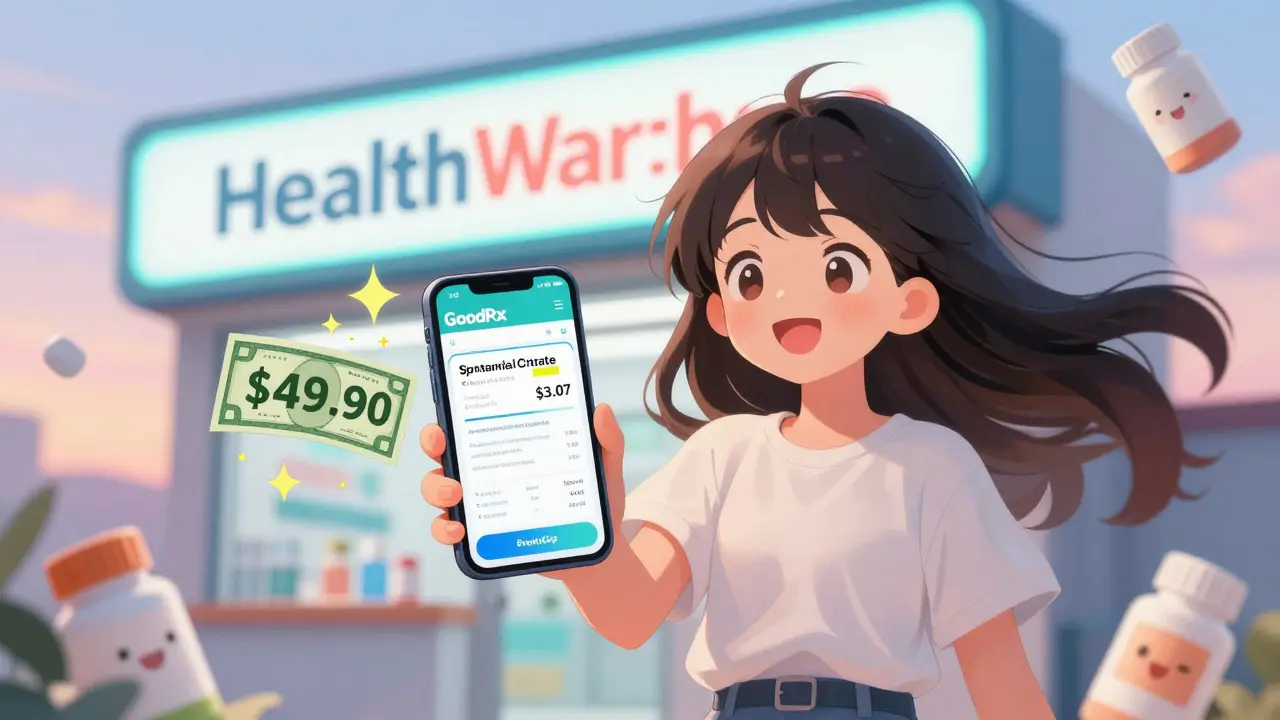
Same story with Sildenafil Citrate (the generic for Viagra). Price before generics: $49.90. After: $3.07. That’s a 94% drop. Emtricitabine/Tenofovir Disoproxil Fumarate (Truvada) fell from $20.46 to $2.13 - a 90% savings. These aren’t rare cases. They’re the rule.
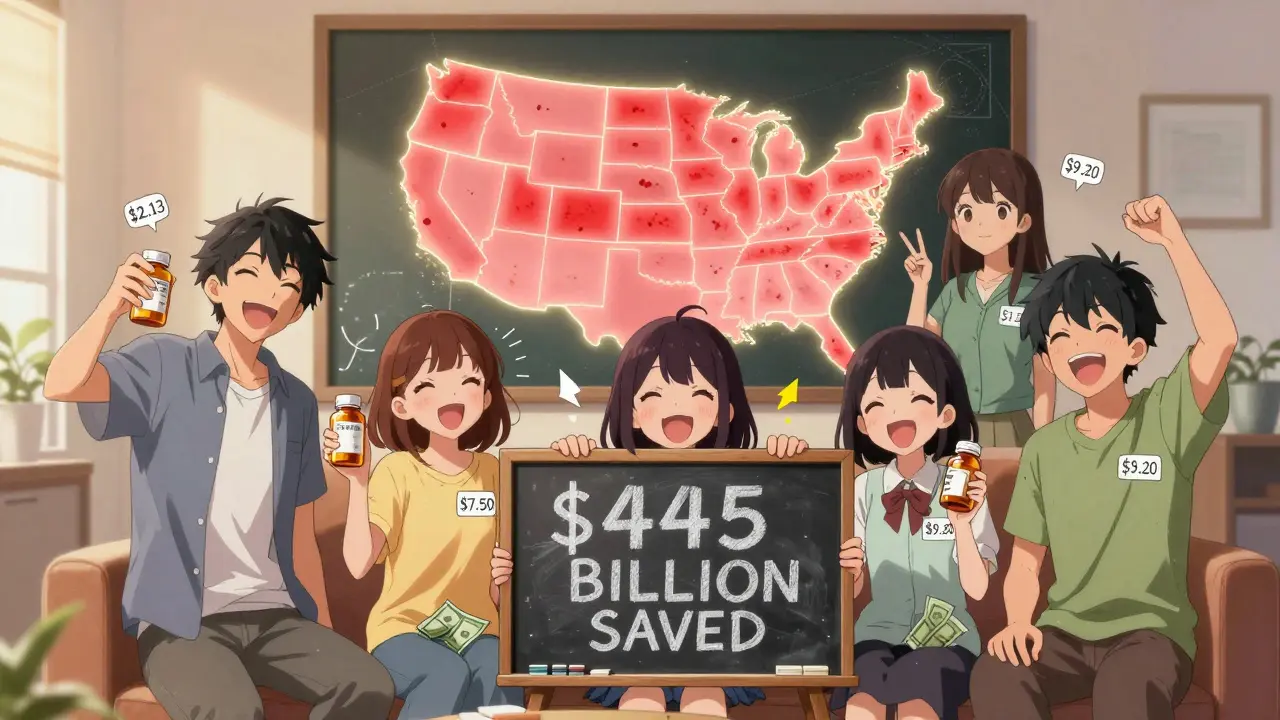
The FDA tracks every new generic approval. In 2021 alone, new generic entries saved the system over $1 billion. And that’s just one year. Over the last decade, generic and biosimilar drugs saved the U.S. healthcare system $445 billion. That’s not a number on a spreadsheet. That’s money back in people’s pockets.
But Why Are You Still Paying Too Much?
Here’s the twist: even when generics are available, many patients still pay way more than they should. Why? Because pharmacies and insurers don’t always show you the real price.
Take Pantoprazole - a common acid reflux pill. At Albertsons, you’ll pay $44 for a 30-day supply. But if you buy it from a direct-to-consumer pharmacy like MCCPDC? $9.20. That’s 79% cheaper. Same pill. Same dosage. Same expiration date.
Or Rosuvastatin (a cholesterol drug). Walgreens charges $110. Health Warehouse? $7.50. That’s a 93% difference.
NIH research in 2023 found that direct-to-consumer pharmacies cut generic drug costs by 76% on average. For expensive generics, that’s $231 saved per prescription. For common ones? Still $19. That’s not a bonus. That’s a refund.
Insurance Isn’t Always Your Friend
Here’s the brutal truth: having insurance doesn’t mean you’re getting the best price. In fact, sometimes you pay more with it.
Medicare Part D - the federal prescription drug plan - overspent by $2.6 billion in 2018 compared to what Costco charged for the same drugs. Why? Because Medicare’s pricing system is broken. For 90-day fills, Medicare paid 29.4% more than Costco’s member price. That’s not a glitch. That’s the system.
And it gets worse. Some insurance plans now put generics on higher cost tiers - the same ones usually reserved for expensive brand-name drugs. That means even though the drug costs $7, your copay jumps to $30 or $40. That’s not saving you money. It’s punishing you for choosing the cheaper option.
One study tracking drug coverage from 2011 to 2019 found that when insurers shifted generics to higher tiers, patients ended up paying 135% more annually - even though overall drug prices were falling.
Who’s Really Getting Paid?
Here’s the hidden layer: the money you pay at the pharmacy doesn’t all go to the drugmaker. A lot of it disappears into the supply chain.
Between 2011 and 2016, patients paid 41.8% of the cost for generic drugs - more than they paid for brand-name drugs (32.1%). That’s backwards. Generics are cheaper to make. They should cost less to buy. But because of how rebates, pharmacy benefit managers (PBMs), and insurer contracts work, patients end up paying a larger share of the bill.
USC Schaeffer Center found that while out-of-pocket costs for generics dropped by half, the total cost - what insurers paid plus what you paid - dropped by 80%. That means the middlemen - PBMs, insurers, pharmacy chains - are pocketing the difference. Patients are paying 13-20% more than they should because pricing is opaque. You’re not just paying for the pill. You’re paying for a system that doesn’t work for you.
How to Pay Less - Right Now
You don’t need to wait for policy changes. You can start saving today.
- Ask your pharmacist: “Is there a generic version?” If they say no, ask again. Sometimes they don’t know.
- Use a direct-to-consumer pharmacy like HealthWarehouse, Costco, or Blink Health. They often list prices online. No insurance needed.
- Compare prices with GoodRx or SingleCare. These apps show you the lowest cash price in your area - even lower than your insurance copay sometimes.
- Ask for a 90-day supply. Many generics cost less per pill when bought in bulk.
- If your insurance pushes a generic to a high tier, call them. Ask why. File a formulary exception. You might get it moved back down.
The Bigger Picture
The U.S. pays nearly three times more for prescription drugs than other wealthy countries. Yet 90% of our prescriptions are for generics. That means the problem isn’t the drugs. It’s the system.
Other countries negotiate prices directly. We let middlemen do it. Other countries cap what pharmacies can charge. We don’t. Other countries make transparency the law. We still treat pricing like a secret.
Generics are the most effective cost-control tool we have. They’re safe. They’re proven. They’re everywhere. But if we keep letting insurers and pharmacies set prices without accountability, patients will keep overpaying - even when they’re doing everything right.
The data is clear: generics save billions. But the savings aren’t reaching you - unless you know where to look.
Are generic drugs as effective as brand-name drugs?
Yes. By law, generic drugs must contain the same active ingredient, strength, dosage form, and route of administration as the brand-name version. They must also meet the same strict standards for quality, purity, and performance set by the FDA. The only differences are in inactive ingredients (like fillers or dyes) and packaging. Thousands of studies confirm generics work just as well. For example, a 2008 analysis of 47 clinical trials found no significant difference in effectiveness between generics and brand-name heart medications.
Why do some pharmacies charge more for the same generic?
It’s because of how drug pricing works in the U.S. Retail pharmacies often charge list prices set by pharmacy benefit managers (PBMs), which can be inflated. PBMs negotiate rebates with drug manufacturers, but those discounts don’t always get passed to you. Direct-to-consumer pharmacies bypass PBMs entirely and buy in bulk, so they can offer lower cash prices. Your insurance copay might be based on an inflated list price, while the cash price at a discount pharmacy is the real cost.
Can I use GoodRx even if I have insurance?
Yes, and you should always check. Sometimes the cash price through GoodRx is lower than your insurance copay - especially for generics. You can’t combine GoodRx with insurance, but you can choose which one to use at the pharmacy. Just ask the pharmacist to process it as a cash transaction. Many people save $20-$100 per prescription this way.
Why does my insurance put generics on a higher tier?
It’s a profit-driven tactic. Some insurers and PBMs push generics to higher tiers to make you pay more - even though the drug costs less. This increases their revenue from your copay. It’s not about cost; it’s about control. If you’re paying $40 for a $7 drug, you’re being overcharged. You can appeal this by asking your insurer for a formulary exception or switching plans during open enrollment.
Are there any generics that aren’t worth it?
Almost all generics are safe and effective. But in rare cases, like some seizure or thyroid medications, small differences in how the drug is absorbed can matter. Your doctor may recommend sticking with a brand if you’re sensitive to minor variations. But even then, you can ask for a generic that’s been bioequivalent-tested. If your doctor says no, ask why - and request the data. Most of the time, it’s habit, not science.
What’s the best way to track my drug savings?
Keep a simple log: write down the drug name, the pharmacy, the price you paid, and whether it was cash or insurance. Use a free app like GoodRx or SingleCare to compare prices monthly. Over time, you’ll see patterns. You might find that you’re paying $50 more per month than you need to - that’s $600 a year you could save.
What Comes Next
The next wave of blockbuster drugs - including newer diabetes, cancer, and autoimmune treatments - will start losing patents in 2025 and 2026. That means more generics. More savings. But only if we fix the system that keeps prices high.
Until then, don’t wait for change. Take control. Ask questions. Compare prices. Use cash options. Push back when your insurance doesn’t make sense. You’re not just buying medicine. You’re fighting a broken pricing system - and you have more power than you think.
Let me get this straight - you’re telling me I’ve been overpaying for my blood pressure med for years because my pharmacy and insurer are playing games with pricing? And the FDA says generics are identical? That’s not just unfair, it’s criminal. I’m filing a complaint with my state AG tomorrow.
OMG I JUST USED GOODRX FOR MY CHOLESTEROL DRUG AND PAID $6.50 INSTEAD OF $110?? I’M CRYING. I’VE BEEN PAYING FOR A LUXURY CAR WHEN I WAS DRIVING A BICYCLE. THIS IS A GAME CHANGER. SHARE THIS WITH EVERYONE YOU KNOW. #GENERICPOWER
So let me summarize: the system is designed to make you feel like a fool for wanting to pay less. You’re not dumb for paying $40 for a $7 pill - you’re just playing by rules written by people who profit from your confusion. Classic capitalism. Now go check your next script on GoodRx. I’ll wait.
As someone from India where generics are the norm and everyone knows their medicine by the active ingredient, not the brand - this hits home. We don’t call it 'Lipitor' here, we call it 'atorvastatin'. No marketing, no hype, just science. I wish more Americans could see this like we do - it’s not about trust, it’s about transparency. Thank you for writing this. It’s beautiful.
i just found out my insulin generic costs 1/5th what my insurance charges… i’ve been crying all day not because i’m sad but because i’m so angry i wasted so much money thinking i was doing the right thing. thank you for this post. i’m telling my mom, my sister, my coworker. we’re all doing this now.
While the economic rationale for generic substitution is irrefutable, the structural inequities embedded within the pharmaceutical supply chain - particularly the opacity of pharmacy benefit manager rebate structures - necessitate a regulatory intervention beyond individual consumer action. The current model incentivizes misaligned pricing mechanisms that externalize cost burdens onto the most vulnerable populations. A systemic recalibration is required.
So the real drug is the one you don’t see - the one hidden in the rebate ledger, the PBM contract, the insurance tier. We’re not paying for medicine. We’re paying for the illusion that someone else is managing it for us. And we’re dumb enough to believe it. The pill is fine. The system? It’s a pyramid scheme with stethoscopes.
From a bioeconomic perspective, the commodification of pharmaceuticals under neoliberal market logics creates a pathological asymmetry in information dissemination - wherein the consumer, lacking access to the true marginal cost of production, becomes a rent-seeking substrate for intermediary capital. The generic is not merely a substitute - it is a rupture in the hegemonic pharmacoeconomic apparatus.
It is a well-documented fact that the United States healthcare expenditure per capita exceeds that of all other OECD nations. The persistence of inflated pricing for generic pharmaceuticals reflects a failure of regulatory oversight and a lack of enforceable price transparency mandates. This is not a market failure. It is a policy failure.
Guys. I just saved $87 on my antidepressant by using HealthWarehouse. I didn’t even tell my insurance. I just walked in, showed the pharmacist my GoodRx coupon, paid $12 cash, and walked out. I felt like I won the lottery. And I’m not even rich. I’m just someone who finally stopped trusting the system. If you’re on meds, do this. Do it now. Your future self will hug you. I’m telling my boss tomorrow. We’re doing a lunch-and-learn on this. This is bigger than pills - it’s about dignity.
Why are we even talking about this? It’s simple: if you can’t afford your meds, you shouldn’t be taking them. The government should stop subsidizing laziness. People who can’t pay for brand-name drugs shouldn’t be on them. We’re not a welfare state. Get a job. Work harder. This isn’t a crisis - it’s a character test.
Oh wow, so now it’s MY FAULT I’m paying $40 for a $7 pill? Maybe if I didn’t have a disability and a part-time job and three kids, I’d have time to hunt down discount pharmacies like some kind of pharmaceutical treasure hunter. Thanks for the guilt trip, capitalist hero.
Generics are the quiet revolution. No fanfare. No CEOs on talk shows. Just science, efficiency, and fairness - and yet we treat them like second-class medicine. We’re not just underpaying for pills. We’re underestimating the dignity of simple solutions. The fact that we need a blog post to tell people to check GoodRx says everything about how broken this system is. Let’s stop celebrating the heroics of survival - and start demanding a system that doesn’t require heroics.
My pharmacist didn’t even know there was a cheaper option. I had to show him the GoodRx price. He looked embarrassed. We both stood there. Silent. Then he said, ‘I’m sorry.’ That’s all. No fix. No apology from anyone above him. Just silence.
I’ve been using GoodRx for my thyroid med for a year now. It’s $5. I used to pay $48 with insurance. I told my doctor. She said, ‘That’s great.’ Then she prescribed me the same thing again the next month. No follow-up. No explanation. I think she doesn’t know either. We’re all just trying to survive a broken machine.