
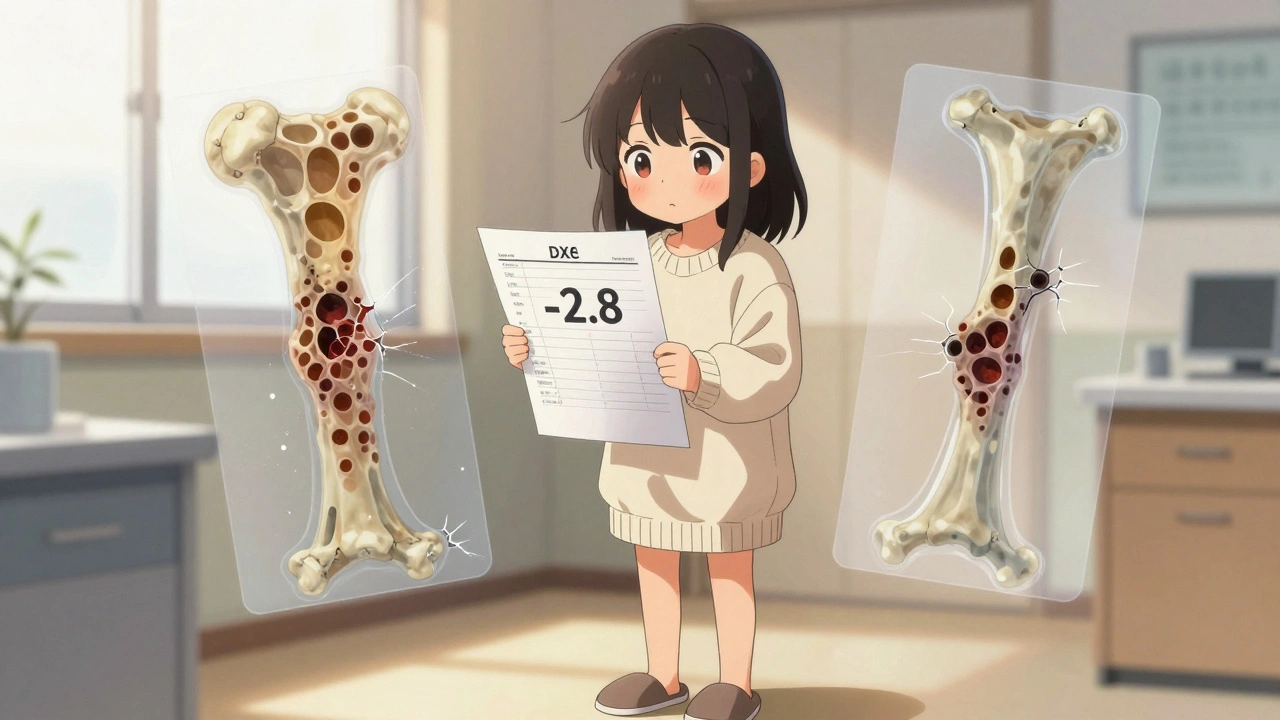
When your bones start to weaken without you even noticing, it’s not just about getting older-it’s about osteoporosis. This silent disease eats away at bone density, turning everyday actions like bending over or sneezing into potential fracture risks. By 2025, more than 10 million Americans have been diagnosed with osteoporosis, and another 44 million are living with low bone mass, putting them on the fast track to fractures. For many, especially women after menopause, the real threat isn’t just pain-it’s losing independence after a hip or spine fracture.
What Exactly Is Osteoporosis?
Osteoporosis isn’t just brittle bones. It’s a disease where your body loses bone faster than it can rebuild it, or doesn’t make enough new bone to begin with. The result? Bones become porous, fragile, and prone to breaking from minor bumps or falls that wouldn’t hurt someone with healthy bones. The key problem lies in the internal structure: the honeycomb-like mesh inside bones gets bigger holes, making them thinner and weaker.
It’s not just an old person’s issue. While risk goes up with age, especially after 50, many people don’t realize they have it until they break something. That’s why it’s called a silent disease. The most common fracture sites are the spine, hip, and wrist. A spinal fracture might not even feel like a fall-it can happen just from bending over. And once you’ve had one, your risk of another skyrockets.
Women are far more likely to develop osteoporosis than men. Why? Estrogen drops sharply after menopause, and estrogen plays a big role in keeping bone density stable. Men can get it too, especially if they have low testosterone, take certain medications like steroids long-term, or have conditions like rheumatoid arthritis or Crohn’s disease.
How Do You Know If You Have Bone Density Loss?
You can’t feel bone thinning. That’s why testing is critical. The gold standard is a DXA scan-short for dual-energy X-ray absorptiometry. It’s quick, painless, and uses very low radiation. The scan measures bone density in your hip and spine and gives you a T-score. A T-score of -1.0 or higher is normal. Between -1.0 and -2.5 means you have osteopenia, or low bone mass. A score of -2.5 or lower is osteoporosis.
Doctors also use the FRAX tool to estimate your 10-year risk of a major fracture. It factors in your age, sex, weight, height, previous fractures, family history, smoking, alcohol use, and whether you take steroids. If your risk of a hip fracture is over 3% or your risk of any major osteoporotic fracture is over 20%, treatment is usually recommended.
Many people get tested after a fracture, but that’s too late. If you’re a woman over 65, or a man over 70, or if you’re younger but have risk factors like a family history of hip fractures, low body weight, or long-term steroid use, ask your doctor about a bone density test.
Why Bisphosphonates Are the First-Line Treatment
Bisphosphonates are the most commonly prescribed drugs for osteoporosis, making up about 65% of all prescriptions in the U.S. They’ve been around since the 1980s, and their track record is solid. Unlike newer drugs that build bone, bisphosphonates work by slowing down the cells that break bone down-osteoclasts. By putting the brakes on bone loss, they help maintain or even slightly increase bone density over time.
There are two types: non-nitrogen and nitrogen-containing. The nitrogen-containing ones-like alendronate (Fosamax), risedronate (Actonel), ibandronate (Boniva), and zoledronic acid (Reclast)-are preferred because they’re more effective. Alendronate, for example, reduces spine fractures by 48% and hip fractures by 51% over three years, based on the landmark Fracture Intervention Trial.
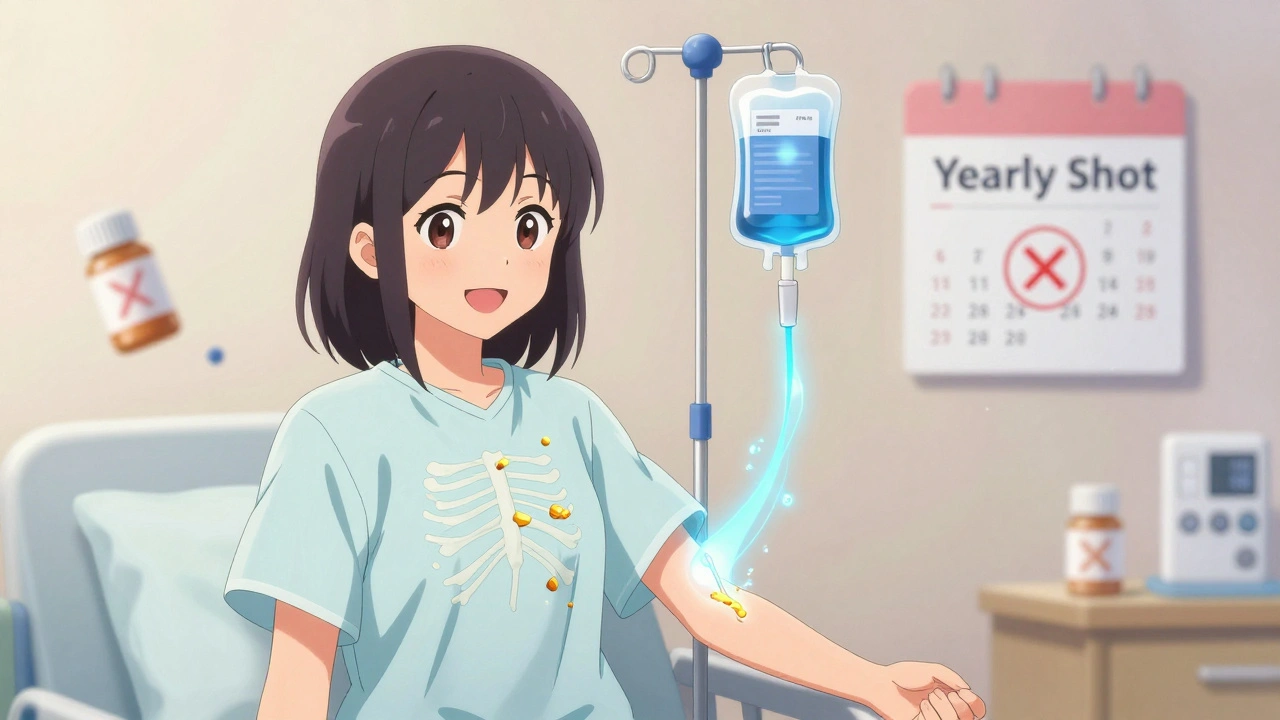
They come in two forms: oral pills and IV infusions. Oral versions are taken once a week or once a month. The IV version, zoledronic acid, is given once a year. For people who struggle with daily or weekly pills, the yearly infusion is a game-changer.
How to Take Oral Bisphosphonates Right
These pills are powerful-but only if you take them correctly. Get it wrong, and they won’t work, and you might hurt yourself. Here’s the exact routine:
- Take the pill first thing in the morning, with a full 8-ounce glass of plain water.
- Stay upright-sitting or standing-for at least 30 to 60 minutes after taking it.
- Don’t eat, drink (except water), or take any other medication during that time.
- Wait at least 30 minutes before eating or drinking anything else.
Why all these rules? Bisphosphonates can irritate the esophagus if they don’t get washed down quickly. If you lie down too soon, the pill can stick and cause painful inflammation or ulcers. Many people stop taking them because of this hassle. One patient on Reddit said, “I couldn’t handle the waiting. I switched to the yearly shot and never looked back.”
Adherence is a real problem. Studies show only about half of people are still taking their oral bisphosphonates after one year. That’s why the yearly IV option has grown so popular-it removes the daily burden.
Side Effects and Risks You Can’t Ignore
Bisphosphonates are generally safe, but they’re not risk-free. About 10-15% of people on oral versions get stomach upset, heartburn, or esophageal irritation. These usually go away if you switch to the IV form.
Two rare but serious side effects have gotten attention in recent years:
- Atypical femoral fractures: These are unusual breaks in the thigh bone, often occurring with little or no trauma. They’re rare-about 3 to 5 cases per 10,000 patient-years-but they’re real. If you get new, persistent thigh or groin pain, tell your doctor.
- Osteonecrosis of the jaw (ONJ): This is when part of the jawbone dies and becomes exposed. It’s extremely rare-0.01% to 0.04% of patients-and mostly happens in people getting high-dose IV bisphosphonates for cancer, not osteoporosis. Still, it’s why dentists ask about your bone meds before doing extractions or implants.
The FDA requires black box warnings for both of these risks. But here’s the key: the benefits of preventing spine and hip fractures far outweigh these rare dangers for most people.
When to Take a Drug Holiday
Long-term use of bisphosphonates-beyond 5 years-has raised questions. Are you still getting benefit? Or are you just increasing your risk of rare side effects?
Current guidelines say: if you’re a low-risk patient-no prior fractures, good bone density after 3 to 5 years of treatment-it’s often safe to pause the medication. This is called a “drug holiday.” You stop taking bisphosphonates for 1 to 3 years and get your bone density checked every year or two.
Why? Bisphosphonates stay in your bones for years after you stop. They keep working, even when you’re not taking them. For many, bone density stays stable during the break. If your bone density drops or you have a new fracture, you restart the medication.
But if you’re high-risk-like someone who’s already had a hip fracture or has very low bone density-you may need to stay on longer. There’s no one-size-fits-all. Your doctor will use your T-scores, FRAX score, and medical history to decide.
How Bisphosphonates Compare to Other Treatments
Bisphosphonates aren’t the only option, but they’re still the most widely used. Here’s how they stack up:
| Medication | Type | Dosing | Fracture Risk Reduction | Cost (Monthly) | Key Limitations |
|---|---|---|---|---|---|
| Bisphosphonates (alendronate) | Anti-resorptive | Oral: weekly or monthly; IV: yearly | 48% spine, 51% hip | $20-$150 | GI side effects, rare jaw/thigh fractures |
| Denosumab (Prolia) | Anti-resorptive | Subcutaneous injection every 6 months | 68% spine | $1,200-$1,500 | Must continue indefinitely; rebound fractures if stopped |
| Teriparatide (Forteo) | Anabolic | Daily injection for up to 2 years | 65% spine | $1,800 | Only 2 years max; expensive; requires daily injection |
| Romosozumab (Evenity) | Anabolic + anti-resorptive | Monthly injection for 12 months | 73% spine | $1,800 | Cardiovascular risk warning; limited to 1 year |
Bisphosphonates win on cost and ease of use. Denosumab works better for some, but if you miss a dose, your bone density can drop fast-and you could break your spine. Teriparatide and romosozumab build new bone, which is great for severe cases, but they’re expensive and have strict time limits.
For most people, especially those just starting treatment, bisphosphonates remain the best balance of effectiveness, safety, and price.
What Patients Are Saying
Real-world feedback tells a mixed story. On Drugs.com, alendronate has a 5.4 out of 10 rating from nearly 2,000 reviews. People who’ve had fractures often say things like, “This stopped my bones from getting worse,” or “It’s affordable.” But others describe terrible side effects: “I couldn’t swallow without burning pain,” or “I had to stop because my stomach was in constant pain.”
One common theme: switching from oral to IV made all the difference. “The yearly infusion was a miracle,” wrote one user. “No more worrying about when to take it, how long to wait, or if I ate too soon.”
Another big concern? The drug holiday. “How do I know when to stop?” asked a user on a patient forum. “What if I start breaking bones again?” That’s why regular follow-ups with your doctor are non-negotiable. Bone density tests, FRAX scores, and your own symptoms all guide when to restart.
What’s Next for Osteoporosis Treatment?
The field is evolving. Newer drugs like romosozumab offer exciting dual-action benefits-building bone while slowing breakdown. But they come with higher costs and new warnings. Research is also looking at longer treatment durations. A 2023 study showed patients who took teriparatide and alendronate together for 10 years still had strong bones, challenging the idea that you can’t use these drugs for more than 5 years.
The future is personalization. Instead of giving everyone the same treatment, doctors are starting to use genetic markers, bone turnover tests, and detailed fracture risk profiles to tailor therapy. Some are even exploring longer-acting bisphosphonates that could be given every 2 or 3 years.
For now, bisphosphonates remain the backbone of treatment. They’re proven, affordable, and effective. If you’ve been diagnosed with osteoporosis, talk to your doctor about whether they’re right for you. Don’t assume you need to take them forever. And don’t skip the follow-ups. Your bones are counting on it.
Can you reverse osteoporosis with bisphosphonates?
Bisphosphonates don’t reverse osteoporosis, but they can stop or slow bone loss and may slightly increase bone density over time. The main goal is to prevent fractures, not to restore bones to their original strength. For true bone rebuilding, anabolic drugs like teriparatide or romosozumab are needed, but they’re used for shorter periods and in more severe cases.
How long should you take bisphosphonates?
Most guidelines recommend 3 to 5 years for low-risk patients, then a drug holiday. High-risk patients-those with prior fractures or very low bone density-may need to continue longer, sometimes up to 10 years. Your doctor will monitor your bone density and fracture risk to decide when to pause or restart treatment.
Are there natural alternatives to bisphosphonates?
Calcium and vitamin D are essential, but they’re not enough on their own to treat osteoporosis. Weight-bearing exercise helps maintain bone strength, but it won’t stop rapid bone loss. No supplement, herb, or diet has been proven to reduce fracture risk like bisphosphonates or other FDA-approved medications. Natural approaches should support, not replace, medical treatment.
Can men get osteoporosis and benefit from bisphosphonates?
Yes. While osteoporosis is more common in women, about 2 million American men have it. Men with low testosterone, long-term steroid use, or chronic illnesses like Crohn’s disease are at higher risk. Bisphosphonates work the same way in men and are recommended for men with osteoporosis or high fracture risk, according to the National Osteoporosis Foundation.
What happens if you stop bisphosphonates too soon?
Stopping too early can mean losing the protection you gained. Bone density may start to decline again, increasing fracture risk. That’s why drug holidays are planned and monitored-not done randomly. If you stop without a plan, your doctor should schedule follow-up bone scans to catch any rapid loss early.
Is it safe to take bisphosphonates if you have kidney problems?
It depends. Oral bisphosphonates usually require a creatinine clearance of at least 30-35 mL/min. Zoledronic acid needs at least 35 mL/min. If your kidney function is lower, your doctor may avoid bisphosphonates or choose a different treatment like denosumab, which is cleared by the liver, not the kidneys.
What to Do Next
If you’ve been diagnosed with osteoporosis or osteopenia, don’t wait. Talk to your doctor about your fracture risk, your bone density numbers, and your options. Ask if bisphosphonates are right for you. If you’re already on them, make sure you’re taking them correctly. If side effects are stopping you, don’t quit-ask about switching to the yearly IV version.
Get your bone density tested regularly. Stay active with walking, strength training, and balance exercises. Make sure you’re getting enough calcium (1,200 mg daily) and vitamin D (800-1,000 IU daily). And remember: the goal isn’t just to live longer-it’s to stay strong, mobile, and independent for as long as possible.


