
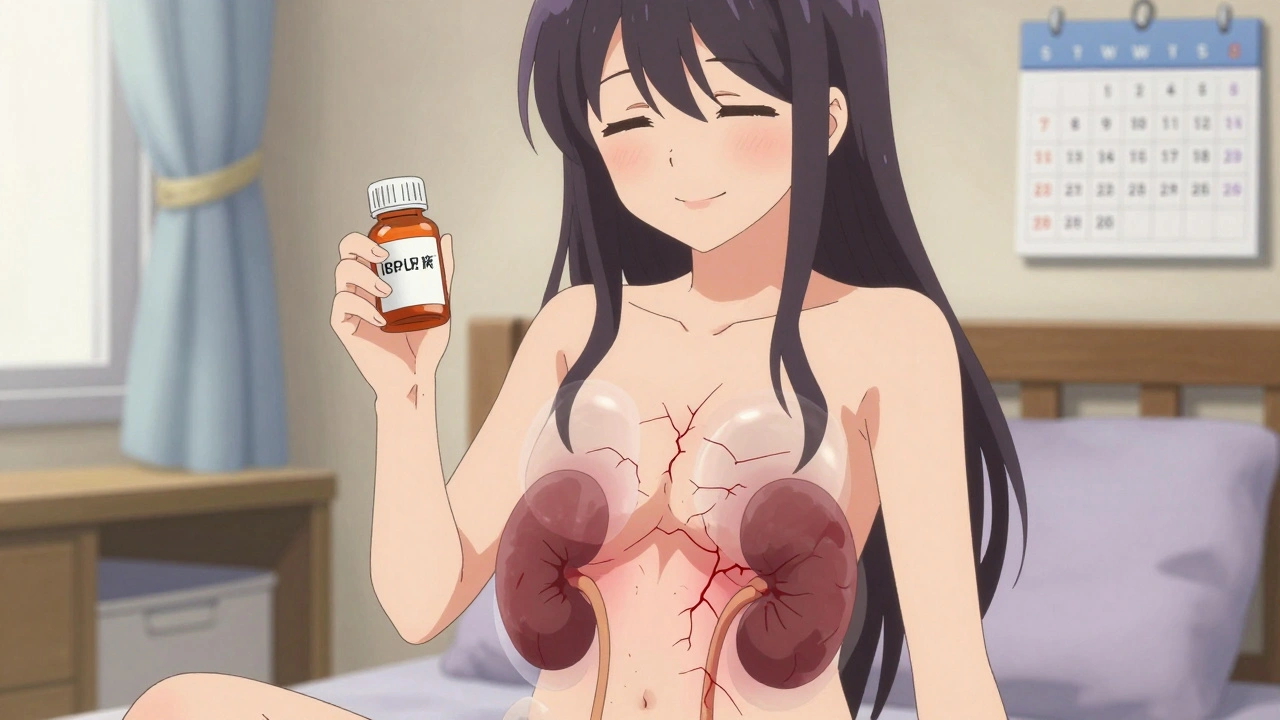
Every year, millions of people reach for ibuprofen or naproxen to ease a headache, back pain, or arthritis flare-up. It’s quick, cheap, and seems harmless-until it isn’t. What most users don’t realize is that these common painkillers carry hidden dangers that can quietly damage your stomach, intestines, and kidneys-sometimes without warning. By 2025, NSAID-related complications are responsible for over 100,000 hospitalizations and 16,000 deaths in the U.S. alone. This isn’t about rare side effects. It’s about routine use turning into serious harm.
How NSAIDs Hurt Your Stomach (Even When You Feel Fine)
NSAIDs work by blocking enzymes called COX-1 and COX-2. COX-2 causes inflammation and pain. COX-1 protects your stomach lining by producing prostaglandins that keep mucus and blood flow steady. When you take a non-selective NSAID like ibuprofen or naproxen, you’re shutting down both. That means less protection for your gut.
Up to 50% of people who take NSAIDs regularly develop some form of stomach irritation. That doesn’t always mean heartburn or nausea. In fact, half of all NSAID-related ulcers show no symptoms until they bleed. You might feel fine, but your stomach lining could be eroding. Signs you might miss: fatigue from low iron, dark or tarry stools, or unexplained anemia. A 2021 study found that 15% of long-term NSAID users end up with peptic ulcers-some so severe they require surgery.
Lower GI damage is even sneakier. NSAIDs can inflame the small intestine and colon, causing diarrhea, bleeding, or protein loss. Unlike stomach ulcers, there’s no reliable way to prevent or treat this damage. No pill, no supplement, no magic fix. The only proven strategy? Stop using NSAIDs-or use them for the shortest time possible.
Kidney Damage: The Silent Threat
Your kidneys rely on prostaglandins to maintain blood flow, especially when you’re dehydrated, older, or already have kidney trouble. NSAIDs block those signals. The result? Reduced kidney function, acute injury, or even permanent damage.
Studies show 1% to 5% of NSAID users develop acute kidney injury. That number jumps to over 20% in people over 65 or those with existing kidney disease. Chronic use can lead to interstitial nephritis, high blood pressure, or papillary necrosis-a condition where parts of the kidney tissue die. The FDA now requires boxed warnings on all prescription NSAIDs for kidney risks in patients over 65.
Here’s the scary part: you won’t feel it coming. No pain. No swelling. Just a slow drop in kidney function, detectable only through blood tests. Many patients don’t realize their kidneys are failing until they’re in crisis.
Who’s at Highest Risk?
Not everyone faces the same danger. The American College of Gastroenterology has a simple scoring system to spot high-risk users:
- Age 65 or older: +2 points
- History of stomach ulcer or bleeding: +3 points
- Taking blood thinners (like warfarin or apixaban): +2 points
- Using corticosteroids (like prednisone): +1 point
If you score 4 or more, you’re in the high-risk zone. That means you shouldn’t be taking NSAIDs without a plan. Yet, only 41% of high-risk patients get proper protection-like a proton pump inhibitor (PPI) to shield the stomach. In some countries, like Greece, that number drops to 29%.
Other red flags: diabetes, heart failure, liver disease, or being on multiple medications. If you’re over 75, have had a GI bleed before, or take SSRIs (antidepressants), your risk of bleeding skyrockets-by over 3 times, according to a 2022 JAMA study.
Which NSAID Is Safest?
Not all NSAIDs are created equal. A 2023 meta-analysis found:
- Naproxen: 4.2 times higher risk of upper GI bleeding
- Ibuprofen: 2.7 times higher risk than celecoxib
- Celecoxib (COX-2 inhibitor): Only 1.9 times higher risk
That makes celecoxib a better choice for stomach safety-but it’s not risk-free. It still affects kidneys and carries cardiovascular concerns. And here’s the catch: many people switch to celecoxib thinking they’re safe, then take it daily for years. That’s a mistake.
Even “safer” NSAIDs like naproxcinod (a newer version approved in 2023) show only 58% fewer ulcers than naproxen-not zero. And while celecoxib may spare your stomach, it doesn’t protect your intestines. The lower GI damage? Still there.
Monitoring: What Your Doctor Should Be Checking
If you’re on NSAIDs for more than a few weeks, you need regular checks. Yet, only 52% of NSAID users have their kidney function tested within 90 days of starting, according to Medicare data.
Here’s what you should ask for:
- Serum creatinine and eGFR: Check within 30 days of starting, then every 3-6 months if long-term use.
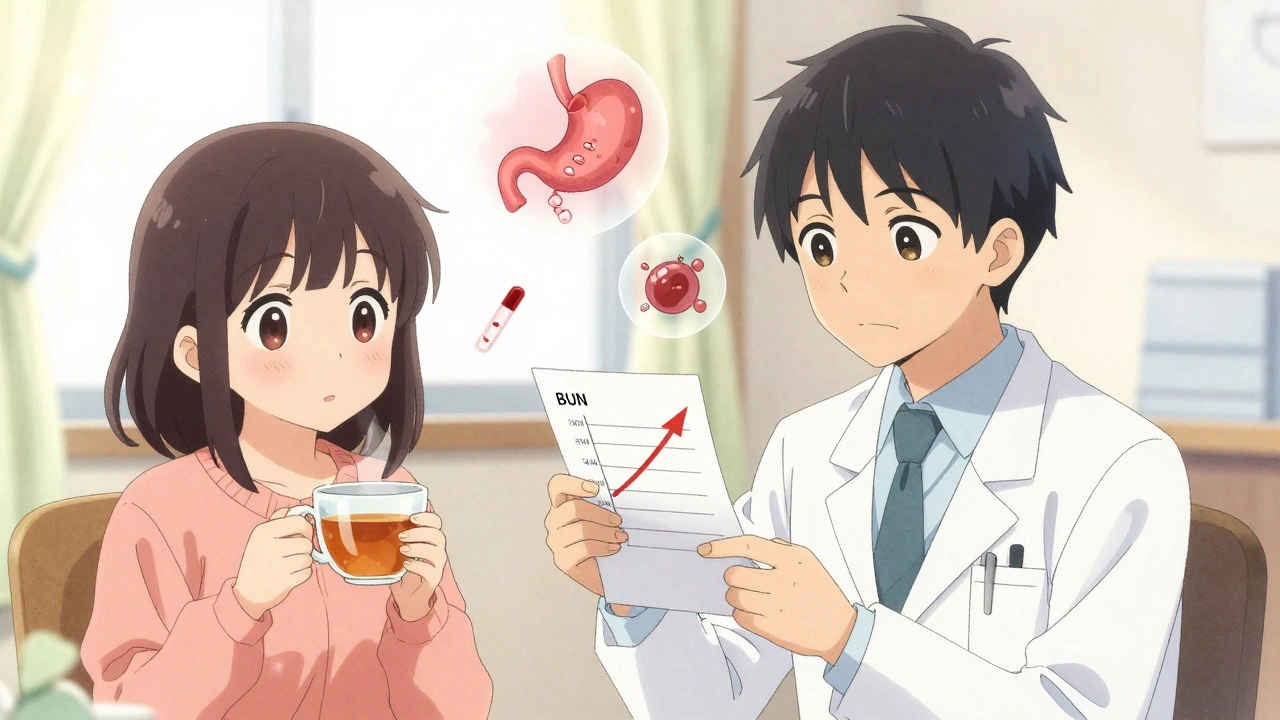
- Blood urea nitrogen (BUN): Helps confirm kidney stress.
- Complete blood count (CBC): Looks for anemia from hidden bleeding.
- Fecal occult blood test: Recommended every 6 months for high-risk patients. New point-of-care FIT tests (launched in 2024) detect bleeding with 92% accuracy.
Don’t wait for symptoms. By the time you feel pain, nausea, or fatigue, damage may already be done.

The PPI Trap: When Protection Becomes a Problem
Doctors often prescribe proton pump inhibitors (PPIs) like omeprazole alongside NSAIDs to protect the stomach. And yes, they reduce ulcer risk by 70-90%. But here’s the dark side: long-term PPI use with NSAIDs increases the risk of microscopic colitis by over 6 times, according to the American Gastroenterological Association.
Microscopic colitis causes chronic diarrhea, weight loss, and abdominal cramps. It’s often misdiagnosed as IBS. And once it starts, stopping NSAIDs isn’t always enough-you may need months of treatment.
Also, PPIs can interfere with other medications, raise infection risk, and cause nutrient deficiencies. They’re not harmless. Use them only if you’re high-risk, and only for the shortest time possible.
What to Do Instead
NSAIDs aren’t the only option. For osteoarthritis or chronic pain:
- Try topical NSAIDs (gels or patches)-they deliver pain relief with 90% less systemic exposure.
- Use acetaminophen (paracetamol) for mild to moderate pain. It doesn’t hurt the stomach or kidneys (but don’t exceed 3,000 mg/day).
- Consider physical therapy, weight loss, or braces for joint pain.
- For inflammation, low-dose corticosteroid injections may be safer than daily pills.
And if you must use NSAIDs: use the lowest dose for the shortest time. Each extra week of use increases complication risk by 3-5%. That’s not a small detail. It’s the core rule.
The Bottom Line
NSAIDs are not harmless. They’re powerful drugs with serious, under-recognized risks. Your stomach and kidneys don’t send warning signals until it’s too late. The safest NSAID is the one you never take. If you need one, use it sparingly, get monitored, and never assume you’re immune just because you feel fine.
Ask your doctor: “Is this the shortest course possible? Are my kidneys being checked? Do I really need this, or is there a safer alternative?” If they can’t answer clearly, it’s time to rethink your plan.
Can NSAIDs cause bleeding without any symptoms?
Yes. Up to 50% of NSAID-related gastrointestinal bleeding happens without warning signs like pain or nausea. It can present as fatigue from anemia, dark stools, or low iron levels. That’s why routine blood tests and fecal occult blood screening are critical for long-term users.
Is celecoxib safer than ibuprofen for the stomach?
Yes, for the upper GI tract. Celecoxib carries about half the risk of stomach bleeding compared to ibuprofen. But it doesn’t protect your lower intestine, and it still affects kidney function. It’s not a free pass-just a lower-risk option that still needs careful use.
How often should I get my kidneys checked if I take NSAIDs?
If you’re taking NSAIDs for more than 2 weeks, get a serum creatinine and eGFR test within 30 days of starting. If you’re on them long-term (more than 3 months), check every 3-6 months. More often if you’re over 65, have high blood pressure, or are dehydrated.
Are over-the-counter NSAIDs safer than prescription ones?
No. The dose and duration matter more than whether it’s OTC or prescription. Taking 800 mg of ibuprofen three times a day for months is just as risky as a prescription-strength dose. Many people underestimate OTC NSAIDs because they’re easy to buy-but the dangers are identical.
Can I take NSAIDs if I have high blood pressure?
Use extreme caution. NSAIDs can raise blood pressure and interfere with many blood pressure medications, including ACE inhibitors and diuretics. If you have hypertension, talk to your doctor before using any NSAID. Acetaminophen or topical treatments are usually better options.
What’s the safest way to stop NSAIDs after long-term use?
Don’t stop suddenly if you’ve been using them daily for months. Talk to your doctor first. They may recommend tapering or switching to a non-NSAID pain management plan. Abruptly stopping can cause rebound pain or inflammation, especially in arthritis patients. The goal is to replace, not just remove.
Do NSAIDs affect fertility or pregnancy?
Yes. In women, regular NSAID use can interfere with ovulation and reduce fertility. In pregnancy, especially after 20 weeks, NSAIDs can cause premature closure of a fetal blood vessel and reduce amniotic fluid. Avoid them entirely during the third trimester unless directed by a specialist.
They don't want you to know this. Big Pharma pays doctors to hand out NSAIDs like candy. Your stomach isn't 'eroding'-it's being erased by a corporate agenda. They know the truth. They just don't care if you bleed out quietly. The FDA? A puppet. The 'boxed warnings'? A joke. You think they care about your kidneys? They care about your next prescription.
They're selling you a slow death with a 99-cent sticker on it. And you're still buying it.
Wake up.
OMG i knew it!! they been hiding this from us since like 2003!! i saw a doc on youtube who said NSAIDs are linked to the cia mind control program!! that's why they dont tell you about the kidney thing!! they dont want you to feel pain so you dont notice the chips in your brain!!
also my cousin took ibuprofen and now his pee glows. not a joke. i saw it. he says its 'the government testing us'.
stop the lies. #NSAIDconspiracy
Thank you for this meticulously researched and profoundly important exposition. The clinical data presented here is not merely informative-it is a moral imperative for public health discourse. In my practice in Mumbai, I have observed a disturbing trend: patients self-medicate with NSAIDs for months, unaware of the silent devastation unfolding within their renal parenchyma and gastrointestinal mucosa.
It is imperative that healthcare systems prioritize patient education and routine monitoring. The absence of symptoms does not equate to the absence of pathology. We must advocate for accessible, low-cost screening protocols, particularly in low-resource settings where awareness remains critically low.
Let us not wait for tragedy to prompt action.
You people are so naive. You think the government or doctors care? They don’t. They’re all in on it. NSAIDs are the perfect tool-cheap, legal, and they make you dependent. You take one for a headache, then another for back pain, then another for arthritis, and suddenly you’re on PPIs, then blood thinners, then kidney meds. It’s a money machine.
And you wonder why your doctor won’t listen? Because if you stopped NSAIDs, he’d lose his commission from the pharma reps. You’re not a patient-you’re a revenue stream.
And don’t even get me started on celecoxib. That’s just the fancy version. Same poison, new label.
NSAIDs cause silent GI bleeding. No symptoms. Just anemia. Blood tests save lives.
I used to pop ibuprofen like candy-every morning for my lower back, every night for my knees. Felt fine. Until I started feeling… nothing. Like, literally nothing. No energy. Pale as a ghost. My doctor looked at my CBC and went quiet. ‘You’re running on fumes,’ she said. Turns out I was bleeding internally. No pain. No warning. Just exhaustion.
Now I use a topical gel. It’s slower. It’s messier. But I can feel my body again. I sleep. I breathe. I’m not a walking lab report.
Don’t wait until your body screams. It won’t. It’ll just… fade.
It’s fascinating how we treat pain like a bug to be eradicated, rather than a signal. NSAIDs are like putting tape over a smoke alarm-you silence the noise, but the fire keeps burning.
Maybe the real issue isn’t just the drugs, but our cultural refusal to sit with discomfort. We’ve outsourced healing to pills because we don’t have time for rest, therapy, movement, or stillness.
There’s value in the pain. Not the suffering-but the message. What if we listened instead of silenced?
Oh honey, I knew this was a plot. The UK government has been pushing NSAIDs since the 90s because they’re cheaper than physiotherapy. And now look-our NHS is drowning in kidney failures and GI bleeds. They don’t care about us. They care about the bottom line.
And don’t get me started on how they’re pushing celecoxib now. It’s all about profit. They don’t want us to use ice packs or acupuncture. Too British. Too old-school.
They’re trying to make us docile. Pills. More pills. More tests. More bills. I’m done. I’m going herbal. Turmeric and willow bark. That’s what our ancestors used. And they lived to 90.
Everyone’s acting like this is news. Please. I’ve been screaming this since 2018. NSAIDs are not OTC. They’re prescription-grade toxins with a candy wrapper. And the fact that people think ‘lower dose’ means ‘safe’? That’s why we’re in this mess.
And PPIs? Oh yeah, because nothing says ‘I care about your health’ like giving someone a drug that causes pneumonia, C. diff, and vitamin B12 deficiency while pretending to fix the problem they created.
And celecoxib? It’s not safer. It’s just more expensive. Same damage, higher price tag.
Stop listening to doctors who don’t read studies. Start reading them yourself.
You think this is bad? Wait until you see what they’re doing with acetaminophen. The liver damage is worse. And no one talks about it because Big Pharma owns the liver research too. NSAIDs? Child’s play. They’re just the warm-up. The real kill shot is the ‘safe’ alternative you’re taking right now.
They don’t want you to know the truth. They want you to keep buying. Keep taking. Keep dying quietly.
And you? You’re still scrolling. Still trusting. Still waiting for permission to live.
Wake up. Before your kidneys give up.