
Critical Medication Buffer Stock Calculator
This calculator helps determine the recommended buffer stock levels for critical medications based on the article's guidelines. The FDA recommends maintaining 14-30 days of critical drugs, but most hospitals only have 8-12 days.
Enter Medication Usage
Recommended Buffer Stock
Enter your usage data to see recommendations
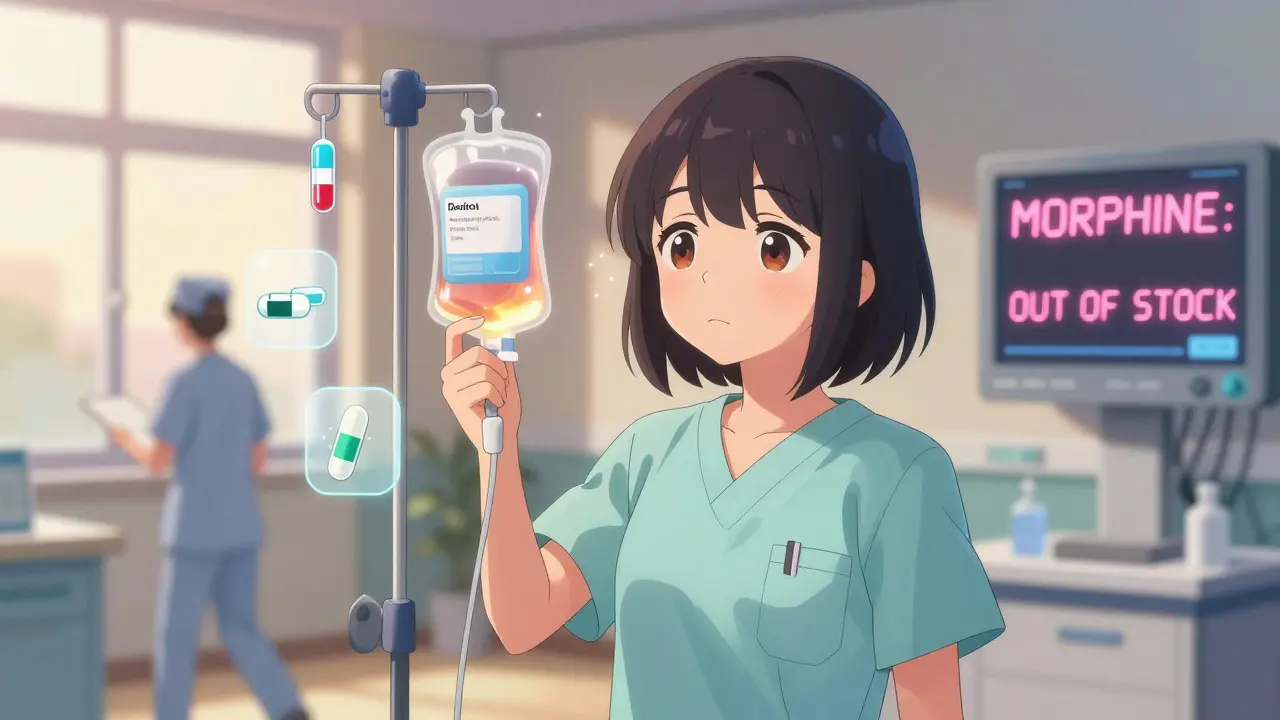
When your hospital runs out of morphine, or your cancer patient can’t get their usual IV antibiotic, it’s not just an inconvenience-it’s a crisis. Medication shortages aren’t rare glitches anymore. They’re a persistent, growing threat to patient care across the U.S., and hospitals are scrambling to keep up. In 2022 alone, there were 287 documented drug shortages, affecting nearly one in five essential medications in hospital formularies. And it’s not getting better. The average shortage now lasts nearly 10 months-longer than ever before. Oncology drugs, anesthesia agents, and critical care meds are hitting the longest gaps, with some lasting over a year. This isn’t theoretical. Real people are getting delayed treatments, switched to riskier alternatives, or sent home without essential meds because the supply chain broke down.
What’s Actually Running Out?
The problem isn’t spread evenly. Almost two-thirds of all drug shortages are in one category: generic sterile injectables. These are the drugs you don’t see on pharmacy shelves-they’re the ones given through IVs in ERs, ICUs, and operating rooms. Think morphine, saline, vancomycin, propofol, epinephrine, and cancer drugs like doxorubicin. These aren’t luxury items. They’re the backbone of emergency and critical care. When they vanish, hospitals don’t just lose inventory-they lose options. Why these drugs? Because they’re made by a handful of manufacturers. Just three companies control 75% of the U.S. supply for many of these injectables. If one plant fails an FDA inspection, or a batch gets contaminated, the entire country feels it. And manufacturing issues? They’re behind 46% of all shortages. That’s down from 62% a few years ago, but still the top cause. Quality control failures-dirty equipment, improper sterilization, flawed packaging-aren’t accidents. They’re systemic. Many of these plants are decades old, underfunded, and squeezed by low profit margins. Generic drugs don’t pay well, so manufacturers don’t invest in upgrades. When a machine breaks, they don’t have spare parts. When a line needs cleaning, they don’t have backup capacity. One failure cascades into a national shortage.How Hospitals Are Reacting (And Why It’s Not Working)
Most hospitals still react to shortages instead of preventing them. A 2024 report found that 87% of pharmacy directors only find out a drug is gone when their order doesn’t arrive. That’s like waiting for your car to break down before buying a spare tire. By then, it’s too late to plan. Pharmacists scramble to find alternatives, often with no time to assess risks. One pharmacist on Reddit shared how switching from morphine to hydromorphone during a shortage led to a 15% spike in medication errors. Why? Because dosing is different. Nurses weren’t trained on the new protocol. The change happened overnight. The workload is crushing. In 2022, 92% of hospital pharmacists reported increased workloads during shortages. Nearly 70% worked over 12 extra hours a week just to manage the chaos. Nurses saw patient wait times for critical meds jump by an average of 22 minutes. Physicians had to delay procedures. One in five patients had treatment postponed because the drug wasn’t there. And the worst part? These impacts hit vulnerable populations hardest. Rural hospitals, safety-net clinics, and Medicaid patients are 78% more likely to have procedures canceled or treatments delayed. They don’t have the budget for backup stock. They don’t have the staff to chase down alternatives.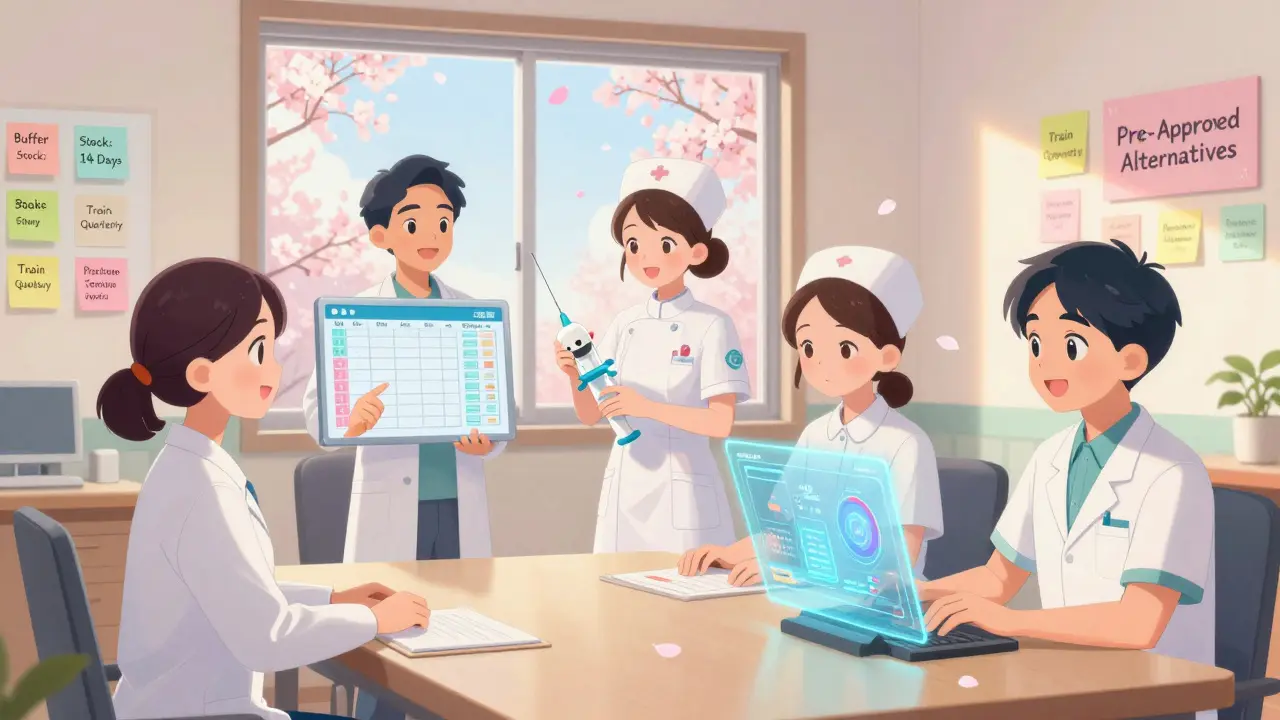
What Works: Proven Strategies to Cope
There are better ways. Some hospitals are doing it right-and the results speak for themselves. The key is building a shortage management team that meets weekly, not just when the crisis hits. This team needs: a pharmacist, a nurse, a purchasing officer, an IT specialist, a risk manager, and a communications lead. They need authority to make decisions fast-within 4 hours of a shortage alert. Here’s what they do differently:- Track inventory in real time-Not just stock levels, but usage trends. If a drug is being used 20% faster than normal, that’s a warning sign.
- Build buffer stock-ASHP recommends keeping 14 to 30 days of critical meds on hand. But most hospitals can’t afford that. Only 35% manage even 14 days. The rest are stuck with 8 to 12 days, if they’re lucky.
- Pre-approve alternatives-Don’t wait until the drug is gone to figure out what to use instead. Test and document safe substitutions ahead of time. For example, if vancomycin is unavailable, what’s the next best IV antibiotic? What’s the dose? What monitoring is needed? Write it down. Train the team.
- Use technology-Hospitals that track medication errors before, during, and after shortages with 95% accuracy cut errors by a third during actual events. That’s not magic. It’s data.
Why the System Is Broken
The problem isn’t just hospitals. It’s the whole system. The U.S. relies on voluntary reporting from drug makers. Manufacturers aren’t required to tell the FDA until a shortage is already happening. Even then, only 65% comply. Meanwhile, countries like France and Canada force manufacturers to report potential shortages months in advance. Result? Shortages last 37% less time. There’s also a financial trap. Many generic drugs are sold through Medicaid and the 340B program, which caps prices and forces manufacturers to give deep discounts. If a drug costs $1 to make, they might only get $0.80 back. So why invest $2 million to upgrade a production line? They don’t. The government pays for the drug, but doesn’t pay for the reliability. That’s a broken incentive. Global supply chains make it worse. Eighty percent of the active ingredients in U.S. drugs come from overseas-mostly China and India. A flood in India, a factory fire in China, or a shipping delay can ripple across American hospitals. And there’s no national stockpile. The Strategic National Stockpile holds emergency supplies for bioterrorism or pandemics-but not for routine drug shortages. There’s no backup for morphine. No reserve for saline. Just hope.
What’s Changing-and What Could Help
There are signs of progress. In 2022, the Department of Health and Human Services created a new role: the Supply Chain Resilience and Shortage Coordinator. Their job? To connect the dots between FDA, CDC, CMS, and manufacturers. By late 2023, they released a full response framework. It’s a start. The FDA is also tightening rules. Their draft guidance, expected to finalize in mid-2024, will require manufacturers to submit risk management plans before launching a drug. That means mapping out every supplier, every machine, every backup plan. If they don’t, they can’t sell the drug. That could force change. Some experts are pushing for Medicare reimbursement reforms. Right now, hospitals get paid the same for a drug whether it’s cheap or expensive. If a hospital uses a more reliable, slightly pricier version of a drug, they don’t get extra money. But if they switch to a cheaper, riskier alternative and a patient has a bad reaction? They get sued. That’s backwards. Rewarding reliability-paying more for drugs from manufacturers with proven quality-could unlock $1.5 billion in new investment. Long-term, advanced manufacturing could be a game-changer. New tech lets companies switch between drugs on the same line in hours, not weeks. That means if one drug’s demand spikes, they can instantly make more. If a batch fails, they can reroute production. If implemented across half of U.S. production, this could cut shortages by 40%.What You Can Do Right Now
If you’re a clinician, pharmacist, or hospital administrator, here’s what you can do today:- Check the FDA Drug Shortage Database daily-It’s updated in real time. Don’t wait for alerts. Know what’s coming.
- Start a shortage log-Record every shortage: when it happened, what was used instead, how many patients were affected, what errors occurred.
- Train your team on alternatives-Don’t wait for a crisis. Run a 30-minute drill every quarter. Practice switching from Drug A to Drug B. Time yourselves.
- Push for buffer stock-Even if you can’t get 30 days, aim for 14. It’s a lifeline.
- Speak up-Tell your hospital leadership. Tell your state association. Tell your lawmakers. This isn’t just a pharmacy problem. It’s a patient safety issue.
Medication shortages aren’t going away. But they don’t have to be chaos. With better planning, better incentives, and better communication, hospitals can protect patients-even when the supply chain fails. The tools exist. The data is there. What’s missing is the will to act before it’s too late.
What causes most medication shortages in the U.S.?
Manufacturing quality issues are the leading cause, responsible for 46% of shortages in 2022. These include contamination, equipment failures, and poor sterilization-especially in facilities producing generic sterile injectables. Many of these plants are aging and underfunded, with low profit margins making upgrades unlikely. Supply chain disruptions overseas, where 80% of active pharmaceutical ingredients are made, also contribute significantly.
Which drugs are most commonly in short supply?
Generic sterile injectables make up 63% of all shortages. These include essential medications like morphine, saline, vancomycin, epinephrine, propofol, doxorubicin, and IV antibiotics. These drugs are used in emergency rooms, ICUs, and during surgeries. Their production is concentrated among just a few manufacturers, so one facility failure can trigger a nationwide shortage.
How long do drug shortages typically last?
The average drug shortage now lasts 9.8 months-up from 6.2 months in 2015. Oncology drugs have the longest average duration at 14.3 months. Shortages are getting longer because manufacturers lack incentives to invest in reliable production, and the U.S. lacks a national strategic stockpile for routine medications.
What can hospitals do to prepare for shortages?
Hospitals should form a dedicated shortage management team that meets weekly and responds within 4 hours of a shortage alert. They should maintain real-time inventory tracking, pre-approve and train staff on safe alternatives, and build buffer stocks of 14-30 days for critical drugs. Using data to track medication errors before and during shortages helps reduce risks. Quarterly simulation drills improve team readiness and cut errors by up to 33%.
Are there any government solutions in place?
Yes. The U.S. Department of Health and Human Services created the Supply Chain Resilience and Shortage Coordinator role in 2022 to improve interagency coordination. The FDA’s draft guidance, expected to finalize in 2024, will require manufacturers to submit risk management plans before launching a drug. These plans must include supply chain mapping and mitigation strategies. While these are steps forward, the U.S. still lacks mandatory reporting and a national stockpile for routine medications, unlike countries like Canada and Germany.