
When you walk into a pharmacy in the U.S. and see a $6 copay for your generic blood pressure pill, it’s easy to think you’re getting a deal. But here’s the twist: generic drugs in the United States are actually cheaper than in most other wealthy countries. That’s right. While Americans pay the highest prices in the world for brand-name drugs, the exact same generic versions often cost less here than they do in Canada, Germany, or even Japan.
Why U.S. Generic Drugs Are So Cheap
The U.S. generic drug market runs on volume and competition. Nearly 90% of all prescriptions filled in the U.S. are for generic drugs. That’s way higher than the global average of about 40%. When multiple companies can make the same drug-say, metformin for diabetes or lisinopril for high blood pressure-they fight for market share by slashing prices. The FDA says when three or more generic manufacturers enter the market, prices drop to just 15-20% of the original brand-name drug’s list price. In some cases, a 30-day supply of generic atorvastatin (Lipitor’s generic) costs less than $5 at Walmart or Costco. This doesn’t happen everywhere. In countries like France and Japan, government agencies set fixed prices and limit the number of generic manufacturers allowed to sell. Less competition means higher prices-even for generics. In the U.S., the system is built to drive prices down fast. The result? Americans pay 33% less for generic drugs on average than people in 33 other OECD countries, according to a 2022 RAND Corporation study for the U.S. Department of Health and Human Services.The Brand-Name Divide
But here’s where things flip. While generics are cheaper, brand-name drugs in the U.S. are the most expensive in the world. A 30-day supply of the diabetes drug Jardiance costs $204 in Medicare, but just $52 on average in other wealthy countries. Stelara, used for psoriasis and Crohn’s, runs $4,490 in the U.S. compared to $2,822 abroad. That’s not a mistake-it’s the system. The U.S. doesn’t negotiate drug prices the way other countries do. Canada, Germany, and the U.K. have centralized agencies that bargain with drugmakers for lower prices. The U.S. Medicare program only started negotiating prices in 2022, and even then, the negotiated prices are still 2.8 times higher than the average in 11 other countries. That’s because U.S. drugmakers charge high list prices upfront, knowing insurers and government programs will negotiate discounts behind the scenes.The Net Price Paradox
You might hear that U.S. drug prices are too high-and you’re right. But the story gets more complicated when you look at what’s actually paid after discounts. A 2024 study from the University of Chicago found that when you factor in rebates, coupons, and negotiated discounts, the U.S. actually pays less for prescription drugs than Canada, Germany, the U.K., and France on a net basis. How? Because U.S. insurers and pharmacy benefit managers (PBMs) squeeze huge rebates out of drugmakers. For every $100 a brand-name drug lists for, the manufacturer might pay back $40-$60 in rebates. That money doesn’t go to the patient, but it lowers the overall cost to the system. In countries with single-payer systems, those rebates don’t exist. Prices are set upfront, with no hidden discounts. This is why you’ll see headlines saying “U.S. drug prices are 2.78 times higher than other countries”-that’s list price. But if you’re on Medicare or have good insurance, your out-of-pocket cost for a generic might be $6, while someone in Germany pays $15 for the same pill with no discount system.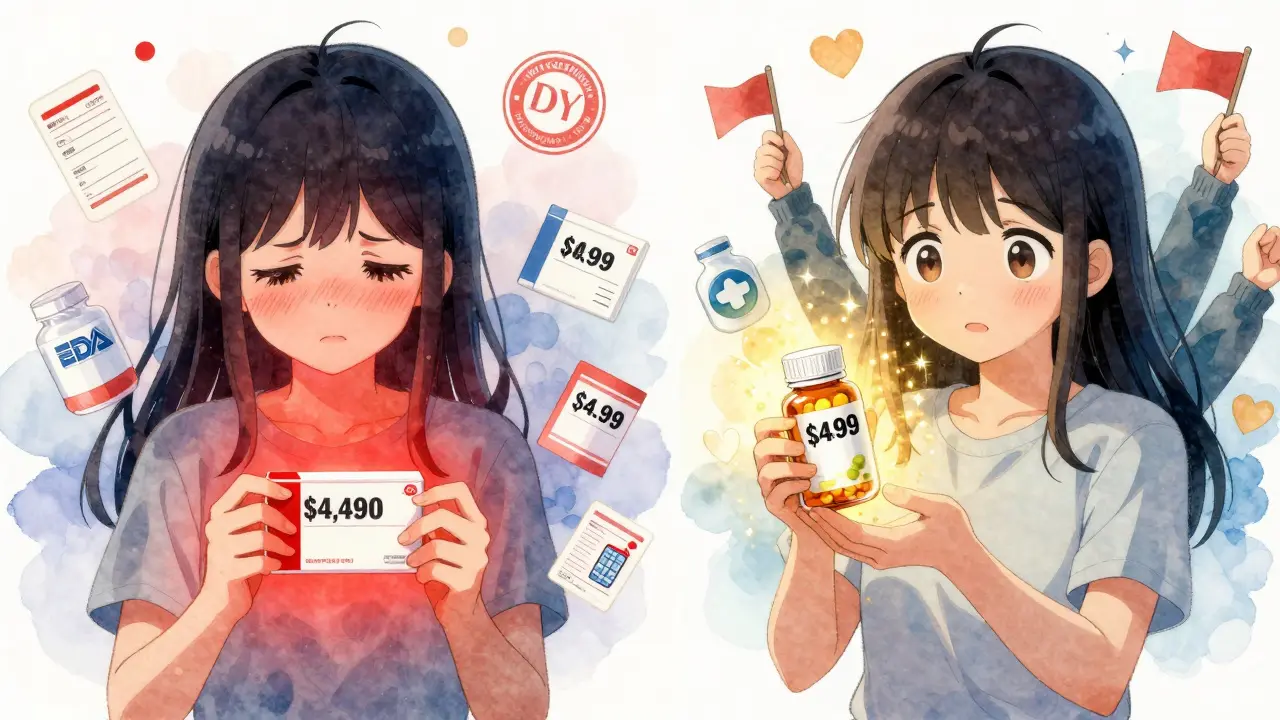
How Generic Competition Drives Prices Down
The key to low generic prices in the U.S. is speed and scale. When a patent expires, dozens of companies can jump in to make the drug. The FDA approved 773 generic drugs in 2023 alone. Each new competitor pushes prices lower. When just one generic enters, prices drop to about 35-40% of the brand. With two or three, they fall to 15-20%. In some cases, prices collapse to pennies per pill. But there’s a dark side. Sometimes, too few companies make a generic. If only one or two manufacturers are left, they can raise prices. In 2017, a generic version of the heart drug doxycycline jumped from $20 to over $1,800 for a 30-day supply because only two companies made it-and one pulled out. The FDA calls this “market failure.” But it’s rare. Most generics stay cheap because competition is fierce.What This Means for You
If you take mostly generic medications, you’re already getting one of the best deals in global healthcare. Your $6 copay for metformin, levothyroxine, or hydrochlorothiazide is cheaper than what most people in Europe or Asia pay for the same pills. You’re benefiting from a system designed to flood the market with low-cost copies. But if you need a brand-name drug-like a new cancer treatment or a biologic for rheumatoid arthritis-you’re in a different world. Those prices are sky-high, and there’s little relief. Even with insurance, your out-of-pocket could be hundreds or thousands of dollars a month. That’s where the real pain lies.
so like… i just paid $4 for my generic metformin at walgreens and i was like wait is this legal?? like i thought drugs were supposed to be expensive??
The empirical data presented in this article aligns with findings from the RAND Corporation’s 2022 comparative analysis of OECD pharmaceutical expenditures. The structural drivers of generic price suppression in the United States-namely, the Hatch-Waxman Act’s expedited approval pathway and the absence of price controls-create a uniquely competitive market environment. This contrasts sharply with the centralized price-setting mechanisms employed by the National Health Service in the United Kingdom and the Riksgälden in Sweden, where market entry is restricted and pricing is administratively determined.
It is also noteworthy that the net price disparity between the U.S. and other high-income nations diminishes significantly when rebates and discounts are accounted for, as highlighted by the University of Chicago’s 2024 study. The opacity of pharmacy benefit manager (PBM) negotiations, however, remains a systemic flaw that undermines patient transparency and equitable access.
While the article correctly identifies the paradox of high brand-name prices subsidizing global innovation, it omits discussion of the moral hazard inherent in allowing U.S. payers to bear disproportionate R&D costs while other nations externalize those expenses through price controls.
usa cheap generics lol
oh so america is the real drug kingpin? we pay more for the fancy ones so the whole world can get cheap pills? guess we’re just the suckers funding global healthcare like some kind of benevolent drug billionaire. real patriotic.
my grandma takes 5 generics and pays $3 a month. i told her she’s basically getting free medicine. she just says ‘thank god for walmart’ and keeps eating her sugar-free jello. i’m not mad, just impressed.
the fact that you can get a month’s supply of lisinopril for less than a latte is wild. we don’t talk about it enough. most people think the whole system is broken but the generic side? it’s actually a masterpiece of market efficiency. kudos to the FDA and all the small pharma companies grinding it out to keep prices down.
we pay for the dream so others can live in the reality.
the whole thing is rigged and you know it. the FDA approves generics like they’re giving out free candy and then the PBMs pocket the rebates and you still get billed for $6 because the system wants you to think you’re winning. it’s all theater. they’re laughing at you while you’re thanking them for your $5 pill
i just read this and thought about how my friend in canada pays $18 for the same pill i get for $4. i didn’t realize we had this weird advantage. it’s not perfect but… i’m glad i live here for this part at least