
Getting your generic prescriptions covered doesn’t have to cost hundreds of dollars a year. If you’re on Medicare and struggling to pay for medications like blood pressure pills, diabetes meds, or cholesterol drugs, Medicare Extra Help could cut your out-of-pocket costs to just $4.90 per prescription - or even less. This isn’t a rumor. It’s a real federal program designed for people with limited income, and millions are already using it. But here’s the problem: nearly 4 out of 10 people who qualify don’t even know they can apply. If you’re paying more than $5 for a generic drug, you need to read this.
What Medicare Extra Help Actually Does
Medicare Extra Help, also called the Part D Low-Income Subsidy (LIS), is a federal program that pays for most of your prescription drug costs. It doesn’t just lower your copays - it removes your monthly premium, wipes out your deductible, and caps what you pay for every generic drug. In 2025, if you qualify, you’ll pay no more than $4.90 for each generic medication, no matter how many times you refill it. For brand-name drugs, it’s $12.15. That’s it. No surprises. No hidden fees.
Compare that to standard Medicare Part D. Without Extra Help, you’d first pay a $595 deductible before your plan even starts helping. Then, you’d pay 25% of the drug’s cost during the initial coverage phase. So if a generic drug costs $50, you’d pay $12.50 after the deductible. Multiply that by 12 prescriptions a month - that’s $748.80 a year just in copays, not counting your premium or deductible. With Extra Help? $705.60 total for the year - and you didn’t pay a dime for the deductible or premium. That’s over $1,300 saved.
Who Qualifies? The Exact Income and Resource Limits
You don’t have to be broke to qualify. The income limits are strict, but they’re not impossible. In 2025, if you’re single, you can earn up to $23,475 a year. If you’re married and living together, the limit is $31,725. That includes Social Security, pensions, and wages - but not housing assistance or Medicaid payments.
Resources matter too. These are things you own that could be turned into cash: bank accounts, stocks, bonds, mutual funds, IRAs, and non-primary real estate. Your primary home doesn’t count. Neither does your car or personal belongings. In 2025, you can have up to $17,600 in resources as a single person, or $35,130 as a couple. You also get a $1,500 allowance for burial expenses that doesn’t count against your limit.
Here’s what this looks like in real life: A 78-year-old widow living on $22,000 a year from Social Security, with $10,000 in savings, qualifies. A 72-year-old man earning $25,000 from a part-time job and $20,000 in a 401(k) doesn’t - even though he’s barely making ends meet. That’s the gap. The program doesn’t consider debt, medical bills, or living expenses. It only looks at income and resources. If you’re close to the limit, don’t assume you’re out - apply anyway. Sometimes, exceptions happen.
How Much You Save on Generic Drugs
Let’s say you take four generic medications a month: lisinopril, metformin, atorvastatin, and levothyroxine. Each costs about $40 per prescription without Extra Help. Without the subsidy, your annual cost might look like this:
- Monthly copay: $10 (after deductible)
- Annual copays: $480
- Deductible: $595
- Monthly premium: $40 x 12 = $480
- Total: $1,555
With Extra Help:
- Monthly copay: $4.90
- Annual copays: $235.20
- Deductible: $0
- Monthly premium: $0
- Total: $235.20
You save $1,319.80 a year. That’s more than $100 a month - enough to cover groceries, heating bills, or a new pair of shoes. For someone on a fixed income, this isn’t just savings. It’s survival.
How to Apply - And What to Watch Out For
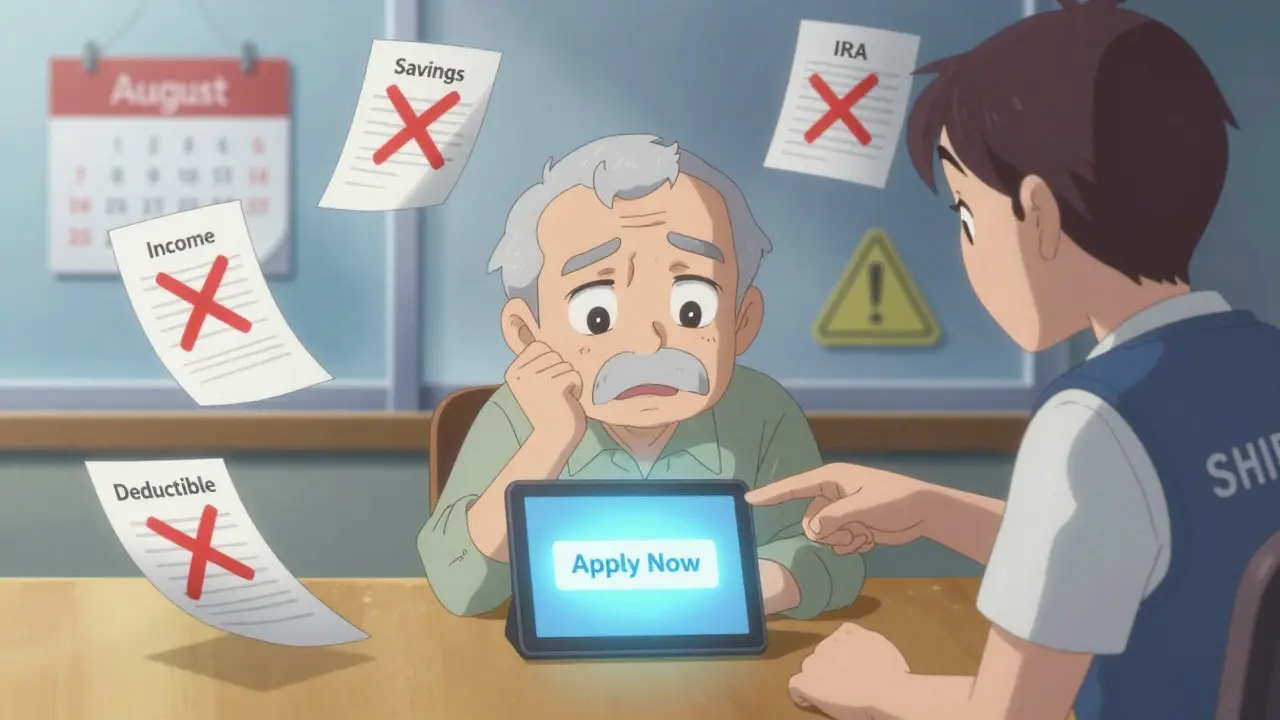
Applying is free. You can do it online at ssa.gov, call 1-800-772-1213, or visit your local Social Security office. If you already get Supplemental Security Income (SSI), Medicaid, or a Medicare Savings Program, you’re automatically enrolled. No paperwork needed.
But here’s the catch: if you don’t get automatic enrollment, you have to apply every year. The Social Security Administration sends out a form in August. You have 30 days to return it. Miss the deadline? Your benefits stop on January 1. No warning. No grace period. Just gone.
Many people lose Extra Help because they don’t realize their income changed. A small raise, a one-time tax refund, or even a slight increase in Social Security can push you over the limit. One Reddit user shared: “I made $500 over the limit. Lost my Extra Help. My $200-a-month prescriptions now cost me $1,200 a year in premiums and copays. It’s devastating.”
Don’t wait. If you think you might qualify, apply now - even if you’re not sure. You can always withdraw if you’re denied. But if you don’t apply, you’ll never know.
What Happens After You’re Approved
Once you’re in, you get a Special Enrollment Period. That means you can switch your Part D plan once a month. Why does that matter? Because not all plans cover the same drugs. Some might charge more for your specific medication, even with Extra Help. Use this power. Compare plans. Find the one with the lowest copay for your exact prescriptions.
Also, you can request formulary exceptions more easily. If your doctor prescribes a drug not on your plan’s list, Extra Help beneficiaries get faster approval. Just call your plan and ask. You’re not alone - 68% of people who got Extra Help say it helped them stick to their meds. That’s not luck. It’s policy.
Why So Many People Miss Out
State Health Insurance Assistance Programs (SHIPs) report that 73% of applicants need help filling out the form. It’s long. It’s confusing. It asks about things most people don’t think about - like whether they own a vacation home or have a trust fund.
And that’s why free help exists. Every state has SHIP counselors who will walk you through the application. No cost. No sales pitch. Just guidance. Find yours at shiptacenter.org. You can also call AARP’s helpline or visit your local Area Agency on Aging. These people do this every day. They’ve seen the forms. They know the tricks.
Still, 37% of eligible people aren’t enrolled. Why? Fear. Shame. Confusion. Many think they make too much. Others think it’s for “welfare.” It’s not. It’s a benefit you paid for with your taxes. You earned it.
What’s Coming Next
The Inflation Reduction Act already capped insulin at $35 a month for everyone on Medicare - including Extra Help recipients. That’s a win. But bigger changes might be coming. The Biden administration proposed expanding Extra Help to people earning up to 175% of the Federal Poverty Level. That would raise the income limit to about $28,500 for singles. If passed, over a million more seniors could qualify.
For now, the program is still limited. But it’s powerful. It’s reliable. And it’s there - if you know how to use it.
Can I get Extra Help if I have savings in the bank?
Yes, as long as your total countable resources don’t exceed $17,600 (single) or $35,130 (couple) in 2025. Your primary home, one car, and personal items don’t count. But bank accounts, stocks, bonds, and IRAs do. If you’re unsure, apply anyway - the Social Security office will review your assets and tell you.
Do I have to reapply every year?
Yes. Every August, you’ll get a form in the mail. You must return it within 30 days to keep your Extra Help for the next year. If you don’t, your benefits end on January 1. Set a reminder. If you’re not sure whether you still qualify, fill it out anyway. You can’t lose anything by trying.
Can I use Extra Help with any pharmacy?
Yes - but only at pharmacies that accept Medicare Part D. That includes major chains like CVS, Walgreens, and Walmart, as well as many local pharmacies. Always check with your pharmacy before filling a prescription. If you’re told you can’t use Extra Help there, ask if they’re a network provider or if you can switch to one that is.
What if my income goes up slightly next year?
You might lose Extra Help - but not always. The program has a 12-month grace period if your income increases due to a one-time event like a tax refund or inheritance. If your income is only slightly over the limit, you can appeal. Call 1-800-772-1213 and ask about a “partial subsidy.” Some people still get reduced help even if they don’t qualify fully.
Can I get Extra Help if I’m not on Medicaid?
Absolutely. Extra Help is separate from Medicaid. You don’t need Medicaid to qualify. You only need to meet the income and resource limits. Many people have Extra Help without Medicaid - especially those who are just above Medicaid’s lower threshold but still can’t afford their prescriptions.
Medicare Extra Help is one of those programs that feels like it was designed by someone who actually lives on a fixed income. The $4.90 copay for generics is a game-changer, especially when you’re juggling multiple meds. I’ve seen older neighbors skip doses because they couldn’t afford the $15 copay - now they’re refilling without hesitation.
Just applied last month after my mom lost her coverage because she missed the form. I cried reading the letter saying her benefits were canceled. She’s on three generics. Without Extra Help, it’s $1,200 a year. With it? $200. I didn’t know it was this easy. Just fill out the form. Seriously. Do it.
They’re not telling you the whole truth. The government doesn’t want you to know how easy it is to get denied. They set the limits so tight that even people who are barely getting by get kicked out. My aunt got cut off because she got a $300 tax refund. That’s not a glitch - it’s the system working as designed. Don’t trust them. They’ll take your help away the second you breathe wrong.
Apply. Now.
My dad got approved last year. He’s 74, lives on Social Security, has $8k in savings. They told him he qualified. He’s paying $4.90 for his blood pressure med now. Before? $58. That’s 12x cheaper. He didn’t even know this existed. If you’re on Medicare and taking more than one pill - you’re probably eligible. Don’t overthink it. Apply.
I’m so grateful for this program 😭 My mom’s diabetes meds went from $110/month to $4.90. We cried. I wish more people knew about this. It’s not welfare - it’s a promise we made to seniors. If you’re close to the limit, APPLY. You have nothing to lose. Seriously. Do it today 💪
so i applied last year and got approved but then they sent me this form in aug and i just… forgot? like i was busy and then jan 1 came and boom no more help. my atorvastatin went from $4.90 to $47. i was so mad. now i have a calendar alert every july 15. dont be me. set a reminder. even if you think you’re fine. just do it. seriously. i’m still mad about it
As someone from Indonesia who’s lived in the U.S. for 12 years, I’ve watched my American friends struggle with drug costs. The Extra Help program is one of the few things that actually works the way it’s supposed to. It’s not perfect - the forms are messy, the limits are rigid - but for those who make it through, it’s life-changing. I’ve helped three neighbors apply. All got approved. No drama. Just paperwork.
My grandmother is on four generics. She didn’t know she qualified. She thought she made too much because she gets Social Security and a small pension. She had $15k in savings. She was convinced she didn’t qualify. I walked her through the form. She got approved. Now she buys groceries instead of choosing between meds. I wish more people had someone to help them. You don’t need to be rich to need this. You just need to know it exists.
My mom applied last year. She’s 70, lives alone, gets $21k from Social Security. She has $9,000 in savings. They approved her. She pays $4.90 for everything. I didn’t even know this existed until she told me. I’m so glad she didn’t give up. I’m telling all my friends now. If you’re on Medicare and take any pills - check it out. It’s not a handout. It’s a right.
It is imperative that individuals who believe they may qualify for Medicare Extra Help take immediate action to complete the application process. The program is a critical component of the Medicare Part D structure and provides substantial financial relief. Failure to respond to the annual renewal form may result in the abrupt termination of benefits, which can have severe consequences for those reliant on prescription medications. I encourage all eligible beneficiaries to verify their eligibility and submit documentation promptly.
One must acknowledge that the income thresholds for Extra Help are not calibrated to reflect modern economic realities. The $23,475 cap for single individuals is archaic. In many urban centers, this is below the poverty line after accounting for healthcare, utilities, and transportation. The program, while well-intentioned, is structurally inadequate. One wonders whether the design reflects genuine policy concern or merely symbolic gesture.
Did you know the government tracks every bank transaction? They use it to cut off your help. I heard a guy on the radio say they cross-check with IRS, banks, even your 401(k) withdrawals. One time you get a tax refund? Boom. No more help. And they don’t warn you. It’s all automated. You think you’re safe? You’re not. They’re watching. Always.
They say it’s for low-income people but the real reason they don’t want you to know about this is because they want you to keep paying. The pharmaceutical companies make billions. This program cuts into their profits. That’s why the forms are confusing. That’s why they don’t advertise it. They don’t want you to win.
Replying to the one about the tax refund - I’ve seen this happen. My neighbor got cut off because she got a $400 refund. She appealed. They gave her a partial subsidy. She still pays $12 instead of $4.90. Not ideal, but better than nothing. It’s worth calling and asking. They have a ‘partial subsidy’ option. No one tells you that. You have to ask.