
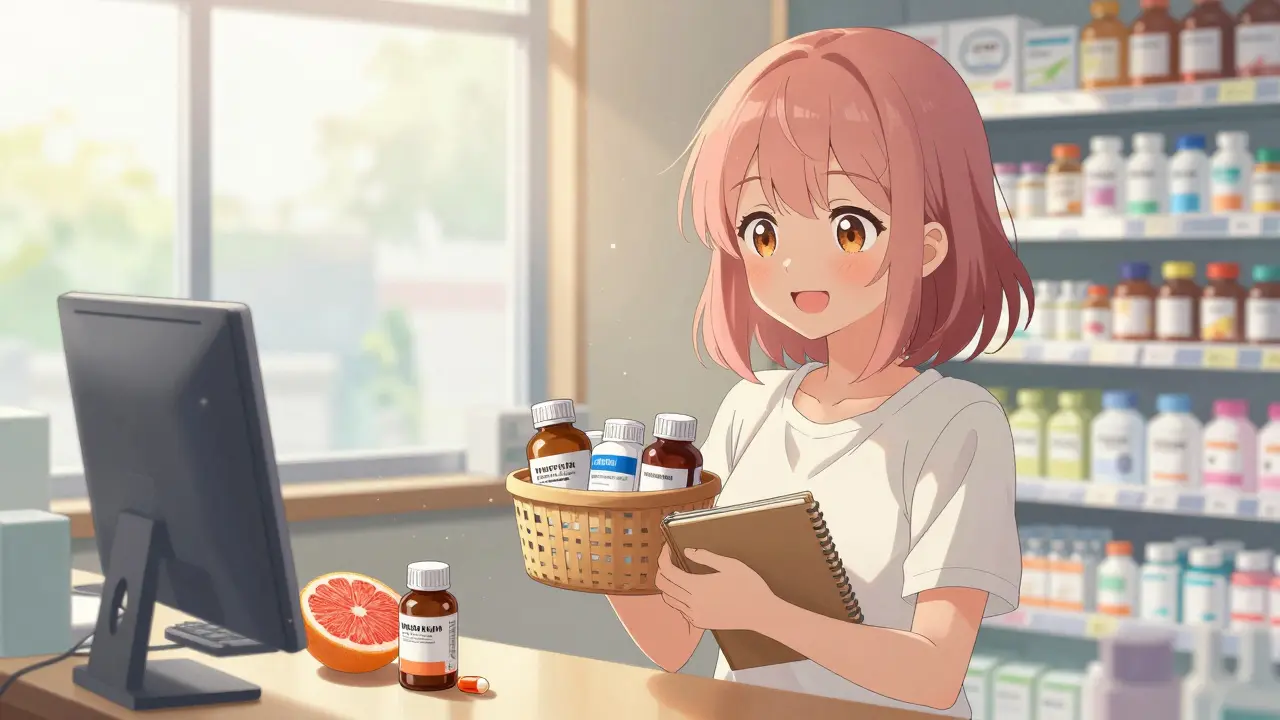
Many people take supplements-vitamins, herbs, fish oil, probiotics-thinking they’re harmless. But if you’re also on prescription meds, that belief could be dangerous. You might not realize that your daily green smoothie, calcium pill, or St. John’s wort could be making your blood thinner less effective, raising your blood pressure, or even causing serotonin syndrome. The good news? Your pharmacist is the best person to ask. They see hundreds of these interactions every week. But most patients never bring it up. Here’s how to change that.
Start with a complete list
Before you walk into the pharmacy, write everything down. Not just the big-name supplements. Include the small bottles in your medicine cabinet, the ones you only take when you feel tired, the ones your friend swore by. Write the brand name, the dose (like 500 mg or 1,000 IU), and how often you take it. Don’t forget the ones you take with food, like magnesium at night or fish oil with breakfast. Include over-the-counter meds too-cold pills, antacids, pain relievers. Even if you think it’s "just a vitamin," list it.Why? Because pharmacists don’t guess. They check databases that flag known interactions. But those databases only work if you give them the full picture. One 2025 study found that when patients gave complete details, pharmacists spotted dangerous interactions in 12.89% of cases-up from just 3.11% when details were vague. That’s a fourfold jump in safety just from being thorough.
Ask about the big risks
Some supplements are known troublemakers. St. John’s wort is one of the most dangerous. It can cut the effectiveness of birth control, antidepressants like Lexapro or Zoloft, and even heart meds. Worse, when mixed with SSRIs, it can trigger serotonin syndrome-a rare but life-threatening condition with symptoms like high fever, rapid heartbeat, and confusion. If you’re on any mental health med, ask: "Could this interact with St. John’s wort?"Goldenseal is another red flag. It affects liver enzymes that break down dozens of common drugs, including statins, blood thinners, and diabetes meds. Even if you’ve taken it for years without issue, your body changes over time. A new medication or a change in dosage can flip a safe combo into a risky one.
Don’t forget grapefruit. Yes, it’s a fruit. But it’s not harmless. It blocks enzymes that process over 85 medications, including some statins, blood pressure drugs, and anti-anxiety pills. One grapefruit can affect your body for up to 72 hours. If you take any heart or mental health meds, ask: "Is grapefruit safe with what I’m on?"
Know how food affects your meds
It’s not just supplements. Your breakfast can interfere with your pills. Dairy products-milk, yogurt, cheese-contain calcium. That calcium can bind to antibiotics like tetracycline or doxycycline, making them useless. Same with iron pills and calcium supplements. The fix? Take them at least two to four hours apart.Proton pump inhibitors (PPIs) like omeprazole reduce stomach acid to treat heartburn. But that also makes it harder for your body to absorb vitamin B12, magnesium, and calcium. If you’ve been on a PPI for more than six months, ask your pharmacist: "Should I be taking a B12 or magnesium supplement?"
Metformin, a common diabetes drug, depletes B12 and folate over time. That can lead to nerve damage, fatigue, and brain fog. Statins, used for cholesterol, lower coenzyme Q10-a compound your muscles need. That’s why many people on statins feel achy or exhausted. Diuretics, often called water pills, drain potassium and magnesium. Low levels can cause cramps, irregular heartbeat, or dizziness. If you’re on any of these, ask: "Am I losing nutrients I should replace?"
Don’t assume "natural" means safe
You might think, "It’s herbal, so it’s gentle." That’s a myth. The FDA doesn’t approve supplements before they hit shelves. That means what’s on the label isn’t always what’s inside. A 2024 study found that 1 in 5 herbal products contained unlisted pharmaceuticals-like hidden steroids or blood thinners. Some ginseng supplements had no ginseng at all. That’s why you need to ask: "Is this brand tested by USP, NSF, or ConsumerLab?" Those are third-party groups that verify purity and strength.Even "natural" herbs can be toxic in high doses. Kava, often used for anxiety, has been linked to liver damage. Comfrey, used topically for bruises, can harm your liver if swallowed. Your pharmacist knows which herbs have real safety data-and which ones don’t.
Timing matters more than you think
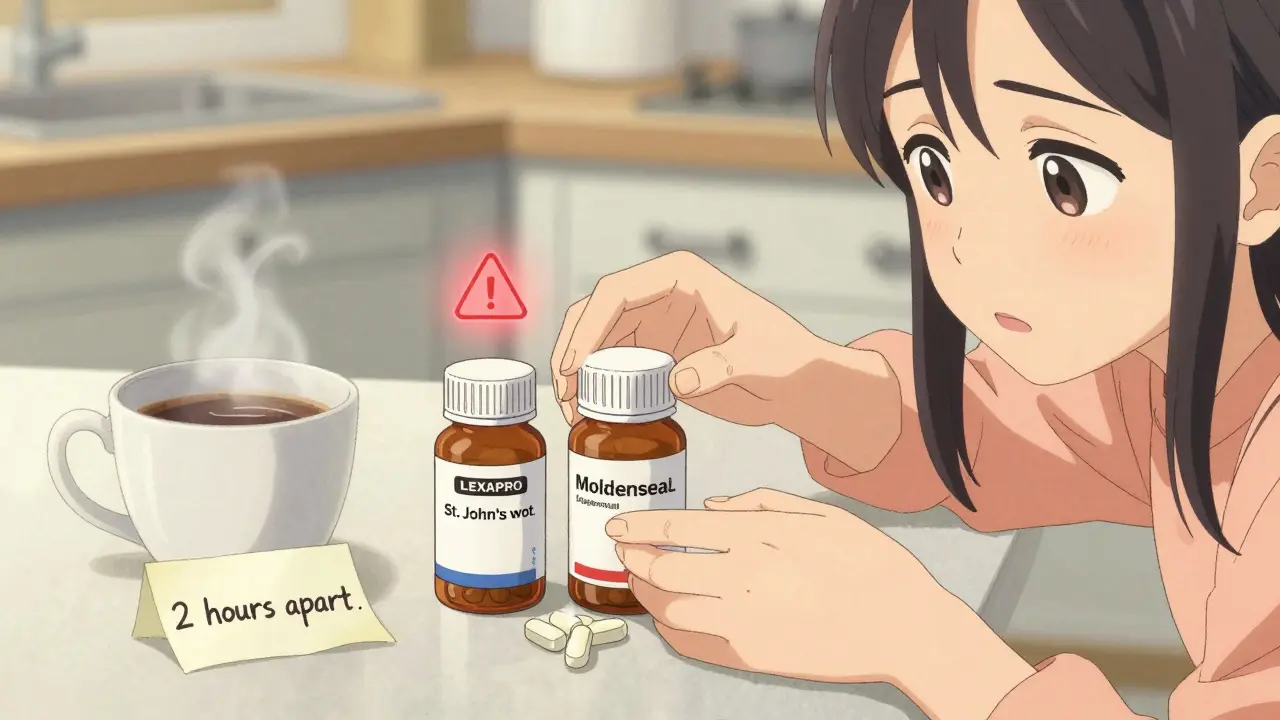
It’s not just what you take-it’s when. Taking your thyroid med with coffee? That can block absorption. Taking your calcium with your antibiotic? They’ll cancel each other out. Taking your blood thinner with cranberry juice? That could increase bleeding risk.Ask your pharmacist: "When’s the best time to take each of these?" They’ll tell you to space them out. For example: take your multivitamin with breakfast, your statin at night, your calcium two hours after your antibiotic. Small changes like this make a big difference in how well your meds work.
Bring your supplements to the pharmacy
Don’t just describe them. Bring the bottles. Even if they’re half-empty. Pharmacists can read the labels, check expiration dates, spot fake brands, and see if you’re taking too much of something. If you’re on five or more meds, bring your entire medicine bag. They’ll sort it out for you.Many community pharmacies now have digital tools that scan your bottles and flag interactions automatically. CVS and Walgreens rolled out these systems in late 2025. But they only work if you let them scan your stuff.
Ask the right questions
Don’t just say, "Is this safe?" That’s too vague. Be specific:- "I take warfarin. Is avocado oil safe?"
- "I’m on metformin. Should I take a B12 supplement?"
- "I started taking magnesium for sleep. Will that affect my blood pressure pill?"
- "I take St. John’s wort for mood. Could that mess with my birth control?"
Pharmacists are trained to answer these. But they won’t ask unless you bring it up. A 2025 study showed that only 6.67% of pharmacists proactively asked patients about supplement use. Don’t wait for them to ask. Ask first.
Don’t stop or start anything on your own
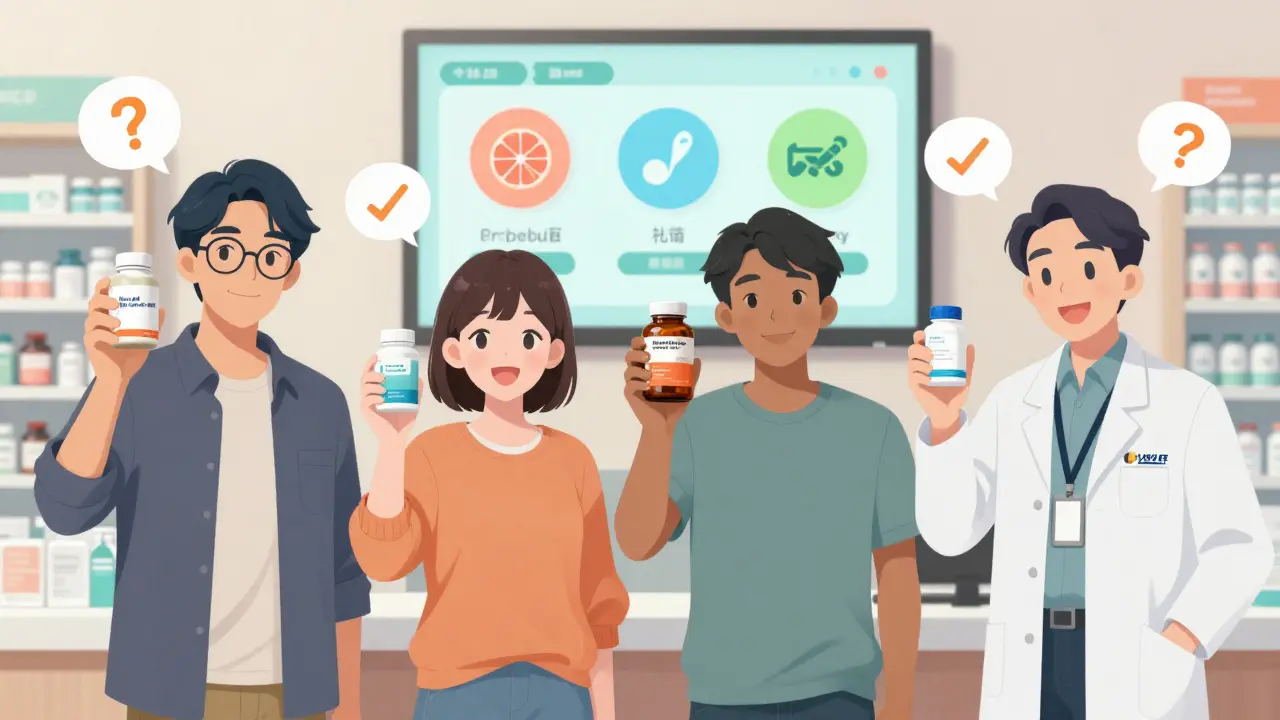
You might think, "I feel better without this supplement," or "I heard this herb helps with my joint pain." Don’t quit or add anything without checking with your pharmacist. Suddenly stopping a supplement can cause withdrawal-like symptoms. Adding a new one without knowing the interaction could be risky.Even if your doctor told you to take something, your pharmacist might know more about how it interacts with your other meds. They’re the medication experts. Your doctor treats your condition. Your pharmacist keeps your whole regimen safe.
It’s not just about pills-it’s about your health
Talking to your pharmacist about supplements isn’t just about avoiding bad reactions. It’s about optimizing your health. Maybe you’re low on vitamin D and your fatigue won’t go away. Maybe your magnesium levels are dropping because of your diuretic, and that’s why you’re getting leg cramps. Your pharmacist can spot these patterns. They can suggest evidence-backed alternatives or adjustments that actually help.And they’re easy to reach. Ninety-three percent of Americans live within five miles of a community pharmacy. You don’t need an appointment. You can walk in, hand them your bottle, and get advice in 10 minutes. No waiting room. No copay. Just expert, personalized help.
The supplement market is growing fast-projected to hit $88 billion by 2028. But with more options comes more risk. The only way to stay safe is to be informed. And your pharmacist is your best tool for that.
Can I just ask my doctor instead of my pharmacist?
Your doctor is important, but pharmacists specialize in how medications and supplements interact. Doctors focus on diagnosis and treatment plans. Pharmacists focus on the details: how your pills work together, what affects absorption, what to avoid. Most drug interactions happen because of overlooked supplement use-and pharmacists see those every day. They’re the experts in the fine print.
What if I don’t remember the names of my supplements?
Bring the bottles. Even if the labels are faded, pharmacists can often identify them by shape, color, or imprint codes. If you don’t have the bottles, write down what you remember: color, shape, what it was for (e.g., "blue pill for sleep," "red capsules for joints"). You’d be surprised how often they can match it. Don’t guess-bring what you have.
Are all supplements risky?
No. Many supplements, like vitamin D or fish oil, have low interaction risk when taken properly. But "low risk" doesn’t mean "no risk." Even vitamin K can interfere with blood thinners. Ginkgo can increase bleeding with aspirin or warfarin. The key isn’t avoiding all supplements-it’s knowing which ones are safe with your specific meds. That’s why you talk to your pharmacist.
Should I stop my supplements before a doctor’s appointment?
No. Stopping suddenly could affect your health or mask symptoms your doctor needs to see. Instead, bring them with you and tell your doctor and pharmacist exactly what you take and why. They can assess whether it’s helping, hurting, or doing nothing at all.
Is it worth paying for high-quality supplements?
Yes-if you’re taking them long-term. Cheap supplements may contain fillers, no active ingredient, or even contaminants. Look for seals from USP, NSF, or ConsumerLab. These mean the product was tested for what’s on the label and free of harmful substances. It’s not about being fancy-it’s about safety and effectiveness. For a daily supplement you’ll take for years, spending a little more is smart.
Next steps: What to do today
- Write down every supplement, vitamin, and herb you take-name, dose, frequency.
- Gather all the bottles and put them in a bag.
- Write down your top 3 questions: "Is this safe with my blood pressure med?" "Could this be causing my fatigue?" "Should I be taking something else?"
- Walk into your local pharmacy. No appointment needed. Ask for a quick supplement review.
You don’t need to be sick to do this. You don’t need to be on ten meds. Even if you take one supplement and one prescription, it’s worth five minutes. Your pharmacist is there to help. You just have to ask.
I used to think supplements were just fancy vitamins until my pharmacist pulled up a list of 12 interactions I didn’t even know existed. I was taking St. John’s wort for ‘mood support’ and my blood pressure med was basically useless. She showed me the data on her screen-like, real-time graphs-and I just sat there thinking, ‘How did I not know this?’ Now I bring my whole medicine cabinet every time I walk in. No judgment, just help. And honestly? It’s the most useful 10 minutes of my week.
Also, grapefruit? Yeah, I stopped. Not because I’m scared-but because my pharmacist looked at me like I’d just told her I drink bleach for breakfast. Fair enough.
Pro tip: write everything down on your phone notes. Don’t trust your memory. I lost a whole bottle once and had to describe it as ‘that blue capsule with the weird red dot’-she found it in 30 seconds. Pharmacists are wizards.
And yes, I now call my pharmacist ‘my health hype woman.’ She deserves a medal.
This is so needed. I’m a nurse and I’ve seen patients come in with 15 different supplements, none of which they can name, and then act surprised when their INR spikes. One guy was taking ginkgo, fish oil, and aspirin-all for ‘heart health’-and didn’t realize he was basically bleeding internally. No one told him.
Pharmacists aren’t just people who hand out pills. They’re the unsung heroes who catch the stuff doctors miss because they’re juggling 20 patients an hour. If you’re on meds, even one, walk in. Bring the bottles. Say ‘I’m not sure if this is safe.’ They won’t laugh. They’ll thank you.
Let’s be real-this article is basic. I’ve been doing this since 2018. You think St. John’s wort is dangerous? Try combining it with MAO inhibitors. Or mixing magnesium with metformin without monitoring serum levels. Or not realizing that turmeric increases bleeding risk with warfarin by 400%.
And don’t get me started on ‘natural’ brands. I tested a ‘premium’ ashwagandha supplement last year. It had lead levels higher than a 1980s toy. The label said ‘organic.’ The lab report said ‘toxic.’
USP? NSF? Those are the bare minimum. You need to check the Certificate of Analysis on the manufacturer’s site. And if they don’t have one? Don’t touch it. Your liver will thank you later-or it won’t. Either way, you’re on your own.
Also, grapefruit isn’t the only citrus. Seville oranges, pomelos, even some bergamot teas-same problem. Learn the CYP3A4 enzyme. It’s not hard.
And yes, I’m the person who brings a printed spreadsheet to the pharmacy. You’re welcome.
My grandma used to say ‘if it’s in a bottle, it’s medicine’ and she was right
I took melatonin for sleep and didn’t realize it was making my antidepressant useless until my pharmacist asked ‘what’s that blue pill you take at night’ and I said ‘oh that’s just a sleep aid’
She looked at me like I’d just told her I was trying to fly off the roof
Now I bring everything-even the gummy vitamins my kid stole and I forgot to throw away
Turns out the ‘natural’ gummy had iron in it and it was wrecking my stomach meds
Pharmacists are the real MVPs. No cap. No drama. Just straight facts and zero judgment
Also grapefruit juice is a sneaky villain. Don’t let it fool you
And yes I now keep a little notebook in my purse. Like a secret health diary
Best $0 investment I ever made
Wow. A whole article about telling your pharmacist what you’re taking. Groundbreaking. Next up: ‘How to Use a Toaster Without Setting Off the Smoke Alarm.’
Of course your supplements interact with your meds. You think the FDA is running a safety review on every gummy bear labeled ‘immune boost’? Please.
But hey, if you want to spend 10 minutes explaining to a stranger why you’re taking ‘turmeric for your soul,’ go ahead. I’ll be here, alive, not taking anything but coffee and common sense.
Just walked into my pharmacy yesterday with 7 bottles and a list written on a napkin. The pharmacist smiled, said ‘I’ve been waiting for you’ and spent 15 minutes sorting it all out.
Turns out my magnesium was canceling out my thyroid med. My fish oil was making my blood thinner too strong. And my ‘natural’ sleep aid had hidden diphenhydramine.
She gave me a new plan, printed it out, and even wrote down when to take each thing with emojis: ☀️ for morning, 🌙 for night, 🚫 for grapefruit.
That’s the kind of care you don’t get from a doctor who’s rushing between rooms.
You don’t need to be sick to do this. You just need to care enough to ask.
Go. Do it. Your future self will high-five you. 🙌
As someone who grew up in a household where ‘medicine’ meant tea, honey, and a prayer, this article hits different. My mom took ginseng for ‘energy’ and never told anyone. She ended up in the ER because it spiked her BP while on her heart med.
Now I bring my supplements to the pharmacy every time I refill a prescription. I even show them the labels from my aunt’s ‘herbal blend’ from the market in Delhi. They can ID it.
Pharmacists aren’t just dispensers-they’re cultural translators too. They know what ‘Ayurvedic’ or ‘traditional Chinese herb’ might actually mean on the bottle.
Don’t let pride keep you silent. Your body doesn’t care about your cultural stigma. It only cares what’s in your system.
This article is dangerously misleading. The notion that pharmacists are ‘medication experts’ is a marketing construct perpetuated by the pharmaceutical-industrial complex. Pharmacists are not physicians, nor are they trained in clinical decision-making. They are technicians trained to dispense according to protocols. The idea that a community pharmacist can accurately assess polypharmacy interactions without access to full medical records, lab values, or patient history is a fallacy.
Furthermore, the emphasis on third-party verification seals (USP, NSF) is economically biased-these certifications are expensive and not universally accessible, yet the article implies they are mandatory for safety. Many safe, low-cost supplements are produced by reputable manufacturers without such seals.
Additionally, the claim that ‘93% of Americans live within five miles of a pharmacy’ is statistically irrelevant when 40% of those pharmacies are in corporate chains with underpaid staff working 12-hour shifts. The notion that a 10-minute walk-in consultation yields meaningful risk assessment is laughable.
Patients should rely on their primary care provider and, if necessary, a clinical pharmacist affiliated with an academic medical center-not a cashier at CVS.
Do not be manipulated by emotionally charged appeals to ‘trust your pharmacist.’ Trust your data. Trust your physician. Trust evidence-based medicine-not anecdotal retail advice.