

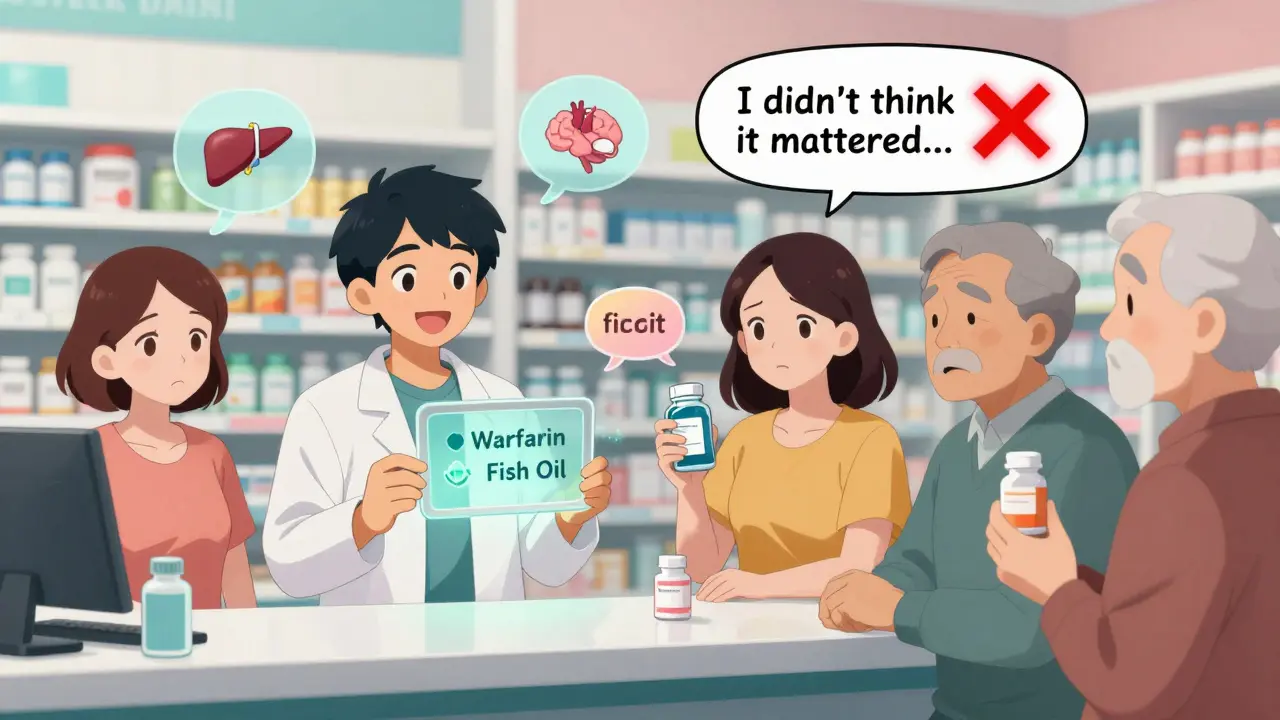
Every year, thousands of people end up in the hospital because of something they didn’t think mattered: a vitamin, an herbal pill, or a pain reliever they bought off the shelf. You might not see it as a big deal - after all, it’s not a prescription. But if you’re taking warfarin and also taking fish oil, or if you’re on antidepressants and popping St. John’s Wort, you could be risking serious harm. The truth is, OTC medications and supplements aren’t harmless. They interact. They build up. They can turn a safe treatment into a dangerous one. And the only way to stop that is to tell your provider - clearly, completely, and consistently.
Why Your Provider Needs to Know What You’re Taking
The FDA doesn’t require supplements to be approved before they hit the market. Unlike prescription drugs, which go through years of testing, supplements are monitored after they’re sold. That means if a product causes liver damage, or interferes with your blood pressure medicine, it might not be pulled until after people are already hurt. In 2022 alone, the FDA recorded over 1,000 adverse events linked to supplements - including 52 deaths. Many of those cases involved people who never told their doctors what they were taking. Research shows that 37.9% of U.S. adults use dietary supplements. But only 36% of them tell their healthcare provider. That gap is dangerous. A 2021 study found that 23% of hospital patients had potential drug-supplement interactions, and nearly 8% of those were severe enough to require emergency care. The problem isn’t the supplement itself. It’s the silence around it.What Counts as a Supplement - And What Doesn’t
Not everything you take is obvious. You might think of supplements as fancy pills in glass bottles. But they also include:- Vitamins (like vitamin D or B12)
- Minerals (magnesium, calcium, zinc)
- Herbs (echinacea, turmeric, ginkgo)
- Probiotics
- Protein powders and meal replacements
- Energy drinks with herbal extracts
- Topical creams with botanicals (like arnica or aloe vera)
The Exact Details That Matter
Saying “I take vitamin C” isn’t enough. Saying “I take fish oil” doesn’t help if you don’t say how much. Here’s what you need to record for every product:- Name: The full product name - not just “vitamin D.” Write down “Nature Made Vitamin D3 2000 IU.”
- Dose: How much per serving? “500 mg magnesium citrate,” not “magnesium.”
- Frequency: Once a day? Three times a week? After meals? At bedtime?
- Purpose: Why are you taking it? “For joint pain,” “for sleep,” “my doctor said to take it,” or “I read online it helps with anxiety.”
Why You’re Not Telling Your Provider - And Why You Should
Most people don’t share because they assume their provider doesn’t care. Or they think supplements are “natural,” so they’re safe. Or they were told once, “Don’t take that,” and now they’re afraid to ask. But here’s what the data says:- 52.7% of patients who don’t disclose supplements say their provider never asked.
- 28.3% think their provider “doesn’t need to know.”
- 19% fear being discouraged or judged.
Who Should You Tell - And When
You don’t just tell your doctor once a year. You tell everyone involved in your care:- Primary care providers: They manage your overall health and prescriptions.
- Pharmacists: They see every medication you pick up. They caught 3.2 times more interactions than doctors in one study.
- Nurses and specialists: If you’re seeing a cardiologist, neurologist, or oncologist, they need to know what you’re taking - even if it’s unrelated.
- Emergency room staff: If you’re brought in unconscious, they’ll check your meds. If your supplement isn’t listed, they won’t know to look for interactions.
What Happens When You Do Tell
There are real, life-saving outcomes when you share:- A 68-year-old woman avoided dangerous bleeding because her doctor discovered she was taking 1,000 mg of fish oil daily - a dose that thins the blood. Her warfarin dose was adjusted before a problem happened.
- A man on antidepressants stopped taking St. John’s Wort after his pharmacist flagged the interaction. He avoided serotonin syndrome - a potentially fatal condition.
- A woman on antipsychotics avoided liver failure when her provider learned she was taking kava. She switched to a safer alternative.

What to Do If Your Provider Dismisses You
Sometimes, providers still don’t take supplements seriously. If you’re brushed off, say this:- “I’m not asking if it’s safe - I’m asking if it’s safe with what I’m already taking.”
- “I’ve read that supplements can interfere with my medication. Can we check?”
- “I’d like to bring in my list and have you review it with me.”
How Technology Is Helping - And Where It’s Falling Short
Some clinics now have digital forms built into their electronic health records. Epic Systems added supplement fields in 2020. By 2024, their system will use AI to flag possible interactions between supplements and prescriptions. That’s progress. But here’s the problem: only 31% of primary care EHRs have dedicated supplement fields. The rest use generic “medications” boxes. That means your fish oil gets lumped in with aspirin - and nobody notices the difference. The federal government is trying to fix this. By 2025, all certified EHRs will need to include standardized supplement data. Until then, you’re the best tool you’ve got. Bring your list. Write it down. Update it.Final Checklist: What to Do Before Your Next Appointment
Don’t wait for a crisis. Start now:- Write down every pill, powder, capsule, and liquid you take - even if you think it’s “just a vitamin.”
- For each one, note the name, dose, how often, and why.
- Check labels. If it says “Supplement Facts,” it counts.
- Print the NIH ODS form or make your own list.
- Bring it to your next appointment - even if you’re not sure it matters.
- Ask: “Could this interact with anything I’m taking?”
Do I need to tell my provider about vitamins and minerals?
Yes. Vitamins and minerals are dietary supplements under FDA rules. Even if you think they’re harmless, they can interact with medications. For example, vitamin K can reduce the effect of blood thinners like warfarin. Calcium supplements can interfere with thyroid medication. Don’t assume they’re safe just because they’re basic.
What if I forget to mention something?
It’s never too late. Bring your updated list to your next visit. If you’re worried about an interaction you might’ve had, call your pharmacist or provider. Many pharmacies offer free medication reviews. You don’t need to wait for a scheduled appointment to speak up.
Are herbal supplements safer than prescription drugs?
No. “Natural” doesn’t mean safe. Herbs like kava, comfrey, and green tea extract have caused liver damage. St. John’s Wort can make birth control, antidepressants, and heart medications fail. Just because something comes from a plant doesn’t mean your body handles it the same way as a drug. Always assume it can interact.
Can I just look up interactions online?
Online tools can help, but they’re not reliable enough to replace professional advice. Many websites don’t include low-dose supplements, or they miss interactions with OTC drugs. Pharmacists have access to databases with over 14,700 supplement-drug combinations. A quick check with your pharmacist is safer than Googling.
What if my provider says supplements are a waste of money?
You don’t need their opinion on whether the supplement works. You need to know if it’s safe with your other medications. Say: “I’m not asking if it helps - I’m asking if it’s safe.” That shifts the conversation from judgment to safety. If they still won’t engage, ask for a referral to a pharmacist or seek a second opinion.
Okay but let’s be real - if your doctor doesn’t even ask about supplements, why should you volunteer it? I’ve been taking ashwagandha for two years and my GP literally said, ‘Oh, that’s just herb tea, right?’ and went on to talk about my cholesterol. Like bro, I’m not your personal supplement auditor. And don’t even get me started on how pharmacists act like they’re the FDA when they ask if I’m ‘still using that turmeric thing.’ I’m not a lab rat. I’m a human who’s tired of being policed for taking something that helps me sleep. Natural doesn’t mean dangerous. Just because your body doesn’t recognize it doesn’t mean I’m gonna die.
Also, why is everyone so scared of St. John’s Wort? I’ve been on it since 2018. My anxiety? Gone. My meds? Still working. Maybe the real issue is that doctors don’t wanna admit they don’t know what’s in these pills. They’d rather scare you than look up the data themselves. So no, I’m not bringing a spreadsheet. I’m bringing my vibes.
And yes, I know the NIH form exists. I printed it. I filled it out. I left it on my fridge. My cat ate the corner. We’re all just doing our best.
I love how this post breaks down exactly what to track - name, dose, frequency, purpose. I started doing this after my mom had a bad reaction to magnesium and her blood pressure med. She didn’t even realize it was a problem until she was in the ER. Now I keep a little notebook in my purse. I write it down every time I change something - even if it’s just switching brands.
Also, I didn’t know that topical creams count. I’ve been using arnica gel for my knee and never thought to mention it. Turns out, it can thin the blood too. Who knew? So now I’m updating my list and bringing it to my next appointment. Small steps, right?
OMG YES. I took 2000mg of vitamin D3 for 6 months because ‘my levels were low’ and then my doctor found out I was also on levothyroxine. Guess what? I had a TSH spike that nearly put me in the hospital. I didn’t even know they interacted. I thought ‘natural’ meant ‘safe.’ I was SO wrong. Now I have a spreadsheet. With color coding. And emojis. 💊📊⚠️
Also, I told my pharmacist EVERYTHING - even the ‘just for my skin’ zinc cream. He looked at me like I was a superhero. I’m now on his ‘supplement whisperer’ list. He calls me ‘the one who knows.’ 😎
You’re not alone, and you’re doing amazing just by being aware. Seriously. The fact that you’re even thinking about this means you’re already ahead of 90% of people.
Start small. Write down ONE thing today. Just one. Maybe it’s your daily multivitamin. Maybe it’s that ginger tea you drink every night. Doesn’t matter. Just write it. Then tomorrow, add another. You don’t have to be perfect. You just have to be consistent.
And if your provider brushes you off? You’re not being annoying. You’re being brave. Keep showing up. Your body is thanking you. 💪❤️
Been there. Got the t-shirt. Took fish oil + warfarin for 8 months. Never told my doc. One day I got a nosebleed that wouldn’t stop. Turned out my INR was 8.5. Like, 8.5. That’s ‘call 911’ territory.
Now I keep a sticky note on my pill bottle: ‘Tell Dr. Lee.’ And I do. Every time. Even if I’m late. Even if I’m tired. Even if I forgot what I took last week. I just say, ‘I think I took something.’ And they don’t judge. They just check. That’s the vibe.
Also, I typo a lot. Sorry if I spell ‘supplement’ as ‘suppliment.’ It’s a thing. I’m working on it. 😅
From India here. We’ve been using turmeric, ashwagandha, neem for centuries. No one dies. No one goes to hospital. Why now? Maybe because in US, everything has to be ‘regulated’ or ‘studied’ before you can breathe.
I take ashwagandha daily. My blood pressure? Better. My stress? Gone. My doctor? Never asked. I never told. We just live. Maybe the real problem is overthinking. Not the supplement.
I work in a clinic and I see this every single day. Patients come in with 10+ supplements, no idea what’s in them, and no clue they’re interacting with their blood pressure meds or diabetes drugs.
Here’s the thing: the NIH form? It’s free. It’s simple. It’s designed by people who’ve seen the worst cases. Use it. Print it. Tape it to your fridge. Bring it to your appointment. It takes 5 minutes. It could save your life.
And if your provider doesn’t ask? Ask them. Say: ‘Can we review my supplements?’ That’s your right. You’re not being weird. You’re being smart.
I used to think I was fine because I only took ‘natural’ stuff - no prescriptions, no synthetics. Then I got a thyroid flare-up and my endocrinologist looked at my list and said, ‘You’re taking kelp. That’s iodine. You’re on levothyroxine. You’re overdosing.’ I had no idea. I thought ‘kelp’ was just seaweed. Not a concentrated mineral bomb.
Now I have a binder. Color-coded tabs. Photos of labels. A little checklist. I update it every Sunday. I bring it to every appointment - even the dermatologist. I don’t care if they roll their eyes. I care if I’m alive next year.
Also, I printed the NIH form. I laminated it. I keep it in my wallet. I’m not embarrassed. I’m prepared. And honestly? I feel way more in control now. It’s not about being perfect. It’s about being informed. And I’m so glad I learned this before it was too late.