
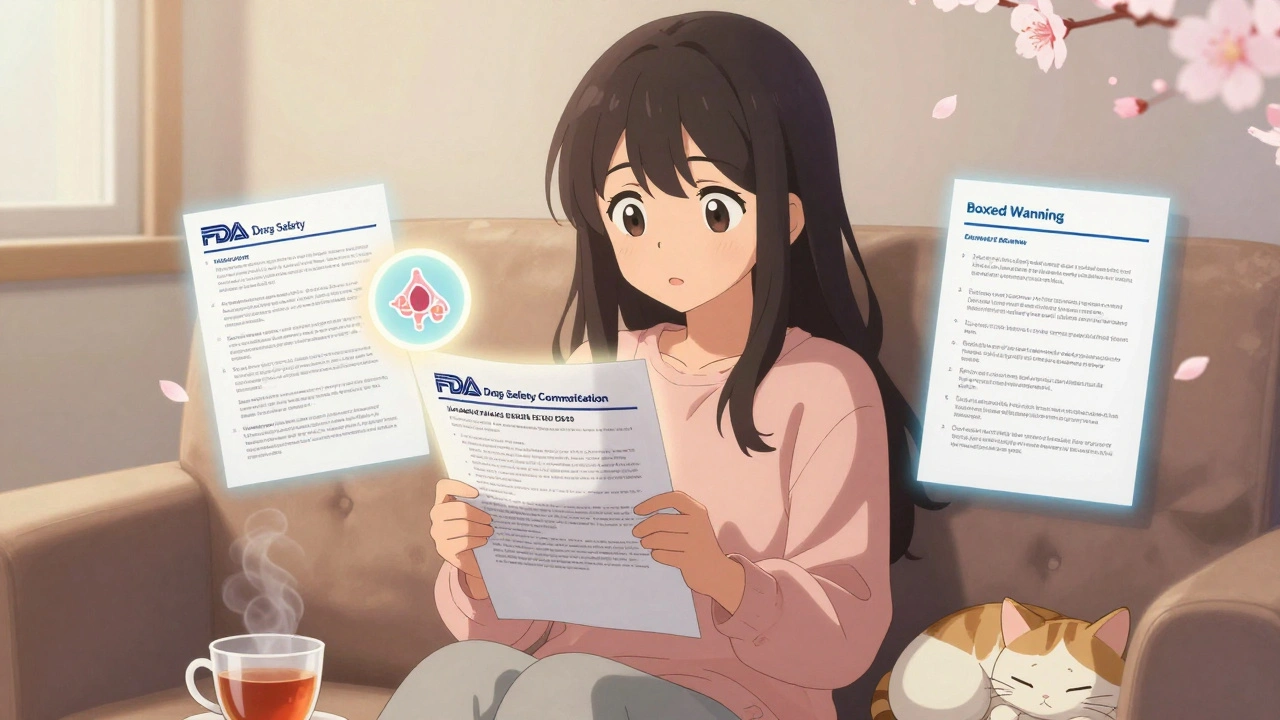
Every year, the U.S. Food and Drug Administration (FDA) issues dozens of safety notices about medications already on the market. These aren’t ads. They aren’t rumors. They’re official updates about real risks-some serious, some subtle-that weren’t fully clear when the drug first came out. If you’re taking a prescription, these communications matter. Not reading them could mean missing a warning that changes how you take your medicine, or even whether you should keep taking it at all.
What Exactly Is an FDA Safety Communication?
An FDA Safety Communication is a public notice that tells patients and doctors about new safety information for a drug after it’s been approved. The FDA doesn’t wait for problems to become epidemics. They monitor reports from doctors, patients, and clinical studies after a drug is out in the real world. When something new shows up-like a rare but dangerous side effect, a dangerous interaction, or a mistake in how the drug should be used-they issue a communication. These aren’t all the same. The FDA breaks them into types:- Drug Safety Communications: The most detailed. These cover major updates like new boxed warnings or changes to dosing.
- Drug Alerts: Shorter, urgent notices. Often about recalls or immediate risks.
- Labeling Changes: Official updates to the prescribing information that doctors use.
- Drug Recalls: When a product is pulled from shelves due to safety or quality issues.
- Compounding Risk Alerts: Warnings about drugs made in special labs that might not meet safety standards.
The Structure: What Each Section Means
FDA Safety Communications follow a clear format. If you skip parts, you might miss the most important details. Here’s how to navigate them.What Safety Concern Is FDA Announcing?
This is the headline. It tells you, in plain language, what the problem is. For example: “FDA warns that certain opioid pain medicines may cause serious breathing problems if used incorrectly.” This section is written for everyone. Read it first. If it doesn’t seem relevant to you, you might be able to stop there.Highlights of Prescribing Information
This is where the FDA pulls out the biggest changes. Look for the Boxed Warning. That’s the FDA’s highest level of warning. It’s bolded, bordered, and appears at the top of the prescribing information. If a communication mentions a Boxed Warning update, that’s a red flag. It means the risk is serious enough that the FDA requires it to be seen before anyone prescribes the drug.Next, look for changes to Dosage and Administration or Warnings and Precautions. These tell you how to use the drug safely. For example, a 2025 update on opioid medications changed the language from “Do not abruptly discontinue” to “Do not rapidly reduce or abruptly discontinue.” That small wording shift matters. It means doctors now need to taper doses more carefully to avoid withdrawal or life-threatening complications.
Section References (e.g., 2.x, 5.x)
These numbers point to exact sections in the full prescribing information. If you’re a patient, you don’t need to dig into these. But if you’re a pharmacist or doctor, they’re critical. They tell you exactly where the label was changed so you can update your records.For Health Care Professionals
This section gives clinical advice. It might say things like: “Consider alternative therapies for patients with kidney impairment.” Or: “Monitor liver enzymes monthly during the first 6 months of treatment.” If you’re not a clinician, you can skip this-but if your doctor mentions a change they read about, this is where they got it.For Patients
This is your section. It’s written in simple language. It tells you what to do. For example, the Copiktra (duvelisib) communication said: “Read the Medication Guide every time you get a refill. Talk to your doctor about the risks and benefits of continuing treatment.” This isn’t fluff. It’s a direct instruction. The FDA requires these messages to be written at an 8th-grade reading level. If it still feels confusing, ask your pharmacist to explain it.How to Spot a Real Risk vs. a Routine Update
Not every safety notice means you need to stop your medicine. The FDA uses specific language to signal urgency.- “STOP using immediately” = Emergency. This usually means a recall or life-threatening reaction.
- “Do not use in patients with…” = New contraindication. You might need a different drug.
- “Consider this information when prescribing” = Important but not urgent. Your doctor may adjust how they monitor you.
- “Updated labeling to reflect…” = Administrative change. The drug hasn’t changed, but the guidance has.
What to Do When You See a Communication About Your Drug
Don’t panic. Don’t stop cold. Do this:- Find the exact drug name. The communication might mention a brand name and a generic name. Make sure yours is listed. Sometimes it’s a whole class of drugs-like “all NSAIDs” or “all SGLT2 inhibitors.”
- Check the “For Patients” section. This tells you exactly what to do. If it says “Talk to your doctor,” that’s your next step.
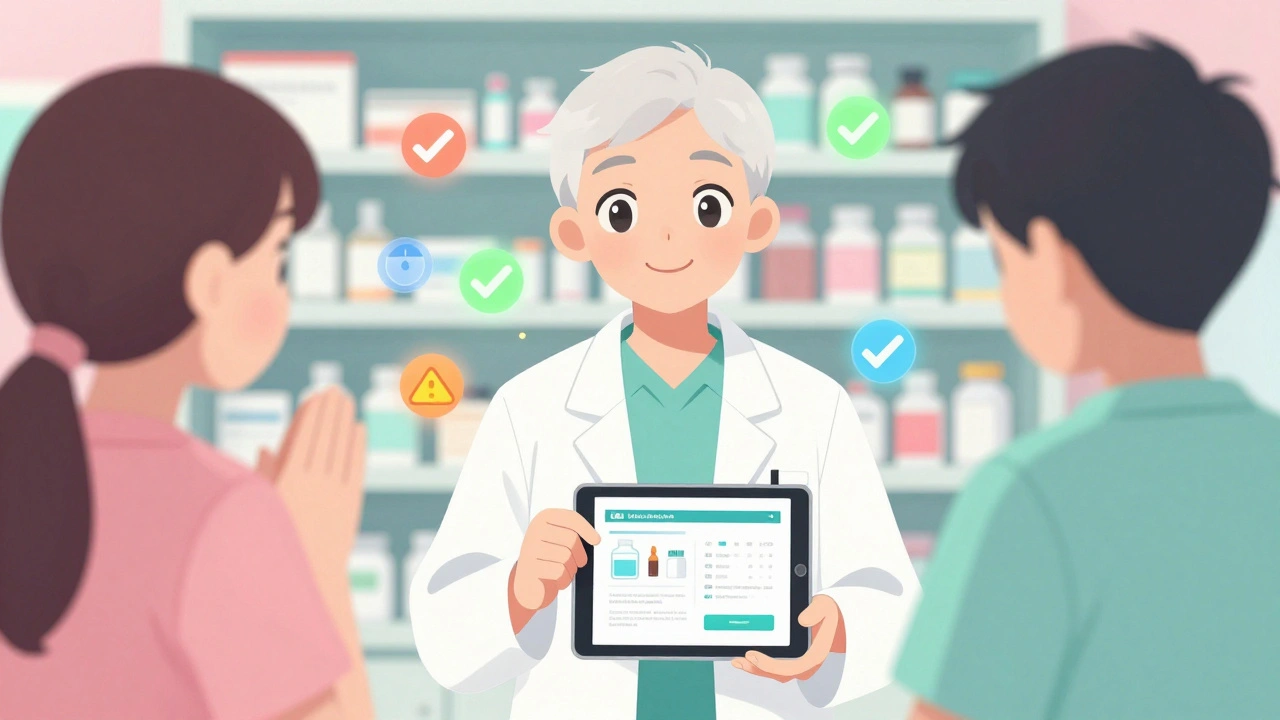
- Call your pharmacist. They get these updates too. They can tell you if your prescription has changed, if your refill will be affected, or if a new Medication Guide is required.
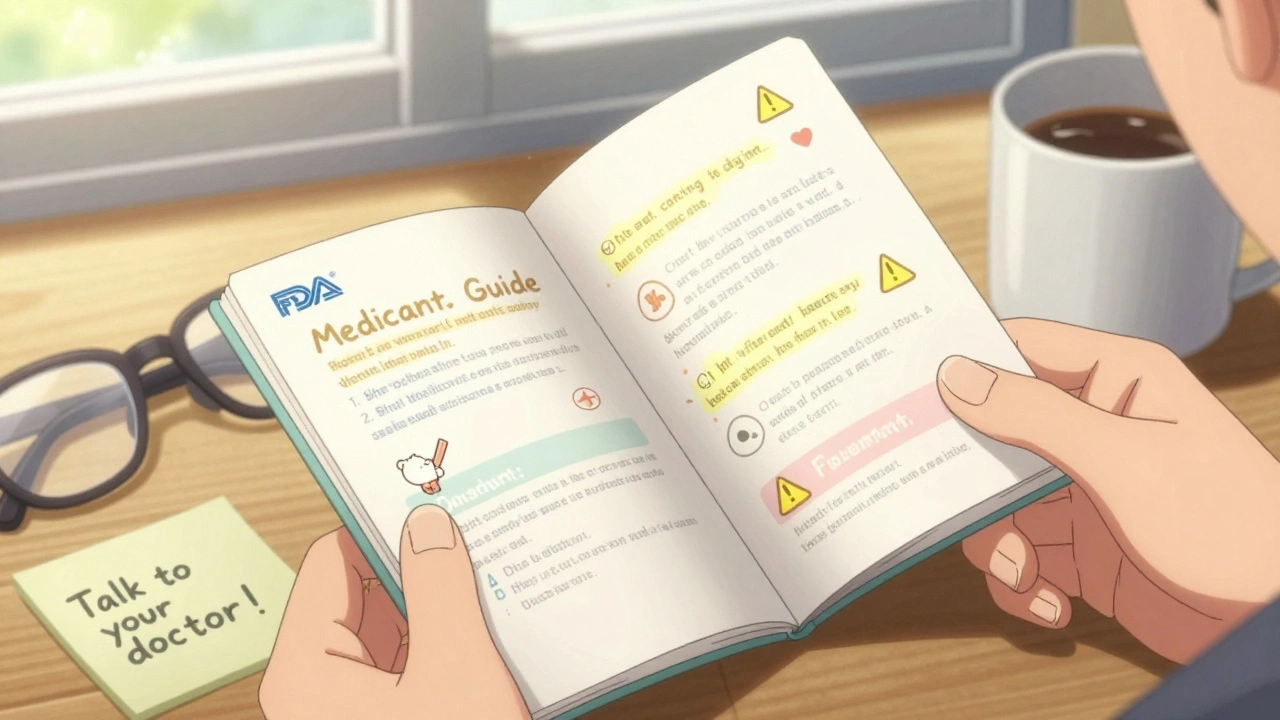
- Read the Medication Guide. Every prescription comes with one. It’s separate from the bottle label. It lists side effects, what the drug is for, how to take it, and what to avoid. The FDA requires it to be clear and easy to understand. Read it every time you get a refill-even if you’ve taken it for years. Things change.
- Don’t ignore it. A 2022 study showed that patients who ignored FDA safety notices were 3 times more likely to experience a preventable adverse event.
How to Stay Updated Without Overwhelming Yourself
You don’t need to check the FDA website every day. Here’s how to make it manageable:- Sign up for email alerts. Go to fda.gov/drugs/drug-safety-and-availability and scroll to the bottom. You can subscribe by drug class-like “antibiotics,” “diabetes meds,” or “pain relievers.” Only get alerts for what you take.
- Ask your doctor to flag important updates. Many doctors now use electronic health records that pull in FDA alerts. Ask if yours does.
- Use the FDA’s “Drug Safety Communications” archive. You can search by drug name or date. If you’re worried about a specific medication, just search it.
- Don’t rely on social media. Reddit, Facebook, or TikTok might share headlines-but they often miss context. Always go to the FDA source.
Why This Matters More Than You Think
Drugs are tested in clinical trials with thousands of people. But real-world use involves millions. Different ages, other medications, chronic conditions, genetic differences-these things show up only after a drug is widely used. That’s why post-market safety monitoring exists. The FDA’s system isn’t perfect. Critics say it takes too long to act. One analysis found that for high-risk drugs, it takes an average of 4.2 years from the first safety report to a major label change. But it’s still the best system we have. And it’s getting better. Since 2023, the FDA has started releasing plain-language summaries of high-impact communications. They’re now available in both English and Spanish. They’re also testing ways to send alerts directly to patient portals by 2025. The bottom line: You’re not just a passive recipient of medicine. You’re part of the safety system. Reading these communications isn’t optional if you want to stay safe.Common Mistakes People Make
- Thinking “It’s just a notice”. Many assume these are warnings for other people. They’re not. If your drug is listed, it applies to you.
- Skipping the Medication Guide. Most people throw it away. But it’s updated with every safety change. Keep it. Re-read it.
- Stopping medication without talking to a doctor. Some changes require tapering. Stopping cold turkey can be dangerous.
- Confusing Drug Alerts with Drug Safety Communications. Alerts are urgent but short. Safety Communications are detailed and long-term. Know the difference.
- Assuming all pharmacies know about changes. Not all pharmacies update their systems in real time. Always confirm with your pharmacist.
What should I do if I see an FDA safety communication about my medication?
Don’t panic. Don’t stop taking it unless the notice says “STOP immediately.” First, read the “For Patients” section. Then, call your pharmacist or doctor. They can tell you if the change affects your prescription, if your dosage needs adjustment, or if you need a new Medication Guide. Most changes require monitoring, not stopping.
Are FDA Safety Communications only for doctors?
No. While they’re written for healthcare professionals, each one includes a “For Patients” section written in plain language. The FDA requires these to be understandable to someone with an 8th-grade reading level. If you’re taking a prescription, you’re the most important person to read this information.
How often does the FDA issue these safety communications?
The FDA issues between 50 and 70 major Drug Safety Communications each year. That’s about one every week or two. They also issue shorter Drug Alerts and labeling changes more frequently. If you’re on a high-risk medication, you might see one every year or two. Signing up for email alerts helps you stay informed without checking constantly.
What’s the difference between a Boxed Warning and a regular warning?
A Boxed Warning is the FDA’s strongest safety alert. It’s placed in a bold, bordered box at the top of the prescribing information. It means the drug carries a risk of serious or life-threatening side effects-like liver failure, heart problems, or death. If your medication has a Boxed Warning update, it’s a major change. You should discuss it with your doctor right away.
Can I trust the FDA’s safety communications?
Yes. The FDA bases these on real data: reports from doctors, patient databases, clinical studies, and post-market surveillance. They don’t issue them for minor issues. While the process can be slow, the information itself is reliable. They’re the most trusted source for drug safety in the U.S. Always go to fda.gov for the official version, not social media or news sites.
The FDA is just another branch of the deep state pushing pharmaceutical propaganda. Every 'safety communication' is a calculated move to scare you into buying more expensive 'updated' meds while they protect Big Pharma's profits. They've been hiding the truth since thalidomide-this is just the same script with new fonts.
And don't get me started on 'plain language summaries.' If they really wanted transparency, they'd release the raw clinical trial data-not curated PR fluff.
They're not protecting you. They're protecting margins.
Read between the lines. Always.
Chris, you're not wrong about the opacity-but your tone undermines the actual point. The FDA's system is flawed, yes, but dismissing it entirely is reckless. I've reviewed 37 safety communications in my pharmacy practice over the last year. Half were trivial. Three were critical. One saved a patient from liver failure because we caught a drug interaction they'd been ignoring for years.
It's not about blind trust. It's about triage. Learn to filter. Ignore the noise. Act on the red flags.
That's the skill here-not paranoia, not obedience. Discrimination.
Ugh. Another 'read the fine print' lecture. Like I don't have enough to worry about. My kid's got asthma, my mom's on blood thinners, and I'm working two jobs. You want me to read FDA jargon like it's a college textbook? Nah. I'll take my chances.
And no, I'm not signing up for emails. I don't trust their servers. They're probably selling my data to Pfizer.
My pharmacist knows what's up. That's enough.
What if the real problem isn't the FDA... but the fact that we've outsourced our health to corporations and then blamed the regulators when things go wrong?
It's not about reading the communications. It's about asking why we're on so many drugs in the first place.
Why are we treating symptoms instead of causes? Why is prevention not incentivized?
The FDA is just the janitor cleaning up the mess after the party.
And we're mad at them for not stopping the party?
That's the real tragedy.
There's a lot here worth unpacking, and I appreciate the structure-it's rare to see such a clear breakdown of FDA communication tiers. I've spent the last six months cross-referencing every safety alert for my anticoagulant, and I can tell you: the labeling changes are almost always more nuanced than they appear.
For example, the recent update to rivaroxaban’s dosing guidance wasn't about increased risk-it was about clarifying that renal clearance varies more than previously modeled in elderly patients with borderline kidney function. The FDA didn't say 'stop taking it.' They said 'monitor creatinine more closely.' That’s the difference between panic and precision.
And yes, the 'For Patients' section is deliberately simple-but that doesn't mean it's incomplete. It's optimized for accessibility, not comprehensiveness. The full details are in the prescribing info, which your doctor should have access to.
Also, the 2022 study showing 3x higher adverse events among non-readers? That’s from JAMA Internal Medicine, 2022, volume 182, issue 7. I can send you the link if you want. It’s peer-reviewed, not some blog post.
Bottom line: ignorance isn’t bravery. It’s just statistically dangerous.
USA always act like they know everything... but their FDA is just a puppet of big pharma. In India we have AYUSH and Ayurveda-real medicine from ancient texts. No corporate labs. No hidden side effects. Just nature. Why do you trust a government that lets drugs with black box warnings stay on shelves for years? We don't need your system. We have wisdom. You have lawsuits.
And why you always write in English? Your own people don't even read it. Hypocrites.
I’ve been on the same medication for 12 years. I read every FDA update. I keep the Medication Guides in a folder. I’ve never had a problem. But I also know people who panic every time they see ‘potential risk’ and stop cold turkey. The real takeaway isn’t fear-it’s awareness. Knowledge doesn’t have to be scary. It can be empowering.
It’s like checking your car’s recall list. You don’t throw the car out. You fix it.
And yes, the language is simple on purpose. If it were all medical jargon, half the population would tune out. That’s not dumbing down. That’s inclusion.
They're lying. Every. Single. Time.
They say 'rare side effect'-but they know it's happening to thousands. They say 'monitor'-but they don't fund the monitoring. They say 'talk to your doctor'-but your doctor gets paid by the same company that makes the drug.
They don't want you to understand. They want you to feel guilty for not reading.
And the email alerts? That's a trap. You sign up, they track you, they sell your data, then they use it to target you with ads for 'safer alternatives'-that are just rebranded versions of the same poison.
Don't be fooled. The system is rigged. And you're the mark.
Oh wow. The FDA? The same agency that let OxyContin ride for 20 years while people dropped like flies? The same ones who approved Vioxx and then quietly buried the data? You’re asking me to trust these people? HA!
And now they’re handing out ‘plain-language summaries’ like candy? Like that’s supposed to make up for decades of negligence?
Let me tell you something-real safety doesn’t come from a government website. It comes from knowing your body. From asking questions. From refusing to be passive.
And if you’re still taking anything prescribed without researching the active ingredient’s history? You’re not informed. You’re just lucky.
Wake up. The wolves are still in the henhouse.
Who even cares? This is just another liberal guilt-trip. You want people to read 20-page PDFs so they feel responsible for their own health? Newsflash: most Americans are too busy surviving to care.
And if your drug has a boxed warning? Good. That means it’s powerful. If you can’t handle that, don’t take it.
Stop treating patients like children. They’re adults. Let them decide.
Also-why is the FDA even involved? Shouldn’t this be up to doctors? Or insurance companies? Or... I dunno, the patient?
It’s not your job to babysit people with PDFs.
I’m from Mexico, and I’ve been taking my blood pressure med for 8 years. My sister in Guadalajara gets the same one. We both read the guides. We both call our pharmacists. We don’t need a fancy website to know when something’s off.
But I love that the FDA is finally making this easier to understand. Even if you’re not a doctor, you can still be your own best advocate.
It’s not about fear. It’s about respect-for your body, your time, your life.
Thank you for writing this. I’m sharing it with my family.
What if the real issue isn't the FDA, but the fact that we've turned healthcare into a transaction instead of a relationship?
When you're treated like a data point, not a person, of course you're going to ignore the notices.
Because if your doctor doesn't even talk to you about your meds, why would you read the fine print?
It's not about literacy. It's about loneliness.
And maybe the FDA can't fix that.
But maybe we can start by asking our doctors one simple question: 'Why this drug? And what else could work?'
As a healthcare professional from India, I can confirm that the FDA’s system, while imperfect, remains the most transparent and evidence-based model in the world.
Many developing countries lack even basic pharmacovigilance systems. We rely on FDA alerts to guide our local prescribing practices.
Yes, there are delays. Yes, bureaucracy exists. But the structure is designed to prevent harm-not to control you.
Reading these communications is not obedience. It is responsibility.
And for patients who feel overwhelmed: start small. One drug. One alert. One conversation with your pharmacist.
Progress, not perfection.
You are not alone in this. Many of us are walking the same path.