
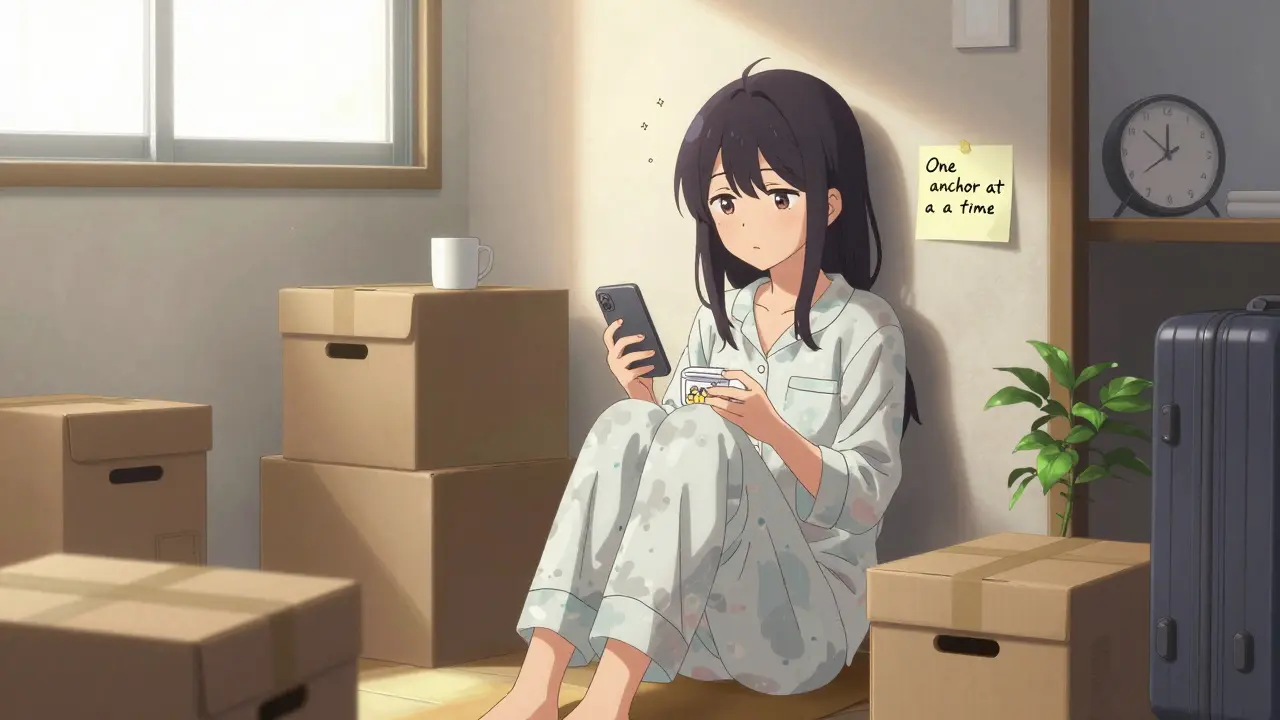
When your life changes - whether you’re moving to a new city, starting a new job, going through a breakup, or dealing with a family crisis - your medication routine often falls apart. Not because you don’t care, but because your brain is overloaded. Stress rewires your habits. New environments erase your cues. And when you’re exhausted, taking a pill at 7 a.m. becomes a luxury you can’t afford. The truth? Medication adherence drops by an average of 32% during major life transitions. And in the first two weeks, it can crash as much as 40%. This isn’t laziness. It’s biology. It’s psychology. And it’s fixable.
Why Your Medication Routine Crashes During Transitions
Most people think adherence is about remembering to take pills. It’s not. It’s about maintaining control when everything else is falling apart. Research from the Journal of Personality and Social Psychology shows that during transitions, people lose their sense of agency. When you’re overwhelmed, your brain defaults to survival mode. Taking a pill? That’s not urgent. Paying rent? That is. A 2023 analysis of over 1,200 Reddit posts from people with chronic conditions found that 78% stopped or skipped medications during life changes. The top triggers? Relocation (63%), job shifts (58%), and relationship breakdowns (49%). These aren’t random. They’re predictable. And they’re preventable. The problem isn’t just forgetting. It’s that your entire system collapses. Your pharmacy changes. Your doctor’s office is far away. Your pill organizer gets packed in a box and forgotten. Your sleep schedule vanishes. Your stress hormones spike, and your body forgets how to prioritize health.Three Lists That Keep You on Track
One of the most powerful tools isn’t an app or a reminder. It’s a simple exercise: make three lists.- Things you can control directly - These are actions you can do today. Like setting a phone alarm, filling your pillbox, or calling your pharmacy to transfer your script.
- Things you can influence - These are situations you can shape, but not fully control. Like asking your employer for flexible hours, or telling a friend you need help carrying groceries.
- Things outside your control - These are the things that happened. A layoff. A breakup. A move you didn’t choose. These drain energy. And they’re the ones you need to stop fighting.
Anchor Routines: The 3-5 Things That Keep You Grounded
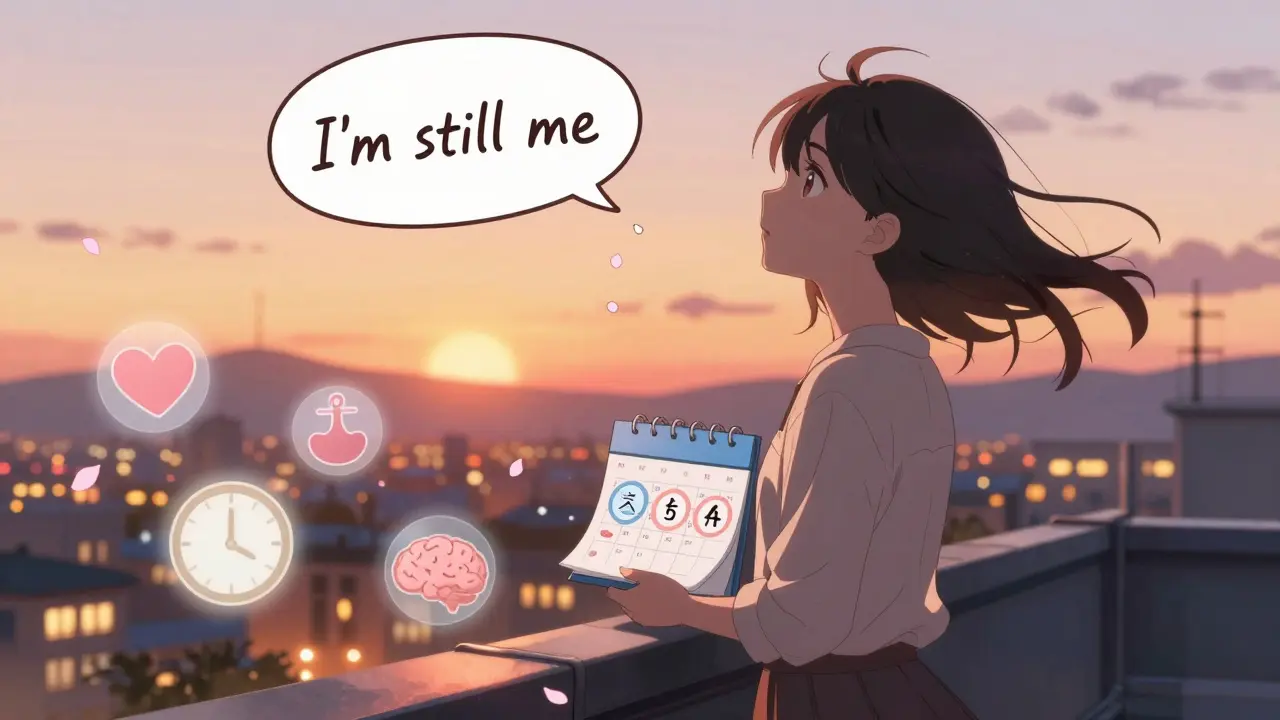
During transitions, your routine doesn’t need to be perfect. It needs to be anchored. Research from the Journal of Personality and Social Psychology shows that keeping just 3 to 5 daily anchor activities reduces psychological distress by 23% and boosts medication adherence by 31.4%. These aren’t chores. They’re rituals that remind your body: I’m still me. Here’s how to build them:- Choose one morning anchor - like drinking water right after you wake up, or brushing your teeth before checking your phone.
- Choose one evening anchor - like laying out your pills before bed, or writing down one thing you’re proud of.
- Add one movement anchor - a 5-minute walk, stretching, or even dancing to one song.
- Keep one connection anchor - a daily text to someone you trust.
- And one calm anchor - 2 minutes of breathing, or sitting quietly with no screens.
Forget Reminder Apps - Try Flexible Time-Blocking
Most people turn to medication reminder apps. They work - until your life changes. A 2023 study in the Journal of Medical Internet Research found that during major transitions, app-based reminders only improved adherence by 8.3%. That’s barely better than doing nothing. Why? Because apps assume your schedule is stable. It’s not. Instead, use time-blocking - but make it flexible. Don’t say: “I take my pill at 8 a.m.” Say: “I take my pill within 2 hours of waking up.” Or: “I take it after breakfast, no matter what time breakfast is.” A 2022 study from the Greater Boston Behavioral Health Institute found that flexible time-blocking increased adherence by 28.6% during transitions. Why? Because it gives you room to adapt. If you’re working a night shift? Take it at 7 p.m. If you’re in a hotel? Take it after you brush your teeth. The goal isn’t consistency of time - it’s consistency of behavior.
Get Professional Support - Not Just Pills
The most effective strategy isn’t a tool. It’s a conversation. Acceptance and Commitment Therapy (ACT) - a form of cognitive behavioral therapy - improved medication adherence by 48.6% during transitions in a 2022 JAMA Internal Medicine trial. That’s nearly double the effect of standard counseling. ACT doesn’t try to “fix” your stress. It teaches you to carry it. To accept that life is messy. And to still choose your health, even when it’s hard. Ask your doctor: “Can we make a transition plan?” Most don’t offer it. But if you bring it up, they’ll help. The American College of Physicians now recommends screening for upcoming life changes during every chronic disease visit. You’re not being difficult. You’re being smart.Build Your Support Team - Even If It’s Just One Person
Social support isn’t fluffy. It’s biological. A 2022 study in Health Psychology found that people who felt supported had 41.7% lower cortisol levels during transitions - and 34.2% better adherence. That’s not coincidence. Support lowers stress. Lower stress means clearer thinking. Clearer thinking means you take your pill. You don’t need a big circle. Just one person. Someone who:- Knows your meds
- Asks: “How’s your routine going?”
- Doesn’t judge if you miss a dose
- Helps you reset
Break It Down - One Step at a Time
Big transitions feel overwhelming because you’re trying to fix everything at once. You’re not. You’re just trying to survive. Break your adherence plan into micro-tasks:- Week 1: Find a new pharmacy or set up mail-order.
- Week 2: Set up one phone alarm.
- Week 3: Tell one person about your meds.
- Week 4: Pick one anchor ritual.
Learn to Say No - Protect Your Health Like a Priority
People who stick to their meds during transitions are 3.2 times more likely to say “no” to non-essential demands. That’s not selfish. It’s survival. If your boss wants you to work late? Say: “I can’t. I have a medical appointment.” If your friend invites you out? Say: “I’m keeping a quiet week. Maybe next time?” If your family pressures you to “just get over it”? Say: “I’m doing what I need to stay healthy. I appreciate your concern.” Your health isn’t optional. It’s the foundation. And you have the right to protect it.What to Do If You’ve Already Stopped
If you’ve missed doses - even for weeks - don’t panic. Don’t shame yourself. Just restart. Step 1: Call your doctor. Tell them exactly what happened. No excuses. Just facts. Step 2: Ask: “Can we adjust the dose or timing?” Sometimes, a simpler schedule works better. Step 3: Use a pillbox with days labeled. Even if you don’t fill it perfectly, it gives you a visual cue. Step 4: Rebuild one anchor. One small ritual. One daily habit. Then add another. You’re not behind. You’re resetting. And that’s okay.What’s Working Now - And What’s Coming
The healthcare system is starting to catch up. In 2024, the American Medical Association rolled out a formal Transition Adherence Protocol. 41 of the 50 largest U.S. health systems now track life changes during appointments. And AI tools like LifeStance Health’s “TransitionRisk” algorithm can predict when someone is likely to stop their meds - 30 days before it happens. But the real breakthrough isn’t tech. It’s awareness. It’s asking: “How’s your routine holding up?” instead of assuming everything’s fine. You don’t need a perfect plan. You need a plan that works when you’re tired, scared, or overwhelmed. And that plan? It starts with one small, honest step.Why do I keep forgetting my meds during stressful times?
Stress doesn’t just make you tired - it changes how your brain prioritizes tasks. When you’re overwhelmed, your brain shifts focus to immediate survival: paying bills, finding housing, managing emotions. Medication becomes a low-priority task, even if it’s critical. This isn’t laziness. It’s a natural response to overload. The solution isn’t to try harder - it’s to simplify your routine and reduce decision fatigue.
Are medication reminder apps helpful during transitions?
Apps help during stable times, improving adherence by 22.8%. But during major life changes - like moving or divorce - their effectiveness drops to just 8.3%. Why? Because apps assume your schedule stays the same. When your routine shatters, rigid reminders fail. Flexible time-blocking - like taking your pill within 2 hours of a daily anchor (e.g., after breakfast) - works better because it adapts to chaos.
Should I talk to my doctor about upcoming life changes?
Yes - and you should do it before the change happens. The American College of Physicians now recommends that doctors screen for upcoming transitions during routine visits. If you’re moving, starting a new job, or going through a breakup, tell your provider. They can adjust your schedule, simplify your regimen, or connect you with resources. This isn’t a sign of weakness - it’s smart self-care.
What if I miss doses for weeks? Can I just start again?
Yes - but don’t restart alone. Call your doctor first. Some medications require a gradual restart. Others may need a dose adjustment. Never double up on pills to make up for missed doses. Instead, focus on rebuilding one small habit at a time: set one alarm, use a pillbox, or tell one person you’re trying to get back on track. Progress, not perfection, is the goal.
How can I get support if I don’t have family nearby?
You don’t need family. You need one reliable person. It could be a friend, a coworker, a pharmacist, or even a peer support group online. Join a community like r/ChronicIllness on Reddit - 78% of users there have struggled with adherence during transitions. Share your story. Ask for help. Many will respond. Even one person who checks in once a week can make a measurable difference in your adherence.
Man, this hit different. I moved three times last year and forgot my meds for like two weeks straight. Not because I didn’t care - I just stopped thinking of it as something that mattered when my whole life was in boxes. The three-list thing? I started doing that. Took me three days to write it out. But once I did, I felt like I could breathe again. Anchor routines saved me. Even just brushing my teeth before I check my phone? That’s my anchor now. Small, dumb, but it’s mine.
And yeah - I didn’t need an app. I needed to stop trying to control everything.
Thanks for writing this.
okay so i just read this while sitting on my bathroom floor at 2am because i missed my last dose and honestly?? i cried a little. not because i’m weak but because this is the first time someone put into words what it feels like when your brain just shuts down and you forget your whole identity is tied to a little pill you’re supposed to take every morning. i’ve been doing the 3 anchors thing since last week - water first thing, lay out my pills before i sleep, and one text to my sister. she doesn’t even reply most times but knowing she’s there? that’s enough. i’m not fixed. but i’m not broken either. just tired. and that’s okay. thanks for this. really.
p.s. i spelled ‘pill’ wrong three times. i’m tired. forgive me.
App-based reminders are garbage during transitions - period. I’ve tried 7 different ones. All failed when I started night shifts. The real hack? Tie it to a behavior you already do. Brush your teeth? Take your pill after. Eat breakfast? Take it with it. No app needed. No guilt. No shame. Just habit stacking. And if you miss it? So what. Do it next time. You’re not a machine. You’re a human with a nervous system that’s been through hell. Stop punishing yourself for being alive.
Also - ACT therapy is the real MVP. Stop trying to ‘fix’ your stress. Learn to carry it. Like a backpack. Heavy? Yes. But you’re still walking.
And if your doctor doesn’t get it? Find a new one. Your health isn’t a suggestion.
While the intentions behind this article are commendable, one must question the underlying epistemological framework that reduces complex physiological adherence to mere behavioral heuristics. The conflation of psychological coping mechanisms with clinical outcomes risks pathologizing normal human responses to environmental perturbations. Furthermore, the reliance on anecdotal Reddit data as empirical evidence is methodologically unsound. One cannot extrapolate therapeutic efficacy from self-reported narratives devoid of controlled variables. The notion that ‘one person’ can substitute for systemic medical support is not only naive, but potentially dangerous. Adherence is not a matter of willpower - it is a function of access, equity, and structural healthcare design. Until we address these, we are merely polishing the coffin.
There’s a quiet dignity in showing up for yourself when the world is falling apart. I’ve been on chronic medication for 12 years. I’ve missed doses during breakups, layoffs, funerals, and moves. I’ve also been the person who called my pharmacist at midnight because I was in a hotel with no pillbox and I needed to know if I could take it with coffee. You’re not lazy. You’re not failing. You’re adapting. And the fact that you’re still here, still trying - that’s courage. I don’t say this to everyone. But I’m saying it to you. You’re doing better than you think.
And yes - the three lists? I made mine on a napkin during a layoff. Still have it taped to my mirror. I don’t need to read it anymore. I just need to know it’s there.
There’s an interesting tension here between individual agency and systemic neglect. The article rightly emphasizes behavioral micro-adjustments - anchors, time-blocking, lists - but these are all coping mechanisms designed for individuals operating within a broken system. What happens when you lack transportation to a new pharmacy? When your insurance doesn’t cover mail-order? When your employer offers no flexibility? The psychological tools are brilliant, but they assume a baseline of privilege: stable housing, digital access, disposable income, and a supportive social network. For many, these are luxuries. The real breakthrough isn’t in teaching people to take pills - it’s in demanding healthcare systems that anticipate, accommodate, and adapt to life’s inevitable chaos. We can’t optimize the individual if the environment is hostile. We must redesign the environment.
USA is the only country where you need a whole 2000-word essay to tell someone to take their damn pill 🤦♂️
My grandma took her meds every day for 40 years. No lists. No anchors. No therapy. Just didn’t forget. Maybe you’re overcomplicating it. Maybe you just need to get your ass in gear. Stop making it a mental health crisis. It’s a pill. Take it. Then go do the rest of your life.
Also - I’m tired of people treating meds like magic. They’re not. They’re chemicals. You take them. You live. You don’t? You die. Simple. No trauma. No journaling. Just responsibility.
PS: I’m not mad. I’m just saying. 🇺🇸
WAIT. WAIT. WAIT. Did you know that the CDC and WHO are secretly using AI to track medication adherence and then send targeted ads for antidepressants? And that the ‘transition protocol’ is just a front for Big Pharma to get more people on lifelong meds? I found a whistleblower on Telegram. He said they’re using your phone’s location data, your smart fridge, and your Fitbit to predict when you’re vulnerable - then they trigger your doctor to ‘recommend’ a new dosage. They want you dependent. They want you scared. That’s why they’re pushing these ‘anchors’ - it’s not to help you, it’s to normalize surveillance. The real solution? Stop taking pills. Go raw. Go alkaline. Go off-grid. And if you see a pillbox? Burn it. 🔥
They’re watching. They always are. 🕵️♂️👁️👁️