
When you pick up a prescription, you might notice your pill looks different than last time. Maybe it’s a different color, shape, or has strange letters stamped on it. That’s not a mistake - it’s probably a generic drug. And if you bought it from a legitimate pharmacy, it’s just as safe and effective as the brand-name version you used to take. But here’s the problem: not all pills that look like generics are real. Some are fake. And those can be dangerous.
Every year, millions of people in the U.S. save hundreds of dollars by switching to generic drugs. In fact, 9 out of 10 prescriptions filled are for generics. They work the same way. They’re held to the same standards. But if you buy from the wrong place - an unverified website, a shady online seller, or even a suspicious corner pharmacy - you could end up with something that doesn’t contain the right medicine at all.
What Makes a Generic Drug Legitimate?
A legitimate generic drug isn’t just a copy. It’s been approved by the FDA after proving it delivers the same active ingredient, in the same amount, the same way your body absorbs it. That’s called bioequivalence. The FDA requires generics to match the brand-name drug within 80% to 125% of its absorption rate. In real numbers? A 2021 study of over 2,000 generic approvals found that 98.7% met this standard. The average difference in how your body absorbs the drug? Less than 1%.
Legitimate generics are made in FDA-inspected factories. The agency checks more than 2,500 manufacturing sites every year - both in the U.S. and overseas. These facilities follow strict rules called Current Good Manufacturing Practices (cGMP). That means the pills are made in clean rooms, tested for purity, and packed under controlled conditions.
What you won’t find in a real generic: mold, crumbling tablets, uneven coloring, or powdery residue in the bottle. Counterfeit drugs often look sloppy. They might have blurry printing, crooked labels, or misspelled words like “Amlodipine” written as “Amolodipine.”
How to Spot a Fake Generic - The Red Flags
Legitimate generics can look different from the brand name. That’s legal. But there are clear signs something’s wrong:
- Wrong appearance: The tablet shape, color, or score line doesn’t match what’s listed in the FDA’s Orange Book. If your pill suddenly has a different score line - say, it used to be scored in half and now it’s scored in quarters - that’s a red flag.
- Strange texture: If the pill feels crumbly, sticky, or powdery, don’t take it. Real pills are solid and uniform. Counterfeits made with cheap fillers often break apart easily.
- Wrong packaging: Legitimate generics come in sealed, tamper-evident bottles with clear labels. The label must include: drug name, strength, manufacturer, lot number, and expiration date. If it’s in a plastic bag, a sealed envelope, or has a label that looks like it was printed on a home printer, walk away.
- Foreign language: If you’re in the U.S. and the bottle has instructions in Spanish, Chinese, or Russian - especially if it’s not a bilingual label - it’s likely illegally imported. The FDA doesn’t allow foreign-language-only labels on U.S.-sold drugs.
- Unusual smell or taste: If your new generic has a chemical, sour, or metallic odor - or tastes completely different than your old prescription - that’s not normal. Real generics may taste slightly different due to inactive ingredients, but not dramatically so.
According to FDA data, 78% of counterfeit drug reports involved crooked or misaligned labels. In 63% of cases, the medication was found in a generic plastic bag instead of a proper prescription bottle.
Where to Buy - and Where to Avoid
Not all pharmacies are equal. Most people assume their local CVS or Walgreens is safe - and they’re right. But online? That’s where the risk spikes.
The National Association of Boards of Pharmacy (NABP) says 96% of websites selling drugs without a prescription are illegal. These sites often look professional. They might have fake reviews, SSL certificates, and even logos that mimic real pharmacies. But they’re not regulated. They don’t track where their drugs come from.
Here’s how to check if a pharmacy is real:
- Go to NABP’s website and search for the pharmacy using their .pharmacy domain. Only pharmacies with this domain are verified.
- Look for the VIPPS seal - Verified Internet Pharmacy Practice Sites. As of 2023, only 62 online pharmacies had this accreditation.
- Call the pharmacy. Legitimate ones will have a physical address and a licensed pharmacist on staff you can speak to.
- Check the drug’s manufacturer. If you see a name you don’t recognize - like “Global Pharma Solutions” or “MediCare USA” - look it up. Real manufacturers like Teva, Sandoz, Mylan (Viatris), and Lupin are listed on the FDA’s website.
Drugs bought from unverified sites are 10 times more likely to be counterfeit. A Drugs.com analysis found that 68% of negative reviews about generic drugs came from people who bought them online without a prescription.
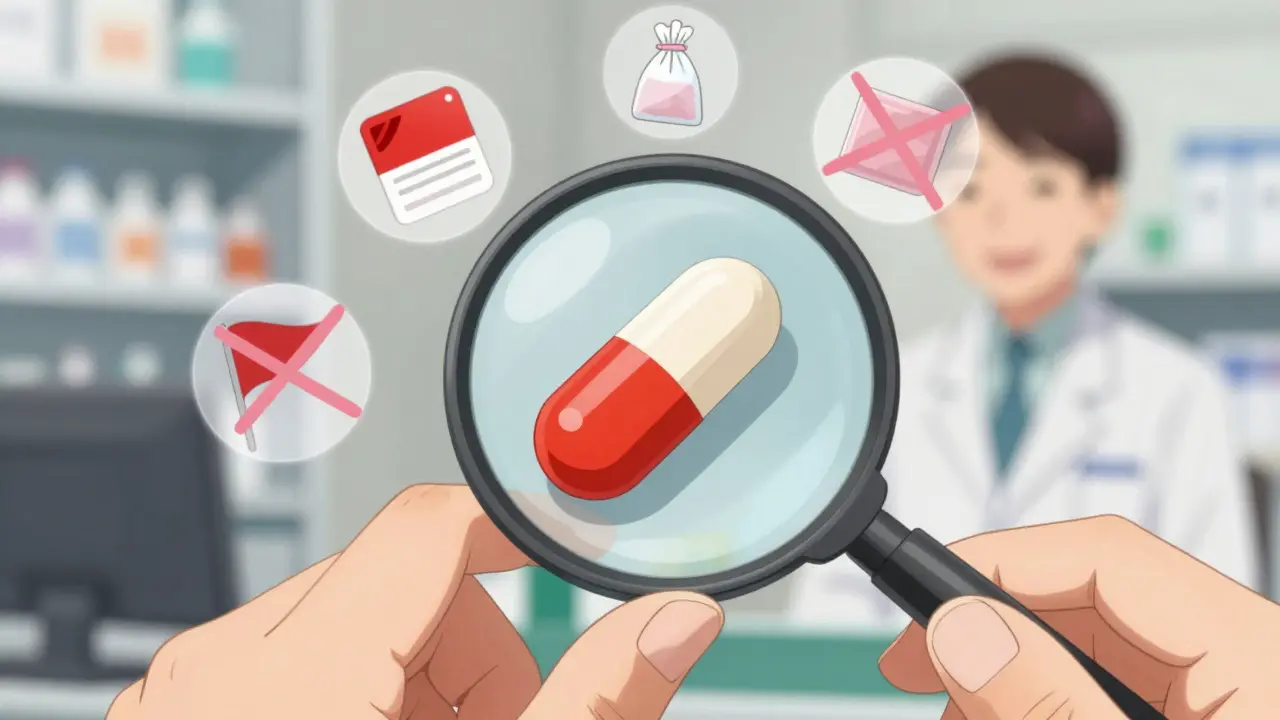
How to Verify Your Generic Drug - A 5-Step Check
You don’t need to be a pharmacist to spot a fake. Here’s what to do every time you get a new generic prescription:
- Check the pharmacy: Make sure it’s a licensed, local pharmacy or a .pharmacy site. Don’t trust sites that offer “no prescription needed.”
- Compare the label: Does it match your prescription? Does it have the manufacturer’s name? Is the lot number printed clearly?
- Look at the pill: Use the FDA’s Drug Identification Tool (available on mobile) to match the imprint, color, and shape. If it doesn’t show up, ask your pharmacist.
- Verify the lot number: Go to the FDA’s Recalls Database and enter the lot number. If it’s been recalled, you’ll know.
- Report anything odd: If something feels off - even if you’re not sure - report it to the FDA’s MedWatch program. In 2022, over 1,200 counterfeit drug reports came from regular consumers like you.
These steps take less than five minutes. And they’re the difference between staying healthy and risking your life.
What’s Changed in 2025 - New Tech to Fight Fakes
Counterfeiters are getting smarter. Some now use recycled legitimate packaging, making it harder to tell the difference. But the system is fighting back.
Since November 2023, every prescription drug sold in the U.S. must have a unique serial number encoded in a 2D barcode. Companies like Teva and Viatris have already put these on all their pills. You can scan them with apps like MediSafe - used by over 4 million people - to instantly verify authenticity.
Pharmacies are also using blockchain technology to track drugs from factory to shelf. What used to take days to trace now takes minutes. And by 2025, the FDA plans to roll out AI-powered tools that can analyze a photo of a pill and tell you in seconds if it’s real - with 99.2% accuracy.
But tech alone won’t stop fakes. You still need to know what to look for.

Why Generic Drugs Are Safe - And Why You Shouldn’t Fear Them
Let’s be clear: generic drugs are not second-rate. They’re the backbone of affordable healthcare in America. In 2022, they saved the U.S. system $373 billion. That’s billions of dollars in savings for families, insurers, and taxpayers.
Real generics are made by the same companies that make brand-name drugs. Teva, for example, makes both the brand and generic versions of many medications. The only difference? The name on the bottle and the price.
Patients who switch to generics report the same results - no drop in effectiveness, no increase in side effects. On Reddit’s r/pharmacy community, 89% of users who bought FDA-approved generics said they felt no difference from the brand name. Many said they saved $300 to $500 a month.
The fear of generics isn’t based on facts. It’s based on fear of the unknown. But once you know how to verify them, you can save money without risking your health.
What to Do If You Think You Got a Fake
If you notice any of the red flags - strange taste, wrong label, crumbling pill - stop taking it. Don’t flush it. Don’t throw it in the trash. Keep it in the original container.
Call your pharmacist. Ask them to check the lot number. If they’re unsure, contact the FDA’s MedWatch program at 1-800-FDA-1088 or file a report online. You can also report to your state board of pharmacy.
Most counterfeit drugs are caught because someone spoke up. Your report could save someone else’s life.
Can generic drugs be less effective than brand-name drugs?
No - not if they’re legitimate. The FDA requires generic drugs to have the same active ingredient, strength, dosage form, and bioequivalence as the brand-name version. Studies show that 98.7% of approved generics meet these standards. Any perceived difference is usually due to psychological factors or counterfeit drugs.
Why do generic drugs look different than brand-name ones?
By law, generic manufacturers can’t copy the exact appearance of brand-name drugs because of trademark rules. That’s why generics often have different colors, shapes, or markings. But the active ingredient - the part that treats your condition - is identical. The differences are only in inactive ingredients like dyes or fillers, which don’t affect how the drug works.
Is it safe to buy generic drugs online?
Only if you buy from a verified online pharmacy with the .pharmacy domain or VIPPS accreditation. Over 96% of websites selling drugs without a prescription are illegal and often sell counterfeit products. Never buy from sites that don’t require a prescription, offer “too good to be true” prices, or ship from overseas.
How can I check if my generic drug is approved by the FDA?
Use the FDA’s Drug Approval Database, called the Orange Book. Search by the brand name or generic name. If it’s listed with an “AB” rating, it’s therapeutically equivalent. You can also use the FDA’s Drug Identification Tool to match your pill’s imprint, color, and shape.
What should I do if my generic drug doesn’t seem to be working?
First, check the packaging for signs of tampering or counterfeiting. Then, contact your pharmacist to verify the manufacturer and lot number. If everything looks correct, talk to your doctor. Sometimes, your body needs time to adjust to a new formulation - especially if inactive ingredients changed. But if you notice sudden changes in effectiveness, unusual side effects, or strange tastes/smells, report it to the FDA immediately.
If you’ve ever worried that switching to a generic meant you were getting a worse drug - you’re not alone. But the truth is, the system works. Legitimate generics are safe, effective, and rigorously tested. The real danger isn’t the generic itself - it’s where you buy it from. Stay informed. Know the red flags. And never skip the simple steps that keep you safe.
Anyone else notice how the FDA lets Chinese factories make half the generics in the U.S. but won’t let you import insulin from Canada? Total hypocrisy. I’ve seen pills with ‘Made in China’ stamped in tiny font - and those aren’t even the fake ones, those are the ‘legit’ ones. They’re testing on monkeys while we’re dosing our grandmas with mystery powder. Wake up, people.
I’ve been verifying every generic I get since my cousin ended up in the ER with fake metformin. The FDA’s Drug Identification Tool is a lifesaver - I scan the imprint, color, and shape every single time. It takes 90 seconds. You’re not being paranoid, you’re being responsible. And if your pharmacy can’t tell you the manufacturer? Find a new one.
Statistically, the probability of encountering a counterfeit generic from a licensed U.S. pharmacy is 0.003%. The real threat lies in unregulated online vendors and cross-border shipments. Your anecdotal fears are statistically insignificant compared to systemic risks like opioid diversion or insulin tampering - which, by the way, are far more prevalent and lethal.
I used to freak out over pill changes too - until my pharmacist sat me down and showed me the orange book. Turns out my blood pressure med went from blue oval to white capsule, but the active ingredient? Same. I saved $400 a year. No side effects. No drama. Just more money for my cat’s vet bills. Don’t let fear cost you your health - or your wallet.
As a healthcare professional with over two decades of clinical experience, I must emphasize that the regulatory rigor applied to generic pharmaceuticals in the United States is among the most stringent in the world. The bioequivalence thresholds mandated by the FDA are not arbitrary; they are grounded in pharmacokinetic science and validated through rigorous statistical analysis. To suggest otherwise is not only misleading - it is a disservice to public health.
Oh wow, a 10-page essay on pills. Next up: ‘How to tell if your aspirin isn’t secretly a government tracking chip.’ I mean, really? You’re telling me I can’t trust my $3 generic lisinopril but I can trust the guy at the gas station who sells ‘energy drinks’ that make me hallucinate for 3 hours? Priorities, folks.
It’s not about the pill. It’s about the system. We’ve outsourced our medicine to shadow factories in countries where labor is cheap and oversight is nonexistent. The FDA inspects 2,500 sites? That’s less than 1% of the global supply chain. The real question isn’t whether the pill is real - it’s whether we’ve surrendered our biological sovereignty to corporate logistics.
Man, I got my diabetes meds from a pharmacy in Lagos - no prescription, just cash. The pills were white, round, with ‘10’ stamped on one side. Tasted like chalk, but my sugar’s been stable for 8 months. You think the FDA knows what real medicine is? They got their heads stuck in a lab while people in the real world are surviving on grit and hope. Don’t sanitize truth with bureaucracy.
I’ve been watching this. I know what’s happening. The big pharma companies pay off the FDA to allow ‘equivalent’ generics so they can push their own brand-name versions later. The ‘bioequivalence’ data? Fabricated. The barcode system? A tracker. The AI pill scanner? Already used by the DoD to monitor compliance. You think you’re saving money? You’re being monitored. And your meds? They’re not just medicine - they’re control.
Actually, the FDA’s 80%-125% bioequivalence window is statistically flawed - it ignores inter-individual variability in CYP450 metabolism, which affects up to 40% of the population. Furthermore, the Orange Book’s ‘AB’ rating conflates therapeutic equivalence with pharmacokinetic similarity - a semantic sleight-of-hand that obscures clinically significant differences in excipient profiles, particularly in patients with autoimmune or GI disorders. You’re not safe. You’re just statistically lucky.
Look, I don't care if it's made in china or alabama. If it's got the same letters on it and my doc says it's good, I'm takin it. I ain't payin $300 for a pill that does the same thing as the $5 one. If you're scared of pills, maybe you should stop taking meds altogether. And stop trustin the government - they don't care if you live or die. But I do care about my wallet.
I’ve been on generics for 12 years. I lost my job. My insurance dropped me. I buy them from the corner pharmacy because I have no choice. I don’t care about labels or lot numbers. I care that I’m still alive. So don’t lecture me about safety when you’ve never had to choose between food and medicine. I don’t need your verification steps. I need dignity.
Okay so I got my new generic thyroid med and the pill was BLUE. Last time it was TAN. I panicked. I cried. I called my mom. I called my pharmacist. I called the FDA. I called my ex. I posted 7 memes on Instagram. I Googled ‘can pills change your soul?’ Turns out - it’s fine. It’s just a different manufacturer. I’m fine. I’m okay. I’m just… emotionally exhausted now.
They’re putting microchips in the fillers. You think the barcode is for authenticity? Nah. It’s for the national ID system. The AI scanner? Already trained to flag ‘non-compliant’ patients. I scanned my pill. It said ‘Alert: Non-compliant dosage profile.’ I haven’t slept since. They know I took it. They know I’m alive. They’re watching. And they’re coming for the rest of us.
Let’s clarify the regulatory architecture: the ANDA pathway under 21 CFR 314.10 requires demonstration of bioequivalence via in vivo pharmacokinetic studies, typically in 24–36 healthy volunteers under fasting conditions. The 80–125% CI is derived from log-transformed AUC and Cmax data using a two-one-sided t-test (TOST) framework - a method validated since 1992. The 98.7% compliance rate isn’t anecdotal; it’s peer-reviewed in JAMA and NEJM. If you’re questioning this, you’re not skeptical - you’re statistically illiterate.