

When you pick up a prescription at the pharmacy, you might not realize that the price you pay isn’t just about the drug itself-it’s shaped by a complex system designed to save money. Insurance companies and pharmacy benefit managers (PBMs) don’t leave cost control to chance. They use generic drugs as their main tool to reduce spending, and the way they structure coverage makes a huge difference in what you pay-and what they save.
Why Generics Are the Backbone of Insurance Cost Control
Generic drugs aren’t cheap because they’re low quality. They’re cheap because they’re proven. After a brand-name drug’s patent expires, other manufacturers can produce the same active ingredient, under the same FDA standards. The difference? Generics typically cost 80% to 85% less. In 2022, generics made up 91.5% of all prescriptions filled in the U.S., but only 22% of total drug spending. That’s $370 billion in annual savings, according to IQVIA. Over the last decade, generics saved the U.S. healthcare system more than $3.7 trillion.That’s not a small win. It’s the reason insurers built their entire benefit design around them. The goal isn’t just to offer generics-it’s to make them the easiest, cheapest, and most logical choice for patients.
How Insurance Plans Push You Toward Generics
Insurance companies don’t just hope you’ll choose generics. They engineer your coverage to make it happen. Here’s how:- Tiered formularies: Most plans split drugs into tiers. Generics sit in Tier 1-the lowest cost. A 30-day supply might cost you $0 to $10. Brand-name drugs? Tier 2 or 3, with copays of $25 to $100 or more.
- Mandatory substitution: In 49 states, pharmacists can swap a brand-name drug for a generic without asking your doctor-unless your doctor specifically says "dispense as written."
- Step therapy: Before your plan will cover a pricey brand-name drug, you may need to try the generic first. This rule is in 92% of Medicare Part D plans.
- Closed formularies: Some plans don’t cover brand-name drugs at all if a generic exists. One Medicare HMO saw brand-name use drop by nearly 30% after switching to this model.
- Lower copays before deductible: In high-deductible health plans (HDHPs), your generic copay often kicks in even before you’ve met your deductible. That’s a direct incentive to pick the cheaper option.
These aren’t just policies-they’re nudges. And they work. In 2024, commercial plans covered generics at a rate of 87.1%, while Medicaid hit 89.3%. Even with inflation and rising drug prices, generics keep overall spending in check.
Who’s Making the Money-and Who’s Not
Here’s where things get messy. You might think the savings from generics go straight to you. But they don’t always.Pharmacy benefit managers (PBMs)-companies like CVS Caremark, OptumRx, and Express Scripts-act as middlemen between insurers, pharmacies, and drug makers. They negotiate discounts and rebates, and they’re the ones setting your copay amounts. The problem? Their pricing isn’t transparent.
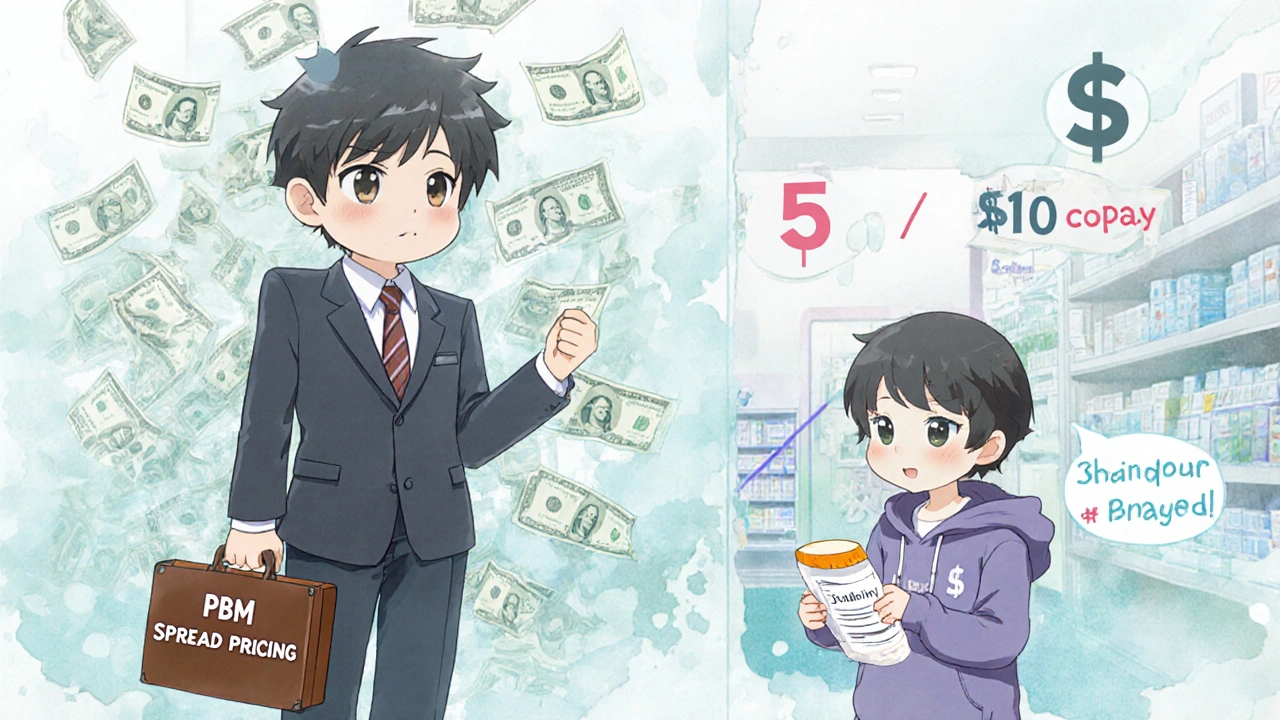
Take spread pricing: A PBM might tell your insurer they paid $5 for a generic drug, but they actually paid $3. You pay a $10 copay. The PBM pockets the $5 difference. That’s not illegal-but it’s not helping you save.
Then there’s copay clawbacks. You pay $10 for a generic, but your plan only covers $7. The pharmacy gets reimbursed $7, but you’ve already paid $10. That $3 is gone. No refund. No explanation. A 2024 Department of Labor report found patients were overpaying by $10-$15 per generic prescription because of these practices.
Meanwhile, PBMs collected $195 billion in rebates and discounts in 2022. But patients rarely see that money. The USC Schaeffer Center calls it a system where savings go into intermediaries’ pockets, not patients’ wallets.
What Patients Actually Experience
Real people have real stories. On Reddit, a thread about a generic copay dropping from $5 to $0 got 142 comments. Eighty-seven percent said it was a win. But 13% reported being stuck-either because their plan didn’t cover their specific generic, or their doctor had to fight for a brand-name drug to be approved.Kaiser Family Foundation surveys show 68% of Medicare Part D users are satisfied with their generic coverage. But 22% struggled with prior authorization. Fourteen percent said their doctors had to appeal multiple times just to get a needed drug covered.
And it’s not just about cost. Some patients report side effects after being switched to a generic. A 2023 Medscape poll found 31% of doctors had patients who experienced issues after an insurance-mandated switch. That’s rare-but it happens. When a generic has different fillers or coatings, it can affect how a drug is absorbed. For some conditions-like thyroid meds or seizure drugs-that matters.
How Different Plans Compare
Not all insurance plans treat generics the same way.| Plan Type | Generic Copay (30-day) | Generic Dispensing Rate | Key Feature |
|---|---|---|---|
| Medicare Part D | $0-$15 | 89.3% | Mandatory tiered formulary; step therapy required |
| Medicaid | $0-$10 (varies by state) | 89.3% | Reimbursement capped at 250% of average manufacturer price |
| Commercial (Employer-Sponsored) | $0-$10 | 87.1% | Often includes HDHPs with low generic copays |
| Self-Insured Employers | $0-$5 | 90%+ | Higher control over formularies; 9-15% savings on drug spending |
| Direct-to-Consumer (e.g., Mark Cuban Cost Plus) | Fixed cost (no insurance) | N/A | Median savings of $4.96 per prescription; no savings for Medicaid users |
Self-insured employers, who pay for their own health plans directly, have the most flexibility. One Johns Hopkins study found two large employers saved 9% to 15% by switching to generics without any drop in health outcomes. That’s real money-and real results.
Meanwhile, the Mark Cuban Cost Plus Drug Company offers a different model: transparent pricing. No PBMs. No rebates. You pay the cost of the drug plus a flat $3 fee. For some generics, that’s cheaper than your insurance copay. But if you’re on Medicaid or Medicare, you can’t use it. It’s designed for the uninsured.

The Big Changes Coming in 2025 and Beyond
The rules are changing. The Inflation Reduction Act, which took effect in 2025, capped out-of-pocket drug costs for Medicare Part D at $2,000 per year. That’s huge. It means seniors won’t be forced to skip doses just to avoid hitting a high cost threshold.Starting in 2026, Medicare will start negotiating prices for 10 high-cost drugs each year. The first set of negotiated prices will be available in 2026 for Part D drugs. That could bring down the cost of some brand-name drugs-but it also puts pressure on PBMs to justify their pricing.
And then there’s the GENEROUS Model, a new CMS program launching in 2026. It’s designed to cut Medicaid drug spending by $40 billion over ten years. How? By giving states the power to negotiate lower prices for generics and enforce uniform coverage rules.
On the transparency front, the Department of Labor now requires insurers to break down exactly how much they paid for each generic drug on your Explanation of Benefits (EOB) statement-starting January 1, 2025. That means you’ll finally see if your copay is higher than what the pharmacy was paid.
What You Can Do
You can’t control your plan’s formulary. But you can control how you use it.- Ask if a generic is available. Even if your doctor prescribes a brand name, ask: "Is there a generic version?" Many are.
- Check your plan’s formulary. Every insurer publishes a list of covered drugs. Look it up before filling a prescription.
- Ask about copay cards or savings programs. Some manufacturers offer coupons for brand-name drugs-but only if you don’t have insurance. If you’re on Medicaid or Medicare, those won’t work.
- Review your EOB. Starting in 2025, you’ll see exactly what your plan paid. If your copay is higher than that, call your insurer.
- Consider direct purchase if you’re uninsured. Sites like Mark Cuban Cost Plus Drug Company can be cheaper than your insurance copay-especially for high-cost generics.
Generics aren’t perfect. But they’re the most powerful tool we have to bring down drug costs. The system isn’t fair, and it’s not always transparent. But when you understand how it works, you can use it to your advantage.
Are generic drugs as effective as brand-name drugs?
Yes. The FDA requires generics to have the same active ingredient, strength, dosage form, and route of administration as the brand-name version. They must also meet the same strict standards for purity and performance. In 9 out of 10 cases, they work the same way. For a small number of drugs-like blood thinners or epilepsy medications-some patients may respond differently due to inactive ingredients, but that’s rare.
Why is my generic drug more expensive than last year?
Generic prices can rise due to supply shortages, manufacturing issues, or reduced competition. If only one company makes a generic, they can raise prices. Some generics have seen price spikes of 500% or more. Always check your plan’s formulary and ask your pharmacist if there’s another generic option.
Can I refuse a generic substitution?
Yes. Your doctor can write "dispense as written" or "no substitution" on the prescription. But your insurance may charge you more-sometimes significantly more-if you choose the brand-name drug. You’ll also need to pay the difference out of pocket.
Do all insurance plans cover generics?
Yes. Nearly every commercial plan, Medicare Part D, and Medicaid program includes generics in their formulary. In fact, 98.7% of commercial plans and 100% of Medicare Part D plans use tiered formularies that favor generics. The only exceptions are rare, experimental, or newly approved drugs without a generic version.
Why do PBMs exist if they make drug prices confusing?
PBMs were created to negotiate lower prices and manage drug benefits efficiently. They help insurers manage thousands of drugs and thousands of pharmacies. But their profit model-based on rebates, spread pricing, and hidden fees-has made the system opaque. The new transparency rules starting in 2025 aim to fix that. Until then, patients should always ask: "What did the pharmacy get paid?" and "What did my plan pay?"
Wow, I never realized how much of a rollercoaster this system is 😅. In Nigeria, we don’t even have generic drug access in half the pharmacies, so reading this made me feel both grateful and furious at the same time. At least y’all have options-even if the middlemen are stealing the savings.
It’s wild how we’ve turned healthcare into a game of financial Jenga-pull one block (the generic) and the whole tower doesn’t collapse, but someone’s definitely getting crushed underneath. The real tragedy? We know the system’s broken, but we keep playing because we don’t have a better rulebook yet. 🤷♂️
Just wanted to say thank you for writing this so clearly. I showed it to my mom who’s on Medicare, and she finally understood why her copay changed last month. Small wins, right? 💛
Stop pretending this is about saving patients money. This is corporate cost-shifting disguised as healthcare reform. PBMs are parasites. If you’re not angry about copay clawbacks, you’re not paying attention. 🚨
Bro, I just bought my thyroid med on Mark Cuban’s site for $3. My insurance copay was $12. I’m never going back. 😎
Okay, so here’s the thing-I get that generics are cheaper, but sometimes the fillers in them give me weird stomach issues… and no one ever tells you that. I had to figure out myself that my generic fluoxetine was making me nauseous. Now I pay extra to stay on brand. Worth it.
Also, why do pharmacies always try to switch me without asking? I’m not a robot. I have preferences. 🙄
They’re lying to us. The government, PBMs, big pharma-they’re all in on it. Generics are just a front. They’re using them to track us, control our bodies, and sell our data. You think your EOB is transparent? Nah. They’re watching. Always watching. 👁️👁️
You people are missing the point. This isn’t about generics. It’s about the fact that we’ve outsourced healthcare to profit-driven middlemen who don’t give a damn about you. The FDA doesn’t regulate the inactive ingredients properly-so your ‘generic’ thyroid med might as well be a placebo. And don’t even get me started on how PBMs manipulate rebate structures to favor overpriced drugs. It’s a scam. A multi-billion-dollar scam. And you’re all just vibing while your insulin costs $300.
Oh wow, so the ‘savings’ go to PBMs? Shocking. Next you’ll tell me water is wet. I’ve been paying $10 for a generic blood pressure med for years. Last month, I checked the PBM’s price-they paid $1.50. I’m switching to cash. And yes, I’m telling my doctor I’m doing it. 😏
Hey everyone, I know this stuff feels overwhelming-but you’re not alone! I used to stress over every prescription until I started checking GoodRx and calling my pharmacy directly. Sometimes the cash price is lower than your copay, even with insurance. And if your doctor says ‘dispense as written,’ just ask them to write it. It’s your right! 💪 You got this. And hey, if you need help reading your EOB, DM me-I’ll walk you through it. We’re all in this together!