

When it comes to cooking, not all oils and fats are created equal. Some help protect your heart. Others quietly raise your risk of heart disease - even if you think you’re eating "healthy." The truth is, your kitchen can be your first line of defense against heart problems. And it starts with knowing what’s in the bottle, what’s on the label, and what you’re really heating up on the stove.
What Makes an Oil Heart-Healthy?
A heart-healthy oil doesn’t just sound good on the label. It has real, measurable qualities: high in monounsaturated fats, low in saturated fats, and free of trans fats. The science behind this goes back decades. The Seven Countries Study in the 1960s showed people in Mediterranean regions - who ate mostly olive oil, nuts, and fish - had far fewer heart attacks than those eating butter, lard, or processed fats. Today, major health groups like the American Heart Association and Harvard Medical School agree: replacing saturated fats with unsaturated fats can lower your "bad" LDL cholesterol by 5-15%.
Here’s what to look for in an oil:
- At least 55% monounsaturated fat
- Less than 15% saturated fat
- No partially hydrogenated oils (that’s trans fat)
- Rich in omega-3s or omega-9s, not overloaded with omega-6s
Extra virgin olive oil checks most of these boxes. It’s got 73% monounsaturated fat, just 14% saturated fat, and powerful antioxidants like oleocanthal that act like natural anti-inflammatories. Studies show these compounds may reduce heart inflammation as effectively as 10% of a standard ibuprofen dose.
The Top 4 Heart-Healthy Oils (and What to Use Them For)
Not every oil works for every job. Heat changes how oils behave - and what they do to your body. Here’s what to pick based on how you cook:
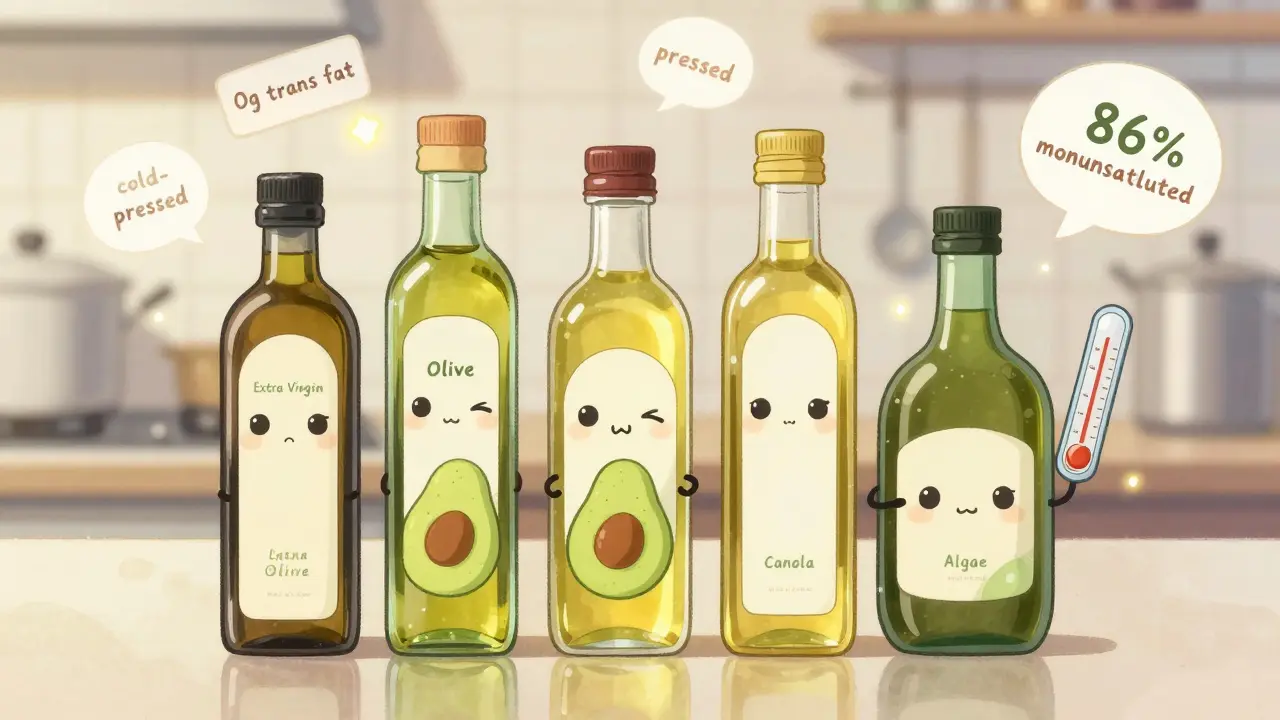
1. Extra Virgin Olive Oil
Best for: Salad dressings, drizzling, light sautéing, low-heat baking
It’s the gold standard for heart health. With 73% monounsaturated fat and polyphenols that fight inflammation, it’s the cornerstone of the Mediterranean diet. But it has a low smoke point - around 375°F. If you heat it past that, it starts breaking down, losing nutrients and creating harmful compounds. Don’t fry with it. Don’t roast at 450°F with it. Save it for flavor, not high heat.
2. Avocado Oil
Best for: Roasting, grilling, stir-frying, searing
Avocado oil has 67% monounsaturated fat - close to olive oil - but its smoke point is 520°F. That means you can sear a steak or roast vegetables at high heat without smoking up your kitchen or creating toxins. It’s also neutral in flavor, so it won’t overpower your food. The downside? It costs 30-50% more than olive oil. But if you do a lot of high-heat cooking, it’s worth the extra $5-$7 per bottle.
3. Canola Oil
Best for: Baking, everyday cooking, frying
Canola oil is one of the most affordable heart-healthy options. It’s 62% monounsaturated fat, only 7% saturated fat, and packed with ALA - a plant-based omega-3. One tablespoon gives you 2.2 grams, which helps lower triglycerides. It’s also got a smoke point of 400°F, making it decent for medium-heat frying. Just watch out for brands that use chemical solvents. Look for "cold-pressed" or "non-GMO" on the label.
4. Algae Oil
Best for: High-heat cooking, deep frying, replacing butter or margarine
This is the new kid on the block. Algae oil has 86% monounsaturated fat - higher than any other common cooking oil. It’s also got a smoke point of 535°F and a completely neutral taste. It’s sustainable, too: it takes 90% less land to produce than olive oil. The catch? It’s still hard to find outside specialty stores like Thrive Market. And it costs about $25 for a 16.9 fl oz bottle. But if you’re serious about heart health and want the cleanest, most stable oil available, this is it.
What to Avoid - Even If It Sounds Healthy
Not all "natural" fats are good for your heart. Some are worse than processed oils.
Coconut oil - Often marketed as a superfood, coconut oil is 82% saturated fat. That’s even higher than butter. The American Heart Association says it raises LDL cholesterol just like animal fats. Don’t use it for heart health.
Corn, sunflower, and safflower oils - These are high in omega-6 fatty acids. Omega-6s aren’t bad - your body needs them. But when you eat too many without enough omega-3s, they trigger inflammation. Most American diets already have 15-20 times more omega-6 than omega-3. Adding more of these oils makes it worse. Use them rarely, if at all.
"Blended" oils - Labels like "vegetable oil" or "canola blend" often hide saturated fats. One brand might say "canola oil" but contain 30% palm oil (which is 50% saturated fat). Always check the ingredient list. If it says "soybean oil," "palm oil," or "partially hydrogenated," put it back.
Trans fats - Even if a label says "0g trans fat," it might still have up to 0.5g per serving. That’s enough to add up over time. The FDA banned partially hydrogenated oils in 2020 - but loopholes remain. Look for "hydrogenated" or "partially hydrogenated" on the ingredient list. If you see it, walk away.
How to Read a Food Label Like a Pro
Labels lie. Or at least, they hide. Here’s how to cut through the noise.
Step 1: Look at the serving size. A bottle might say "0g trans fat," but if the serving size is 1 teaspoon and you use 2 tablespoons, you’re eating 4x the amount. Always calculate based on what you actually use.
Step 2: Check saturated fat per serving. Aim for less than 2g per serving. If it’s 3g or more, ask yourself: Is this worth it? For example, a tablespoon of butter has 7g saturated fat. That’s more than half your daily limit in one spoonful.
Step 3: Scan the ingredient list. Ingredients are listed by weight. If "palm oil" or "hydrogenated soybean oil" is in the top three, skip it. If the first ingredient is "extra virgin olive oil," you’re good.
Step 4: Look for certifications. In Australia, the Heart Foundation Tick means the product meets strict heart-health standards. In Europe, look for "EU Organic" or "Cold-Pressed" labels. In the U.S., no official seal exists - but brands like California Olive Ranch and Chosen Foods are transparent about sourcing and testing.
Step 5: Watch for "heart-healthy" claims. The FDA doesn’t regulate this phrase. A product can say "heart-healthy" and still be loaded with sugar and sodium. Focus on fat content, not marketing.

Common Mistakes and How to Fix Them
Even people who try to eat healthy make these errors:
- Mistake: Using the same oil for everything. Fix: Keep three oils on hand: extra virgin olive for cold uses, avocado for high heat, and canola for baking.
- Mistake: Reusing oil for frying. Fix: Never reuse oil more than once. It breaks down, creates free radicals, and becomes inflammatory.
- Mistake: Storing oils in a hot cabinet. Fix: Keep oils in a dark, cool place. Flaxseed and walnut oils? Refrigerate them. They go rancid in 30 days if left out.
- Mistake: Buying "extra virgin" olive oil from a discount store. Fix: A 2021 study found 60% of "extra virgin" olive oil sold in the U.S. fails purity tests. Stick to trusted brands with harvest dates and batch numbers.
What’s Changing in 2026?
Heart-healthy cooking is evolving fast. Algae oil is now in over 25,000 U.S. stores. The American Heart Association updated its guidelines in 2021 to focus on replacing saturated fats - not just cutting total fat. That’s why sales of avocado and algae oils are growing 12-15% each year. And more people are realizing: you don’t need to give up flavor to protect your heart. You just need to choose better fats.
The bottom line? Your heart doesn’t care about trends. It cares about what’s in your pan. Choose oils with high monounsaturated fat, low saturated fat, and no trans fats. Read labels like a detective. Cook smart. And your heart will thank you - quietly, reliably, for years to come.
What’s the best oil for heart health?
Extra virgin olive oil is the most researched and widely recommended for heart health. It’s high in monounsaturated fat (73%) and packed with anti-inflammatory antioxidants. For high-heat cooking, avocado oil or algae oil are better choices because they don’t break down under heat.
Is coconut oil good for your heart?
No. Coconut oil is 82% saturated fat - higher than butter. The American Heart Association says it raises LDL ("bad") cholesterol just like animal fats. Despite claims about "medium-chain triglycerides," there’s no strong evidence it benefits heart health. Avoid it for cooking if you’re trying to protect your heart.
How do I know if an oil is truly "extra virgin"?
Look for a harvest date, batch number, and third-party certification like the International Olive Council (IOC) or UC Davis Olive Center. Many "extra virgin" oils fail purity tests - 60% in the U.S. According to independent testing. Stick to brands with transparent sourcing and avoid bargain-bin options.
Can I reuse cooking oil?
No, not safely. Reusing oil breaks down its chemical structure, creating harmful compounds that increase inflammation and oxidative stress. Even if it looks clean, it’s damaged. Use oil once, then discard it. For frying, use oils with high smoke points like avocado or algae oil - they hold up better, but still shouldn’t be reused.
What’s the difference between saturated and unsaturated fat?
Saturated fats - found in butter, coconut oil, and lard - raise LDL cholesterol, which builds up in arteries and increases heart disease risk. Unsaturated fats - found in olive oil, avocado, and nuts - lower LDL and raise HDL ("good") cholesterol. They also reduce inflammation. Swapping saturated for unsaturated fats cuts heart attack risk by up to 30%.
Do I need to refrigerate all cooking oils?
No - only oils high in polyunsaturated fats, like flaxseed, walnut, and fish oil. These go rancid quickly when exposed to light and heat. Store them in the fridge and use within 30-60 days. Olive, avocado, and canola oils are stable at room temperature if kept in a dark cabinet.
Based on lipid biochemistry and randomized controlled trials, the optimal fatty acid profile for cardiovascular risk reduction is >60% monounsaturated fat, <7% saturated fat, and an omega-6:omega-3 ratio under 4:1. Algae oil outperforms all conventional oils in this regard, with 86% oleic acid and negligible polyunsaturates. Its oxidative stability (smoke point 535°F) makes it ideal for high-heat applications where lipid peroxidation products like 4-HNE are formed in olive or canola oils. The cost premium is justified by long-term cardiometabolic benefits.
It is imperative to recognize that the so-called "Mediterranean diet" is a romanticized construct propagated by academic institutions with vested interests in olive oil lobbying. The true heart-healthy paradigm, as evidenced by the Inuit and Masai populations, is one of saturated fat predominance-butter, tallow, and lard. Modern lipidology is a fraud built on flawed epidemiology. The AHA guidelines are not science-they are policy dressed as physiology.
Of course they’re pushing algae oil-big agribusiness and Silicon Valley venture capital are behind it. They want you dependent on expensive, patented oils while they patent the algae strains. Meanwhile, coconut oil-used for centuries-is demonized because it can’t be monopolized. Check the funding behind "independent" studies. The FDA didn’t ban trans fats because they care about you-they were pressured by margarine companies trying to replace hydrogenated oils with their own products.
I’ve been using avocado oil for roasting veggies and it’s been a game-changer. No more bitter smoke in the kitchen. I used to think olive oil was fine for everything until I burned a batch at 400°F-smelled like a chemistry lab. Now I keep three bottles: EVOO for drizzling, avocado for roasting, and canola for baking. It’s not about perfection-it’s about progress. Small swaps add up.
Interesting. So we’re supposed to trust the same people who told us fat was bad in the 80s, then carbs were the enemy, now it’s saturated fat? I’ll believe it when I see a double-blind, long-term trial with hard endpoints-not another correlation study based on food frequency questionnaires filled out by college students.
Thank you for this comprehensive breakdown. The emphasis on label literacy is particularly vital. Too many consumers rely on marketing claims like "natural" or "heart-healthy" without scrutinizing the ingredient list. I’ve personally switched to cold-pressed canola oil with verified non-GMO certification, and my lipid panel has improved significantly. Small, informed changes matter.
For anyone feeling overwhelmed-start with one swap. Replace butter with EVOO on toast. Swap canola for avocado oil in your stir-fry. You don’t need to overhaul your pantry overnight. Progress > perfection. And if you’re curious, try a blind taste test between cheap olive oil and a reputable brand-you’ll be shocked at the difference. Knowledge is power, but action is transformation.
Let me tell you-I used coconut oil for three years because of all the "biohacking" blogs. My cholesterol went through the roof. My doctor looked at me like I’d been living in a cave. I switched to avocado oil. My triglycerides dropped 40%. My wife said I stopped being cranky in the mornings. I don’t know if it’s the oil or the fact that I finally listened to a medical professional-but I’m never going back.
Just wanted to say thank you for the detailed breakdown. I’m a nurse, and I’ve seen too many patients with heart disease who thought they were eating "healthy" because they used "coconut oil" or "vegetable oil." This post is a gift to public health. I’ve printed it and posted it in our community kitchen. Small steps, big impact.
What’s your take on the new USDA dietary guidelines shifting focus from total fat to nutrient density? Does that change how we should prioritize oils?