
Garlic Supplement Safety Checker
Check Garlic Supplement Safety
Select your anticoagulant medication and garlic supplement type to determine if they're safe to take together.
Important Note: This tool provides general information about garlic supplement interactions with anticoagulants. Always consult with your doctor or pharmacist before making changes to your medications.
Every year, millions of people take garlic supplements thinking they’re doing something good for their heart. And sure, garlic might help lower blood pressure a little. But if you’re on a blood thinner-warfarin, apixaban, rivaroxaban, or any other anticoagulant-garlic supplements could be quietly putting you at risk for serious, even life-threatening bleeding.
Why Garlic Supplements Are More Dangerous Than You Think
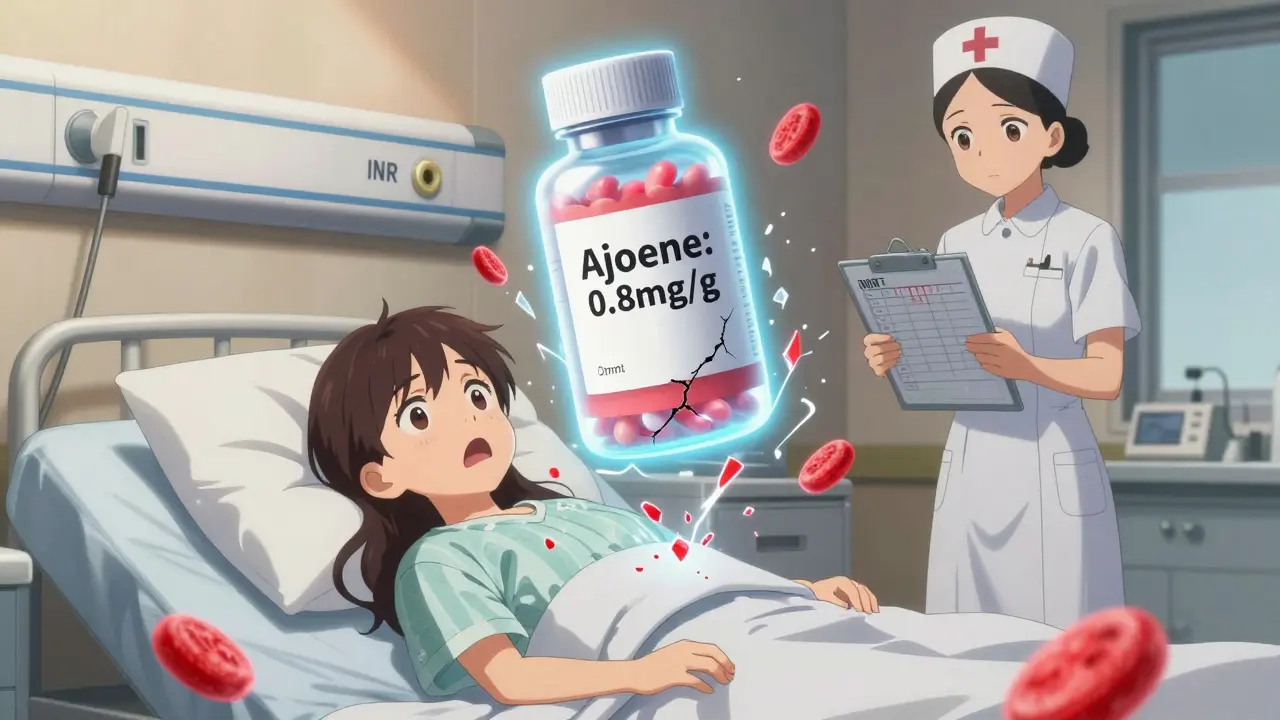
Garlic isn’t just a flavoring in your pasta sauce. When you take it in pill form, you’re getting a concentrated dose of compounds that interfere with how your blood clots. The main culprit is ajoene, a sulfur-based chemical found in garlic oil and raw garlic. Ajoene doesn’t just slow down clotting-it shuts it down at the platelet level. Platelets are the tiny cells in your blood that stick together to seal cuts. Ajoene blocks their ability to grab onto each other, making them useless for stopping bleeding. This isn’t theoretical. Back in 1983, doctors first noticed that people who ate a lot of garlic bled longer after minor injuries. Since then, dozens of studies have confirmed it. One 1996 trial showed that healthy adults who took standard garlic supplements had 20-40% less platelet activity. That’s not a small effect. It’s the same kind of suppression you’d see with low-dose aspirin. And unlike aspirin, which is prescribed and monitored, garlic supplements are bought off the shelf with no oversight.What Happens When Garlic Meets Blood Thinners
Anticoagulants work in different ways. Warfarin slows down the liver’s production of clotting proteins. DOACs like apixaban block specific enzymes that trigger clot formation. Garlic doesn’t just add to this-it multiplies it. The result? Your blood becomes dangerously thin. A 1998 case series in Chest found that patients taking warfarin and garlic supplements saw their INR (a blood test that measures clotting time) jump by 1.0 to 2.5 points. That might not sound like much, but if your INR was already at 2.8 (the upper limit of safe range), a 2-point spike could push it to 4.8. At that level, even a bump on the head could cause bleeding inside the skull. One patient in the study had a spontaneous brain bleed after taking garlic pills for three weeks. It’s not just warfarin. People on DOACs have reported nosebleeds lasting over 30 minutes, bleeding gums, bruising without injury, and internal bleeding after minor surgeries. A Reddit user in March 2023 described needing an ER visit after combining 900 mg of garlic supplements with apixaban. His nose wouldn’t stop bleeding. He wasn’t taking high doses. He wasn’t reckless. He just didn’t know.Not All Garlic Supplements Are the Same
Here’s where things get tricky. Not every garlic pill has the same effect. The amount of ajoene-and therefore the bleeding risk-depends entirely on how the supplement is made.- Oil macerates (garlic soaked in oil) contain the most ajoene-up to 1.0 mg per gram. These are the most dangerous.
- Standard powdered garlic pills (the kind you see in most drugstores) have 0.1-0.3 mg per gram. Still risky.
- Aged garlic extract (like Kyolic) has almost no ajoene. It’s processed in a way that breaks down the active compound. These are considered low-risk.
Who’s at the Highest Risk?
It’s not just people on blood thinners. The real danger comes from people who don’t even know they’re at risk.- People over 65: 18.3% take garlic supplements. Of those, nearly 23% are also on anticoagulants. That’s over 3 million Americans.
- Patients preparing for surgery: A 2017 study found 68% of people continued taking garlic supplements right up until their operation-even after being asked about herbal products.
- People with chronic conditions: Those with heart disease, diabetes, or high blood pressure are more likely to use garlic supplements for “natural” heart support, often without telling their doctor.
What Doctors Say
The medical community isn’t split on this. Major organizations agree: garlic supplements are a high-risk interaction.- The American Society of Anesthesiologists says stop garlic supplements 14 days before any surgery.
- The American Heart Association warns that garlic can cause “serious bleeding complications” when combined with blood thinners.
- Dr. Pieter Cohen from Harvard says garlic supplements can “increase the levels and effects of some medications for heart health, such as blood thinners.”
- The European Medicines Agency now requires garlic supplements to carry a warning about anticoagulant interactions.
What You Should Do
If you’re on any anticoagulant, here’s what you need to do:- Stop all garlic supplements. Not just before surgery-every day. The effects last up to 72 hours, and platelets take 7-10 days to fully recover.
- Don’t assume “natural” means safe. Garlic supplements are not regulated like drugs. What’s on the label may not be what’s inside.
- Ask your doctor or pharmacist directly. Don’t say “Do I need to worry about herbs?” Say: “I take garlic pills. Are they safe with my blood thinner?”
- Check your supplement label. If it says “aged garlic extract,” it’s likely safer. If it says “garlic oil” or “standardized garlic,” assume it’s risky.
- Keep a list of everything you take. Include vitamins, teas, and herbal drops. Bring it to every appointment.
What About Eating Garlic?
Don’t panic. Eating garlic in food is fine. A clove or two in your stir-fry won’t affect your INR. The problem is concentrated doses in pills. You’d need to eat 5-7 whole cloves daily to match the dose in a single supplement. That’s not realistic-and your stomach wouldn’t thank you.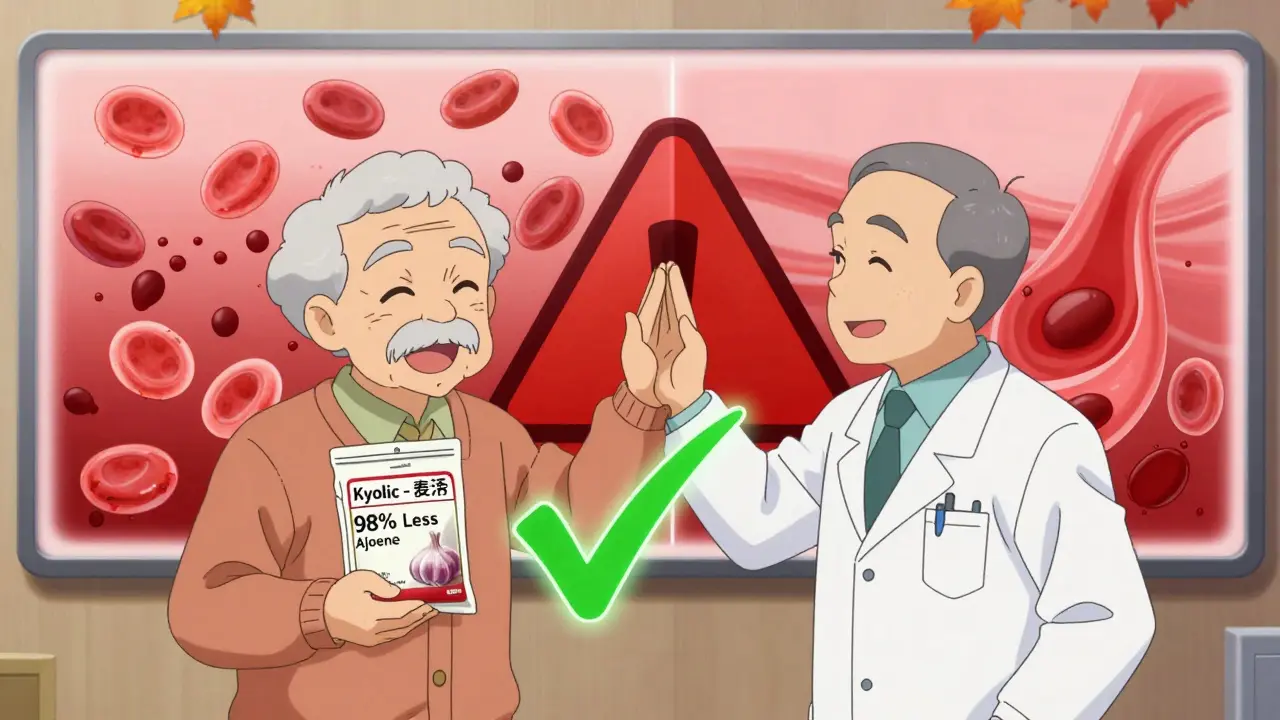
So let me get this straight - you’re telling me that the same stuff I put on my pizza is basically a silent assassin when it’s in pill form? 😅 I’ve been taking ‘garlic capsules’ for my ‘immune support’ since 2019. Guess I just bought a one-way ticket to the ER. Thanks for the wake-up call. I’m tossing mine in the trash today.
Also, why is it that the only time supplement labels need to be honest is when someone dies? The FDA’s ‘drafting rules’ in 2024? Bro, people are bleeding out now.
And don’t even get me started on ‘natural’ being code for ‘unregulated poison.’
Thank you for writing this with so much care. I’m a nurse in India, and I see this every week - elderly patients on warfarin popping garlic pills because their neighbor said it ‘cleanses the blood.’
It breaks my heart. No one’s teaching them that ‘natural’ doesn’t mean ‘safe.’ I’ve started handing out printed one-pagers in our clinic with simple icons: 🌞 garlic in food = good, 💊 garlic pills = stop.
Small steps, but maybe it saves someone.
Also, aged garlic extract is a real thing - Kyolic saved my mom’s life after she switched. Just know what you’re taking.
Oh wow. Another ‘natural medicine is dangerous’ PSA. How original.
Let’s be real - if you’re on a blood thinner and you didn’t know garlic could interact with it, you probably also think ‘detox teas’ fix your liver and ‘crystal healing’ cures anxiety.
Maybe the problem isn’t the supplement industry. Maybe it’s the people who treat their bodies like a TikTok trend.
Also, ‘ajoene’? Sounds like a villain in a Marvel movie. ‘Behold, the Ajoene of Platelet Annihilation!’
Still, I’ll give you this - at least this post didn’t say ‘drink lemon water.’ Progress, I guess.
Wait wait wait - so you’re saying garlic pills = blood thinner? 😳
But I read on Reddit that garlic helps your heart! 🤯
Also I take 2 pills a day and I’m 28 and healthy so I’m fine right? 😇
Also my cousin’s friend’s uncle took garlic and his INR went to 7.3 and he just laughed and kept going. So maybe it’s all hype? 🤔
Also I’m not on warfarin I’m on something else… what’s it called? Eliquis? Xarelto? Same thing right? 😅
i had no idea about this
i take garlic pills cause my mom says its good for colds
i didnt even know they had different kinds
so like… if its aged garlic extract its ok? but if its just garlic oil its bad?
and i thought the label said how strong it was
so i guess im stopping
thanks for the heads up
also my nose bleeds sometimes but i thought it was just dry air
oops
This is one of the most important public health posts I’ve read all year.
Let’s normalize asking your pharmacist: ‘Is this supplement going to kill me with my medication?’
Garlic isn’t the villain - the silence is.
Doctors don’t always ask. Patients don’t always tell. Supplements fly under the radar because they’re ‘natural.’ But if it changes your blood chemistry, it’s medicine - whether it’s FDA-approved or not.
I’m sharing this with my entire book club. And yes - I’m throwing out my garlic capsules. No more ‘natural’ shortcuts.
Knowledge isn’t power. Action is.
Bro. I took garlic pills for 6 months. My gums bled every time I brushed. I thought it was gingivitis.
Then I got a bruise on my thigh that looked like a water balloon filled with red paint.
Went to the doc. Said ‘you on anything?’
I said ‘no.’
He asked again.
I said ‘I take garlic pills.’
He stared at me like I’d just admitted to feeding my cat cocaine.
Turns out I was one bad sneeze away from a brain bleed.
Now I eat garlic. In food. Like a normal person.
And I don’t trust pills anymore.
Rest in peace, my $20 bottle of ‘Heart Health Boost.’ You were a liar.
Thank you so much for this... I really appreciate how detailed it is... I didn't realize that aged garlic extract was different... I've been taking the standard kind... I'm going to check my bottle right now... I'm so glad I found this before something happened... I've been on apixaban for 2 years... I thought garlic was just... garlic...
Also, I didn't know the FDA was doing anything about labeling... I hope they move fast...
And I'm definitely telling my mom... she takes garlic for her cholesterol...
Thank you again... really... thank you...
How dare you imply that people who take garlic supplements are irresponsible? This is a classic example of pharmaceutical-industrial complex propaganda. Garlic has been used for millennia - your modern anticoagulants are synthetic poisons with unpronounceable names, and now you want to vilify nature’s remedy?
INR levels fluctuate. Minor bleeding is the body’s natural detoxification process. You are pathologizing wellness.
Furthermore, the ‘case studies’ you cite are anecdotal - not statistically significant. Where is your double-blind, placebo-controlled, NIH-funded trial proving garlic supplements are dangerous? I await your data.
And to those who say ‘I stopped’ - you are surrendering your autonomy to a system that profits from fear. Eat your garlic. Trust your body. Reject medical tyranny.