
The U.S. Food and Drug Administration doesn’t just approve new drugs - it keeps millions of Americans alive by making sure affordable generic versions hit the market quickly and safely. Every day, 9 out of 10 prescriptions filled in the U.S. are for generic drugs. But behind that simple statistic is a tightly controlled, science-heavy approval system that few people ever see - the Abbreviated New Drug Application, or ANDA.
What Is the ANDA Process?
The ANDA is the legal pathway the FDA uses to approve generic drugs. It was created by the Hatch-Waxman Act of 1984, a law designed to balance innovation and affordability. Before this, generic manufacturers had to repeat the same expensive clinical trials that brand-name drug companies ran. That made generics too costly to produce. The ANDA changed that.Instead of proving a drug is safe and effective from scratch, generic makers only need to show their version works the same way as the original. That means identical active ingredients, same strength, same pill or injection form, and same way it’s taken - whether by mouth, injection, or inhalation. The FDA doesn’t require new clinical trials. Instead, they rely on bioequivalence studies.
How Bioequivalence Works
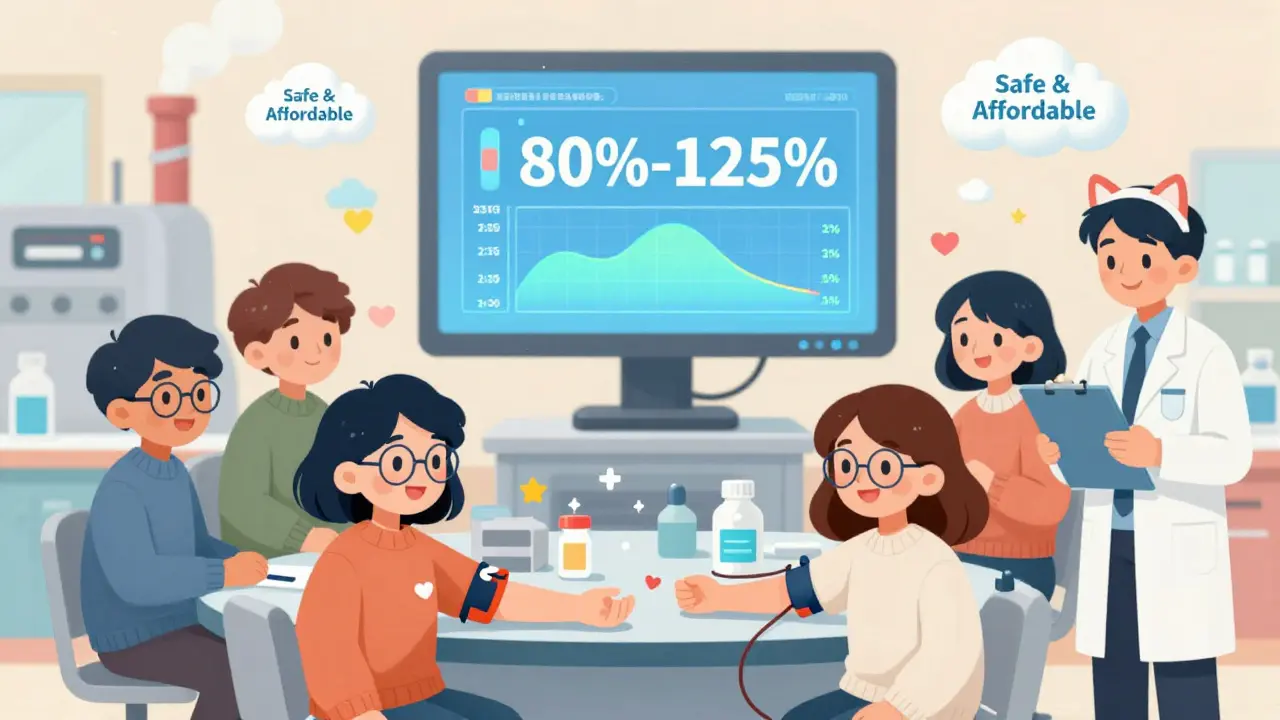
Bioequivalence is the core of the ANDA. It’s not guesswork. It’s hard science. Generic manufacturers run studies with 24 to 36 healthy volunteers. They give half the brand-name drug and half the generic, then measure how much of the drug enters the bloodstream and how fast.The FDA requires the generic’s absorption rate and total exposure to fall within 80% to 125% of the brand-name drug’s numbers. That’s not a wide gap - it’s tight. If a generic’s peak concentration (Cmax) or total absorption (AUC) falls outside that range, the application gets rejected. This isn’t theoretical. In 2022, 14.8% of ANDAs got complete response letters because of bioequivalence issues.
These studies are done under strict conditions. Volunteers fast overnight. Blood samples are taken at precise intervals. The data is analyzed using statistical models that account for natural variation between people. The FDA doesn’t accept sloppy data. If the study design is flawed, the application is refused before it even moves to review.
The Review Timeline - And the Backlog
Once an ANDA is submitted, it goes through two main phases: filing and substantive review. First, the FDA checks if the application is complete. In 2022, 15.3% of submissions got a Refuse-to-Receive letter because they were missing key sections - usually chemistry, manufacturing, or controls (CMC) data.Once filed, the clock starts. Standard applications have a 10-month target review time. Priority applications - like first generics or drugs in shortage - get 8 months. But reality doesn’t always match the target. As of late 2022, over 1,800 ANDAs were sitting in limbo, with 317 waiting more than three years. The FDA admitted resource constraints were a factor. That’s why the Generic Drug User Fee Amendments (GDUFA) exist.
GDUFA lets the FDA collect fees from generic manufacturers to hire more reviewers. The latest version, GDUFA III, went into effect in October 2022. It funded 107 generic approvals in 2022 and 90 in 2023. The program also introduced faster review tracks for complex generics - drugs like inhalers, topical creams, or extended-release pills that are harder to copy.
Manufacturing Isn’t an Afterthought
A generic drug isn’t just the same chemistry - it has to be made the same way. Every facility that produces a generic must pass a Current Good Manufacturing Practice (CGMP) inspection. The FDA inspects these plants every year on average. In 2023, 82.7% of generic manufacturing sites were inspected.CGMP isn’t optional. It covers everything: how raw materials are stored, how equipment is cleaned, how batch records are kept. One failed inspection can delay approval by months. That’s why 41.7% of Refuse-to-Receive letters in 2022 cited CGMP issues. Many generic companies now hire full-time regulatory affairs teams just to keep up with these standards.
Costs and Barriers to Entry
Applying for an ANDA isn’t cheap. The application fee alone is $389,490 under GDUFA III. Facility fees range from $207,700 to $415,400 per year. That’s a big hurdle for small companies. But compared to the $2.6 billion it costs to develop a new brand-name drug, it’s a bargain.Still, the paperwork is massive. A single ANDA submission can run 15,000 to 20,000 pages. To help, the FDA created the Electronic Submission Template and Resource Center (eSTaR), which cut formatting errors by 63.2% since 2020. Even so, first-time applicants often take 18 to 24 months to get it right. Many hire consultants or partner with experienced manufacturers.
Complex Generics Are the New Frontier
Not all generics are created equal. Simple tablets are easy to copy. But complex products - like nasal sprays, injectables, or patches - behave differently in the body. The FDA has made this a priority. In 2023, 37.5% of approved generics were complex products, up from 22.1% in 2018.To keep up, the FDA is piloting AI-assisted review tools and using real-world data to support approvals. By 2026, they aim to use real-world evidence in 25% of complex generic approvals. That’s a big shift. Traditionally, they only trusted lab studies. Now, they’re looking at how patients actually respond after the drug hits the market.
How Much Do Generics Save?
The numbers speak for themselves. In 2023, generic drugs saved U.S. patients $132.6 billion. That’s not just a statistic - it’s life-changing for people on insulin, blood pressure meds, or antidepressants. Pharmacists report generics cut out-of-pocket costs by 80-85%. One Reddit user shared how their patient’s insulin bill dropped from $390 to $98 after switching to a generic biosimilar.But public trust isn’t automatic. A 2023 CVS Health survey found 78.4% of patients trusted FDA-approved generics. Still, 22.7% of adverse event reports involving generics cited perceived effectiveness issues. The FDA investigated those cases and found 92.3% were due to disease progression, not the drug itself. That’s a key point: if a generic seems to stop working, it’s rarely because the drug changed - it’s because the condition did.
What’s Changing in 2025?
The FDA announced a new pilot program on October 3, 2025, to speed up reviews for generic drugs made in the U.S. Qualifying applications will see Target Action Dates reduced by 30%. This is a direct response to supply chain concerns - 78% of active pharmaceutical ingredients for generics come from overseas, mostly in India and China.GDUFA IV, which took effect in 2025, includes $412 million specifically for complex generics. The FDA’s 2024-2026 Strategic Plan also aims to approve 1,500-1,700 generics annually by 2027. There are already 2,147 pending applications for first generics - the most ever.
Why This Matters
The FDA’s role in generic approval isn’t just bureaucratic. It’s economic, medical, and moral. Without this system, millions couldn’t afford their prescriptions. Without strict bioequivalence rules, patients could be at risk. Without inspections, unsafe drugs could slip through.The system isn’t perfect. Backlogs exist. Complex drugs are still hard to copy. Supply chains are fragile. But the FDA has adapted. They’ve increased transparency. They’ve invested in technology. They’ve prioritized the hardest-to-make generics. And they’ve kept the focus where it belongs: on patient safety and access.
Generics aren’t cheap knockoffs. They’re scientifically validated, FDA-approved alternatives that keep the U.S. healthcare system from collapsing under its own weight. And every one of them - from a simple aspirin to a complex injectable - passed through the same rigorous gate: the ANDA process.
How long does it take the FDA to approve a generic drug?
The FDA targets 10 months for standard ANDA applications and 8 months for priority ones, like first generics or drugs in shortage. But delays happen. In 2022, over 300 applications waited more than three years due to staffing and complexity. The new GDUFA IV funding and pilot programs aim to cut review times significantly by 2027.
Are generic drugs as safe as brand-name drugs?
Yes. The FDA requires generics to have the same active ingredient, strength, dosage form, and route of administration as the brand-name drug. They must also prove bioequivalence - meaning they work the same way in the body. Over 90% of Americans take generics, and FDA monitoring shows adverse events are rare and usually tied to underlying conditions, not the drug itself.
What’s the difference between an ANDA and an NDA?
An NDA (New Drug Application) is for brand-name drugs and requires full clinical trials proving safety and effectiveness - costing up to $2.6 billion and taking 10-15 years. An ANDA (Abbreviated New Drug Application) is for generics and skips those trials. Instead, it proves bioequivalence to an already-approved drug, cutting costs to $2.4-6.3 million and time to 3-4 years.
Why do some generics get refused approval?
The most common reasons are incomplete chemistry, manufacturing, or controls (CMC) data (41.7% of Refuse-to-Receive letters), bioequivalence study flaws (28.3%), and failure to meet CGMP standards. Applications with missing documents, poor study designs, or unapproved manufacturing sites are rejected before review even begins.
How does the FDA ensure generic drugs are made safely?
The FDA inspects every manufacturing facility - domestic and international - that produces generics. In 2023, 82.7% of these sites were inspected. All must follow Current Good Manufacturing Practice (CGMP) rules under 21 CFR parts 210 and 211. Facilities that fail inspections can’t ship products until they fix the issues. The FDA also audits raw material sources and monitors supply chains for disruptions.
Can a generic drug be different from the brand-name version?
Yes - but only in inactive ingredients, like fillers, dyes, or preservatives. These don’t affect how the drug works. The active ingredient, strength, dosage form, and route of administration must be identical. Even packaging can differ. But if a patient has an allergy to a dye in the generic, they should talk to their pharmacist - it’s not a safety issue with the drug, just the formulation.
What are complex generics, and why are they harder to approve?
Complex generics include drugs like inhalers, injectables, topical creams, and extended-release tablets. These don’t dissolve the same way in the body as simple pills, so standard bioequivalence studies don’t work. The FDA needs specialized testing - sometimes using animal models or advanced imaging - to prove equivalence. That’s why approval takes longer and costs more. In 2023, 37.5% of approvals were for these complex products, up from 22% in 2018.
How does the FDA handle patent disputes for generics?
The FDA doesn’t resolve patent disputes - that’s handled in court. But the agency tracks them. On average, each branded drug facing generic competition sees 34.7 patent challenges. The FDA will approve a generic if the patent is expired, invalid, or not infringed. They also publish patent and exclusivity information in the Orange Book to help manufacturers navigate legal barriers.


