
When you pick up a prescription, you might see two options: the brand-name pill you’ve always known, or a cheaper generic version that looks different but claims to do the same thing. But here’s the real question: is the cheaper option actually worth it? Not just in price, but in value to your health system, your insurer, and your wallet.
Cost-effectiveness analysis (CEA) is the tool that answers this. It doesn’t just look at the sticker price. It measures how much health you get for every dollar spent. And when it comes to generic drugs, the numbers are staggering.
How Much Do Generics Actually Save?
The U.S. Food and Drug Administration (FDA) found that as soon as the first generic version of a brand-name drug hits the market, prices drop by an average of 39%. That’s not a small discount. That’s a seismic shift. And it doesn’t stop there. When six or more generic manufacturers enter the race, prices fall more than 95% below the original brand price.
Over the decade ending in 2017, generic drugs saved the U.S. healthcare system $1.7 trillion. In 2022 alone, they saved more than $250 billion. That’s not theoretical. That’s cash taken out of the system-money that didn’t go to drug companies, insurers, or patients. It stayed in people’s pockets and in hospital budgets.
Here’s the kicker: generics make up 90% of all prescriptions filled in the U.S. But they account for only 17% of total prescription drug spending. That means for every dollar spent on prescription drugs, just 17 cents goes to generics-but they’re handling nine out of every ten pills.
Not All Generics Are Created Equal
Here’s where things get tricky. Not every generic is the cheapest option-even within the generic market. A 2022 study in JAMA Network Open looked at the top 1,000 most-prescribed generics and found something surprising: 45 of them were priced way higher than other drugs in the same therapeutic class.
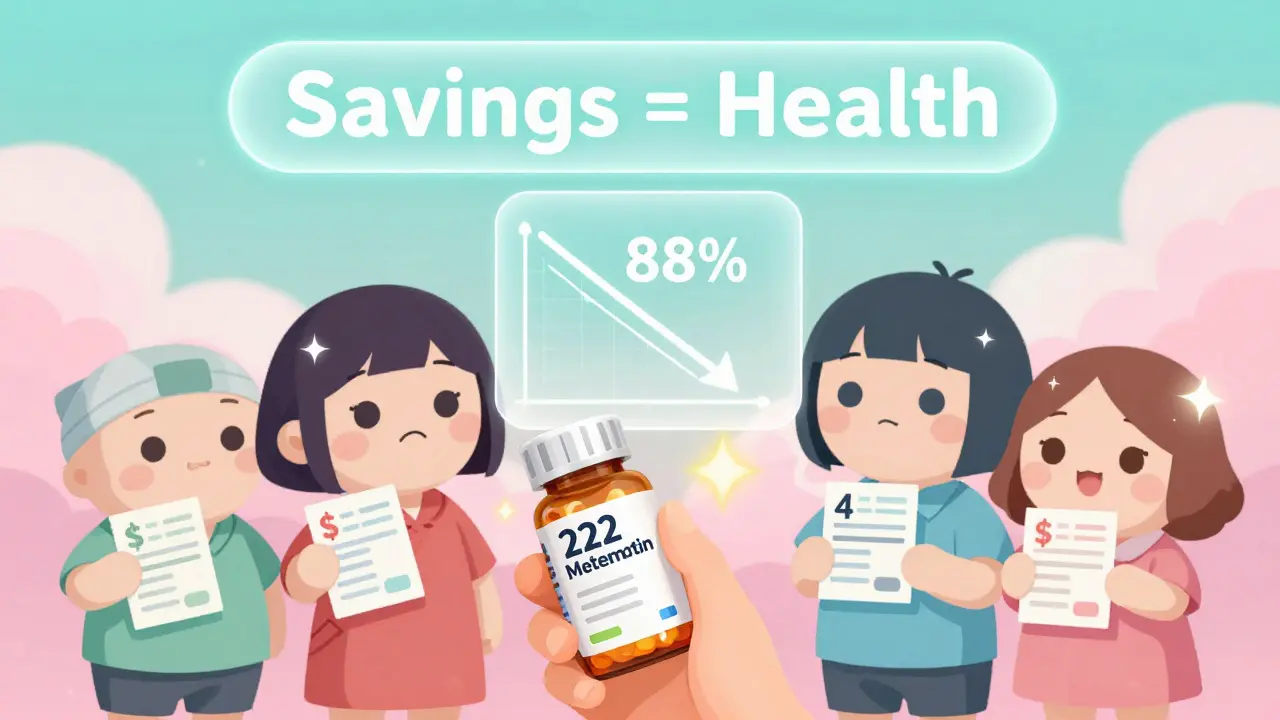
Take metformin, for example. It’s a generic diabetes drug. One manufacturer sells it for $4 a month. Another sells the exact same drug, same dosage, same active ingredient, for $22. Why? Because the higher-priced version is still on the formulary. It’s not because it works better. It’s because Pharmacy Benefit Managers (PBMs) profit from the spread-the difference between what they pay the pharmacy and what they charge the insurer. Sometimes, the more expensive generic pays them more.
Even more startling: when researchers compared generics to other drugs in the same class (like switching from one statin to another), the high-cost generics were 15.6 times more expensive than their cheaper alternatives. If you swapped those 45 high-cost generics for the lower-cost options, total spending would’ve dropped from $7.5 million to just $873,711. That’s an 88% savings.
How Cost-Effectiveness Analysis Works
CEA doesn’t just say, “This pill costs less.” It asks: “How much better health do we get for the extra money?”
The standard metric is the incremental cost-effectiveness ratio, or ICER. It’s calculated as: additional cost divided by additional health benefit. The benefit is usually measured in quality-adjusted life years (QALYs)-a way to count not just how long someone lives, but how well they live.
For example: If Drug A costs $10,000 and gives you 1 QALY, and Drug B costs $12,000 and gives you 1.5 QALYs, the ICER is ($12,000 - $10,000) / (1.5 - 1) = $4,000 per QALY. If the system’s threshold is $50,000 per QALY, Drug B is still cost-effective-even though it’s more expensive.
But here’s the problem: most studies don’t account for what happens next. Over 94% of published cost-effectiveness analyses ignore future generic entry. They treat the brand-name drug as if it’ll stay expensive forever. That makes generics look like a risky bet. But we know they won’t. They’ll come. And prices will crash.
Why the System Gets It Wrong
CEA models are often built using outdated pricing data. Some still use Average Wholesale Price (AWP), which is famously inflated and not reflective of real-world costs. Others use Federal Supply Schedule (FSS) or Veterans Affairs (VA) pricing, which are more accurate. But even then, they don’t adjust for the fact that generic prices keep falling.
The VA Health Economics Resource Center says generic drugs are priced at just 27% of AWP. Brand-name drugs? They’re priced at 64% of AWP. So if your analysis uses AWP without adjusting for that gap, you’re already off by a factor of two.
And then there’s timing. If you’re analyzing a drug that’s still under patent, and you assume its price won’t change for the next 10 years, your analysis is fundamentally flawed. Patents expire. Generics enter. Prices collapse. Ignoring that isn’t just inaccurate-it’s dangerous. It can lead to decisions that block access to cheaper, equally effective drugs.
Dr. John Garrison put it bluntly: “Failing to account for patent expiration creates pricing anomalies that distort incentives for pharmaceutical research.” If the system thinks a drug will always cost $10,000 a year, it might reject a cheaper alternative that’s already on the market. But if it knew that price would drop to $200 in 18 months, it would wait. And patients would get the drug sooner, at a fair price.
Therapeutic Substitution: The Hidden Opportunity
CEA doesn’t just compare brand vs. generic. It can compare one generic to another-and even one drug class to another.
For example: Is it better to use a generic statin like atorvastatin, or switch to a different class of cholesterol-lowering drug that’s cheaper and just as effective? The JAMA study found that when you swap high-cost generics for lower-cost therapeutic alternatives, savings can exceed 88%.
And it’s not just about pills. Sometimes, a generic tablet costs more than a generic liquid version of the same drug. Or a 30-day supply costs more than a 90-day supply. These aren’t clinical differences. They’re pricing quirks. And CEA can spot them.
But here’s the barrier: most formularies don’t allow this kind of substitution without prior authorization. Doctors aren’t trained to think this way. Pharmacists aren’t incentivized to suggest it. And insurers often don’t have the data to know what’s truly cheapest.
Who’s Doing It Right?
In Europe, over 90% of health technology assessment (HTA) agencies use formal CEA to decide which drugs get covered. In the U.S.? Only 35% of commercial insurers do. Medicare and Medicaid have more tools, but they’re still playing catch-up.
One organization that gets it right is the Institute for Clinical and Economic Review (ICER). They publish detailed, transparent reports on drug value-factoring in generic entry, long-term savings, and real-world pricing. Their analyses have directly influenced formulary decisions in multiple states.
But ICER is the exception. Most payers still rely on outdated data, proprietary algorithms, or vendor recommendations. And when your decision-making is opaque, you’re leaving money-and health-on the table.
What Needs to Change
CEA for generics needs three upgrades:
- Forecast generic entry. Don’t assume prices stay flat. Build models that predict when generics will launch and how much prices will drop after each new entrant.
- Use real pricing data. Stop using AWP. Use VA, FSS, or actual wholesale acquisition cost (WAC) data. Adjust for dosage, quantity, and formulation.
- Allow therapeutic substitution. If a cheaper drug in the same class works just as well, make it the default. Don’t make patients and doctors jump through hoops.
And most importantly: stop treating generics as a side note. They’re not a backup. They’re the primary tool for sustainable healthcare.
The Bigger Picture
More than 300 small-molecule drugs are set to lose patent protection between 2020 and 2025. That’s a tidal wave of generic entry. If we don’t update how we measure value now, we’ll be stuck with outdated systems when the real savings arrive.
The Inflation Reduction Act of 2022 started pushing Medicare to negotiate drug prices. But negotiation only works if you know what the real alternatives are. If you don’t know that a $200 generic exists, you’ll end up negotiating with a $1,500 brand-name drug-and thinking you’re doing well.
Cost-effectiveness analysis isn’t about cutting corners. It’s about cutting waste. It’s about making sure every dollar spent on medicine delivers the most health possible. And when it comes to generics, the data is clear: the cheapest option isn’t just affordable. It’s often the smartest.
Are generic drugs as safe and effective as brand-name drugs?
Yes. The FDA requires generics to have the same active ingredient, strength, dosage form, and route of administration as the brand-name drug. They must also meet the same strict standards for quality, purity, and performance. Bioequivalence studies prove they work the same way in the body. The only differences are in inactive ingredients-like fillers or dyes-which don’t affect how the drug works.
Why do some generics cost more than others?
Price differences between generics come from manufacturing scale, distribution deals, and how Pharmacy Benefit Managers (PBMs) structure their contracts. Some PBMs profit from higher prices through "spread pricing," where they charge insurers more than they pay pharmacies. A generic pill might cost $5 to make but be priced at $25 because that’s what the PBM negotiates-and keeps the difference.
Can I switch from a brand-name drug to a generic without my doctor’s approval?
In most cases, yes-pharmacists can substitute a generic unless the prescription says "dispense as written" or "no substitution." But if you’re switching between different drugs in the same class (like switching from one statin to another), you’ll need your doctor’s approval. That’s therapeutic substitution, and it requires a new prescription.
Why don’t insurers always choose the cheapest generic?
Because some insurers rely on formularies built by Pharmacy Benefit Managers (PBMs), who may prioritize drugs that give them higher rebates or spread pricing profits-not the lowest cost. Also, some formularies haven’t been updated to reflect newer, cheaper alternatives. Without cost-effectiveness analysis, they’re flying blind.
How can I find out if there’s a cheaper alternative to my generic drug?
Ask your pharmacist to check therapeutic alternatives using real-time pricing tools like GoodRx or SingleCare. You can also ask your doctor if a different drug in the same class (like switching from metoprolol to atenolol) might work just as well-and cost less. Many times, the answer is yes.
Generics are just branded placebo with different packaging. If it ain't the name you trust, why risk it?
The data here is overwhelming. It's not even close-a 90% market share with only 17% of the spend? That's not a loophole, that's a public health win. We're literally leaving billions on the table by not optimizing formularies.
And the PBM spread pricing? That's not capitalism. That's a tax on sick people.
AMERICA IS BEING ROBBED. The FDA says generics are equal? Fine. But who's really controlling the pricing? Big Pharma? No. PBMs. The same shadowy middlemen who charge you $120 for insulin while paying the pharmacy $4. This isn't healthcare-it's financial engineering with a stethoscope.
And don't get me started on how our ‘cost-effectiveness’ models ignore generic entry like it’s some myth. We’re running medical economics with a 1998 spreadsheet. It’s criminal.
Meanwhile, India’s making generics so cheap they export them to the U.S. and we still pay 20x more. 🇮🇳🇺🇸 #WTFAMERICA
Interesting, very interesting... I am from India, where generics are the norm, and we do not have this kind of confusion. In our country, a patient can buy metformin for less than 10 rupees a month-about 12 cents. And it works. People live. People thrive. Why is America so complicated? Is it because of insurance? Or because of greed? I think both.
Also, I think, the word 'cost-effectiveness' is not understood properly here. It is not just about money-it is about life, dignity, access. And when access is blocked by paperwork and formularies, then it is not healthcare-it is bureaucracy.
I just got my prescription filled and the pharmacist said, 'This one's cheaper.' I asked why the other one was even on the shelf if it was more expensive. She sighed and said, 'Because someone gets paid more if you pick it.' I cried in the parking lot. Not because I couldn't afford it-but because I knew I was being manipulated.
so like… generics are literally the same but cheaper? and we still pay more? wow. that’s wild. my pharmacist just switches it without asking, and i’ve never had an issue. why is this even a debate?
THEY’RE LYING TO YOU. 🚨 The FDA? They’re bought. PBMs? They’re the real drug dealers. And you think you’re saving money? No. You’re being played. This system is designed to keep you dependent, confused, and paying more. Wake up. This isn’t healthcare-it’s a pyramid scheme with pills.
And if you’re still taking brand-name drugs? You’re the reason this system exists. 💔
Why are we even talking about this? It's simple. Brand name = safe. Generic = risky. I don't care what the numbers say. My grandma took the brand and lived to 92. I'm not gambling with my health.
Hey, I work in a pharmacy in Delhi and we send generics to the US every week. The same pills, same batch, same lab. But here, they charge 20 times. I don't get it. You guys have the tech, the science, the money… why not fix this? Just say no to middlemen.
It is imperative to acknowledge that the structural inefficiencies within the U.S. pharmaceutical supply chain are not merely economic anomalies; they are systemic failures rooted in misaligned incentives. The continued reliance on Average Wholesale Price as a benchmark constitutes a profound epistemological error-one that undermines the very foundation of evidence-based policy. We must transition to real-time, transparent pricing models grounded in Wholesale Acquisition Cost, and we must do so without delay.