

If you're taking levothyroxine for hypothyroidism, and you're also popping calcium or iron supplements, you could be quietly sabotaging your treatment. It’s not a myth. It’s not anecdotal. It’s backed by decades of clinical research and confirmed by major medical associations. Calcium and iron don’t just sit quietly in your gut-they bind to your thyroid medication and stop it from being absorbed. That means your body isn’t getting the hormone it needs, even if you’re taking the right dose.
Why Calcium and Iron Ruin Thyroid Medication Absorption
Levothyroxine, the synthetic form of thyroid hormone, needs to be absorbed in the upper part of your small intestine. But when calcium or iron is present at the same time, they form tight, insoluble complexes with the medication. Think of it like glue sticking to a key-your thyroid pill can’t unlock the absorption pathway anymore. Studies show this can cut absorption by up to 36% when taken together.
This isn’t just about pills. Calcium-fortified orange juice, almond milk, or soy milk can have the same effect. One cup of calcium-fortified orange juice contains about 350 mg of calcium-enough to interfere. Iron supplements aren’t the only offenders either. Iron in fortified cereals, prenatal vitamins, or even some multivitamins can do the same thing.
The Numbers Don’t Lie
Let’s look at what real studies found:
- A 2000 study in the Journal of Clinical Endocrinology & Metabolism showed that 1,200 mg of calcium carbonate taken with levothyroxine reduced absorption by 22-36%.
- A 2008 study found that 325 mg of ferrous sulfate (a common iron pill) lowered absorption by 21%.
- A 2021 European review of 27 studies concluded calcium supplements taken within four hours of levothyroxine reduce absorption by an average of 27.3%.
- The American Association of Clinical Endocrinologists says iron taken within two hours of thyroid medication can drop absorption by up to 39%.
And it’s not just numbers on a page. In one study, 20% of patients on levothyroxine who took calcium supplements daily ended up with elevated TSH levels-meaning their thyroid was underactive despite taking medication. Their TSH dropped back to normal only after they stopped taking calcium at the same time.
What the Guidelines Say
Major health organizations agree on one thing: timing matters. But they don’t all agree on exactly how much time.
- Mayo Clinic (2023): Wait at least four hours before or after taking calcium or iron.
- European Thyroid Association (2022): Two to three hours separation is sufficient.
- American Association of Clinical Endocrinologists (2022): Four hours for calcium, two hours for iron.
- Thyroid UK (2022): Four hours for iron, three hours for calcium.
The safest approach? Go with the longest window: four hours. That way, you’re covered no matter which guideline your doctor follows.
When to Take Your Supplements
Here’s how to make it work in real life:
- Take your thyroid pill first thing in the morning-on an empty stomach, with a full glass of water. Wait 30 to 60 minutes before eating or drinking anything else.
- Take calcium supplements at bedtime, at least four hours after your last meal. This is ideal because most people don’t eat after dinner, and it avoids interference with breakfast.
- Take iron supplements at lunchtime, ideally two to four hours after your thyroid pill and at least two hours before or after any calcium-containing food or drink.
- Avoid calcium-fortified foods within four hours of your thyroid dose. That includes orange juice, soy milk, almond milk, and some cereals.
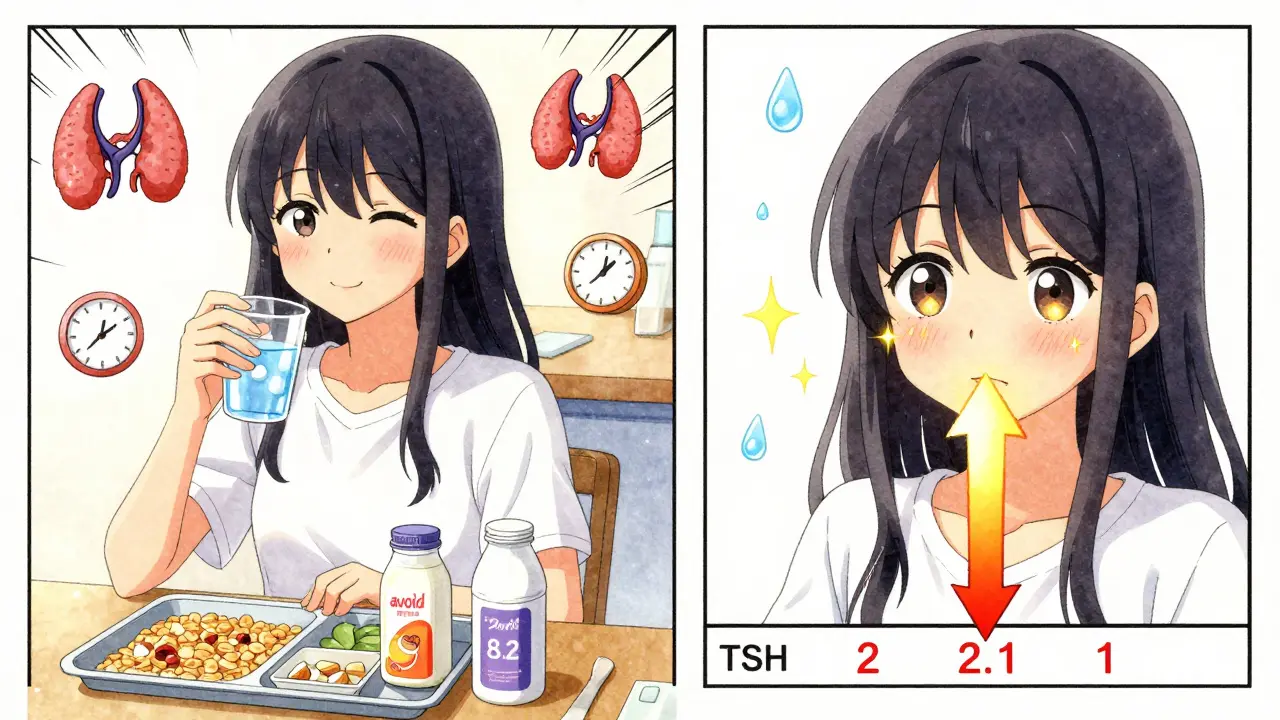
Some patients find switching their thyroid medication to bedtime works better. A Reddit thread from a user named u/HypoMama shared how switching from morning to night dosing solved her absorption issues after she started iron for postpartum anemia. She didn’t change her supplements-she just changed the timing of her pill. Her TSH dropped from 8.2 to 2.1 in three months.

Who’s at Highest Risk?
Not everyone needs to stress equally. These groups are most likely to be affected:
- Pregnant women: Need iron and calcium, and thyroid hormone needs increase by 30-50% during pregnancy. Poor absorption can harm both mother and baby.
- Postmenopausal women: Often prescribed calcium and vitamin D for bone health, and many have hypothyroidism.
- Women with heavy periods: Frequently take iron supplements for anemia.
- Elderly patients: Often on multiple medications and supplements, making timing harder to manage.
A 2023 study found that 45% of pregnant women taking both iron and levothyroxine had elevated TSH levels-even when they spaced their supplements by four hours. That’s why doctors often increase thyroid doses during pregnancy and monitor TSH every 4-6 weeks.
Other Things That Interfere
Calcium and iron aren’t the only troublemakers:
- Soy products: Can increase levothyroxine needs by 18-30%. Avoid soy milk, tofu, or edamame within a few hours of your pill.
- Walnuts: One study showed they reduce absorption by 24%.
- Coffee and tea: Tannins block absorption. Wait at least an hour after your pill before drinking them.
- High-fiber foods: More than 30 grams of fiber within an hour of your pill can raise TSH by 15-25%.
- Biotin: Found in hair and nail supplements. At doses over 5 mg/day, it can cause falsely high thyroid test results, making your doctor think you’re overmedicated when you’re not.
- Antacids and proton-pump inhibitors: These change stomach pH and reduce levothyroxine absorption.
That’s why the official advice is simple: take your thyroid pill with water only. Nothing else. Not food, not coffee, not juice, not supplements. Wait 30-60 minutes before anything else.
What About Newer Thyroid Medications?
There’s some hope on the horizon. A new liquid formulation of levothyroxine, currently in Phase III trials, shows only an 8% drop in absorption when taken with calcium-compared to 32% with standard tablets. That’s a big deal. But right now, it costs about $350 a month, while generic levothyroxine is $15. Most insurance won’t cover it unless you’ve tried everything else.
Another option is enteric-coated tablets, designed to release the medication in the small intestine instead of the stomach. Early results look promising, but they’re not widely available yet.
Why This Matters Financially and Medically
Getting this wrong isn’t just inconvenient-it’s expensive. A 2022 analysis estimated that improper timing of supplements with thyroid medication leads to $187 million in unnecessary healthcare costs each year in the U.S. Why? Repeated blood tests, incorrect dose adjustments, ER visits for fatigue or heart palpitations, and even misdiagnosis of thyroid disease.
And it’s preventable. A 2023 study found only 42% of patients received proper counseling about supplement interactions when they were first prescribed levothyroxine-even though 89% of doctors know it’s important.
What You Should Do Today
If you take levothyroxine and any supplement:
- Check your supplement labels. Look for calcium, iron, magnesium, or aluminum. If it’s in there, note the dose.
- Write down your current routine. When do you take your thyroid pill? When do you take your supplements? Are you eating or drinking anything within an hour?
- Call your doctor or pharmacist. Ask: “Is my supplement schedule interfering with my thyroid medication?” Don’t assume they know what you’re taking.
- Adjust your timing. Move calcium to bedtime. Move iron to lunch. Leave your thyroid pill alone in the morning with water only.
- Get a TSH test in 6-8 weeks. If your levels were high before, they should drop after you fix your timing.
This isn’t about being perfect. It’s about being consistent. One missed window won’t ruin your treatment. But doing it wrong every day? That’s how you end up with fatigue, weight gain, brain fog, and a higher risk of heart problems.
Can I take calcium and iron together?
Yes, you can take calcium and iron together-they don’t interfere with each other. But neither should be taken within four hours of your thyroid medication. The real problem is timing them with levothyroxine, not with each other.
What if I forget and take my supplement with my thyroid pill?
Don’t panic. One mistake won’t cause harm. But don’t double up on your thyroid dose to make up for it-this can be dangerous. Just skip that dose and take your next one as scheduled. If it happens often, adjust your routine. Consider moving your supplement to bedtime or lunchtime.
Does it matter if I take my thyroid pill at night instead of in the morning?
No, the time of day doesn’t matter as long as you’re consistent and take it on an empty stomach. Many people find nighttime dosing easier because they can avoid food, coffee, and supplements. Studies show nighttime levothyroxine works just as well as morning dosing-sometimes better, especially if you take iron or calcium regularly.
Can I take my thyroid medication with just a sip of water?
Yes, a small sip of water is fine. But avoid large amounts of liquid, especially if it’s juice, milk, or tea. Stick to plain water. Also, don’t take it with sparkling water-it can affect absorption slightly.
Why do some people say they feel fine even with supplements taken together?
Some people absorb thyroid medication well even with interference, or their bodies compensate over time. But that doesn’t mean it’s safe. Elevated TSH levels can build up silently. You might feel okay now, but long-term, untreated hypothyroidism increases your risk of heart disease, high cholesterol, and even depression. Blood tests are the only way to know if your dose is right.
Should I stop taking calcium or iron if I have hypothyroidism?
No. You still need these minerals. Calcium for bone health, iron for oxygen transport. The goal isn’t to quit them-it’s to space them out properly. Talk to your doctor about the best timing for your lifestyle. Many people successfully manage both with simple schedule changes.
Final Thought: This Is About Control
Thyroid disease is already a lot to manage. You’re checking symptoms, tracking weight, dealing with fatigue, and trying to stay healthy. The last thing you need is a hidden interaction quietly making your medication less effective. You don’t have to be perfect. But you do need to be aware. A four-hour gap isn’t a burden-it’s your insurance policy for feeling better. Take your pill with water. Wait. Then take your supplements. That’s it. Simple. Effective. And it works.
So basically, big pharma wants you to wait 4 hours? LOL. My grandma took her thyroid pill with coffee and calcium orange juice for 30 years and still ran marathons. 😏
They’re hiding the truth again. Calcium and iron don’t interfere - it’s the fluoride in the water they pump into your town that’s blocking absorption. The FDA knows. The AMA knows. You’re being played. 🇺🇸
did u know that the thyroid gland is controlled by the pineal gland which is affected by EMF radiation from 5g towers? and the 'calcium interference' thing? its just a distraction so you dont ask why your meds dont work... theyre selling you a lie. 💊📡
While the pharmacokinetic interactions between levothyroxine and divalent cations are well-documented, the clinical significance varies considerably among individuals due to gastrointestinal motility, pH gradients, and concomitant dietary factors. A standardized four-hour separation protocol remains the most empirically supported intervention.
I DID IT I SWITCHED TO NIGHTTIME AND MY ENERGY IS BACK OMG I WAS SO TIRED FOR A YEAR AND NO ONE TOLD ME THIS IS A THING I LOVE YOU POSTER YOU SAVED MY LIFE 💪🌙
It’s amazing how something so simple can make such a huge difference. I used to take my iron with breakfast and wonder why I never felt better. Now I take it at lunch and I’m actually sleeping through the night. Small changes, big results.
As a registered dietitian in Vancouver, I routinely counsel patients on this exact issue. The four-hour window is not arbitrary - it’s biochemically grounded. Consistency, not perfection, is the goal. Many patients are shocked to learn their TSH improved simply by moving supplements to bedtime.
bro i took my thyroid pill with my protein shake for 2 years and felt fine 😎 but then i tried this 4hr thing and now i have superpowers 🤖✨
The data presented is statistically valid but fails to account for inter-individual variability in gastric emptying time, which can range from 30 minutes to over 2 hours. Therefore, rigid temporal separation protocols may be unnecessarily restrictive for a significant subset of the population.
I get it - timing is a pain. But I started writing my supplement times on my calendar and it’s made all the difference. No more guessing. No more guilt. Just peace of mind.
Iron and calcium don’t interact with each other. Only with levothyroxine. Take them together at lunch if you want.
For patients with malabsorption syndromes or gastric bypass, even the 4-hour window may be insufficient. Enteric-coated formulations or liquid levothyroxine are emerging alternatives - though cost and access remain barriers. Always test TSH 6-8 weeks post-adjustment.
Interesting. I’ve been taking mine at night for months and my TSH dropped from 7.1 to 2.9. I didn’t change anything else. Maybe the morning routine isn’t the only way.