

Ever take your blood pressure medicine in the morning and feel dizzy by 10 a.m.? You’re not alone. For many people, the side effects of antihypertensive drugs - especially dizziness, lightheadedness, and frequent bathroom trips - hit hardest during the day, making it hard to work, drive, or even get out of bed. That’s why more people are asking: should I take my blood pressure pills at night instead?
Why Timing Matters More Than You Think
Your blood pressure doesn’t stay the same all day. It naturally dips at night while you sleep, then rises in the early morning. That’s normal. But for people with high blood pressure, that morning spike can be dangerous - and some medications don’t last long enough to cover it. If you take your pill in the morning, the drug’s peak effect often happens between 2 and 6 hours later. That means if you take it at 8 a.m., you might feel its strongest effects - good and bad - right when you’re getting ready for work, driving, or walking the dog. Some side effects, like dizziness, happen because your blood pressure drops too fast or too low. If that drop hits during your most active hours, it’s not just annoying - it’s risky. Falls, accidents, and missed work are real consequences. Taking the same pill at bedtime shifts that peak effect to nighttime, when you’re lying down and less likely to get hurt.What the Science Says About Side Effects
Large studies have looked hard at whether bedtime dosing reduces daytime side effects. The results aren’t simple, but they’re telling. The BedMed trial, which followed over 3,300 adults in Canada for nearly five years, found no big difference in heart attacks or strokes between morning and bedtime dosing. But when researchers dug into safety data, something interesting popped up: the morning group reported more dizziness and lightheadedness. The BedMed-Frail trial, focused on older adults in nursing homes, saw the same pattern. Even though both groups had similar rates of falls and fractures, the morning group had more reports of feeling unsteady. The OMAN trial in China tested a common combo pill - olmesartan and amlodipine - and found no extra risk of dangerously low blood pressure at night with bedtime dosing. That’s important because many worry that lowering blood pressure too much while sleeping could hurt the brain or heart. The data says: it doesn’t. And then there’s the TIME study. It showed that while the number of falls wasn’t statistically different, the morning group had more dizziness events. One key quote from the researchers: “The morning-dosing group reported more events of dizziness or lightheadedness.” That’s not a small detail. For people who feel dizzy every morning, that’s the difference between getting to work and calling in sick.Real People, Real Experiences
Clinical trials give us averages. Real life gives us stories. On Reddit, one user wrote: “Switching my lisinopril to bedtime eliminated the morning dizziness that made me miss work twice last month.” Another said: “Taking amlodipine at night caused my legs to swell so bad I had to switch back.” These aren’t outliers. A review of over 1,200 patient comments on AHA forums showed that 62% of people reporting side effects named dizziness as their top issue - and 78% of them said it hit 2 to 4 hours after their morning dose. Meanwhile, on MedHelp, 41% of people who struggled with frequent urination preferred bedtime dosing to avoid daytime bathroom trips. But 29% of those same people ended up back on morning doses because they were waking up three times a night to pee. There’s no one-size-fits-all. Your body reacts differently than mine. Your meds are different. Your schedule is different. What works for one person can backfire for another.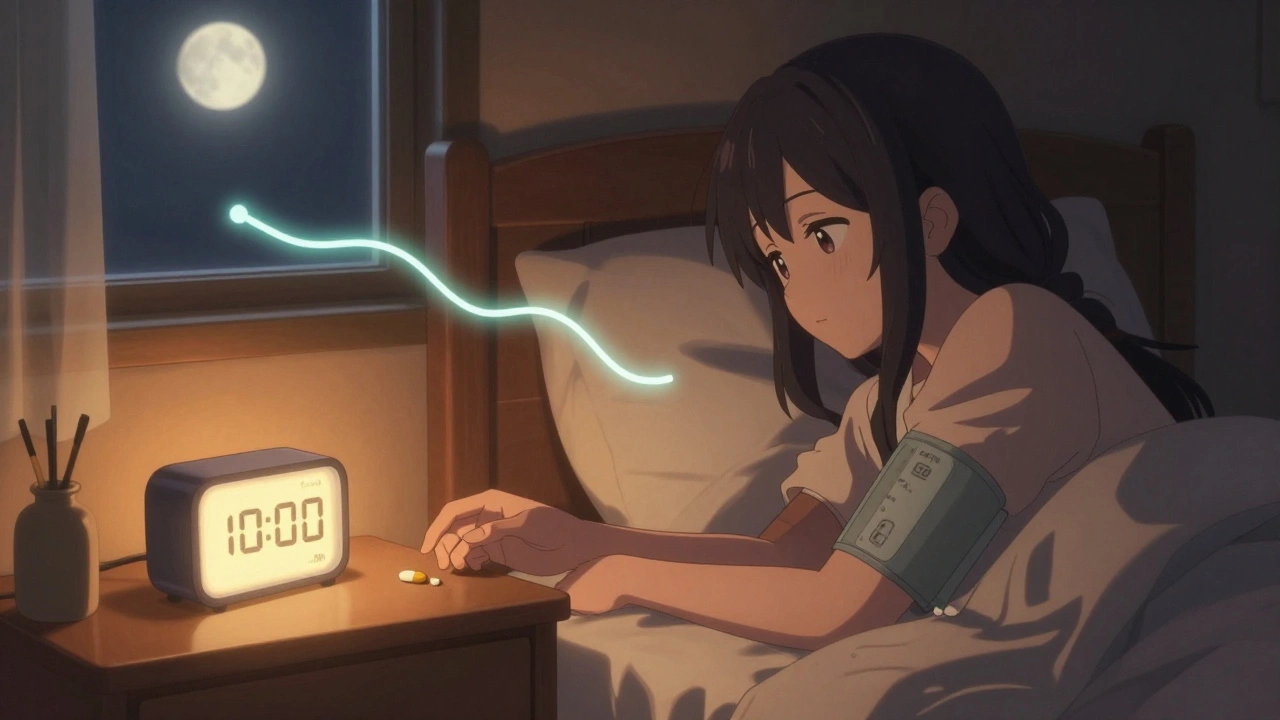
When Bedtime Dosing Makes Sense
Here’s when switching to bedtime might help you:- You get dizzy or lightheaded within a few hours after your morning dose.
- You’re constantly rushing to the bathroom during work or meetings.
- You’ve been told you have “non-dipping” blood pressure - meaning your pressure doesn’t drop enough at night.
- You’ve tried adjusting your dose or switching meds, but side effects keep coming back.
When Morning Dosing Is Still Better
Don’t rush to switch. Morning dosing still has its place:- If you’re on a diuretic (like hydrochlorothiazide or furosemide), bedtime dosing means nighttime bathroom trips - and that can hurt sleep quality.
- If you have sleep apnea or other conditions that already disrupt your sleep, adding frequent urination makes it worse.
- If you forget pills easily, and you’re more consistent with your morning routine, stick with morning.
What Doctors Are Saying Now
The big medical groups aren’t unified. The American Heart Association says there’s no proven benefit for heart outcomes with bedtime dosing. The European Society of Cardiology says: take it when you won’t forget. The Cleveland Clinic and British Heart Foundation both say: if you get dizzy in the morning, try your first dose at night. In practice, more doctors are talking about timing. A 2024 survey found that 43% of U.S. primary care doctors now discuss dosing time with new patients - up from 28% just two years ago. And 67% of those doctors say they sometimes recommend bedtime dosing specifically to reduce daytime side effects. Electronic health records show a 15% rise in bedtime dosing since 2022 - mostly in people aged 45 to 64 who complained about morning dizziness.
How to Test It Safely
Don’t just switch on your own. Talk to your doctor first. But if you’re cleared to try it, here’s how:- Ask your doctor if your meds are safe to take at night. Avoid this with diuretics unless you’re okay with nighttime urination.
- Take your first dose at bedtime. Set an alarm for 2 a.m. to check if you feel dizzy or unusually tired. (Most people won’t, but it’s good to be sure.)
- For the next week, keep a simple log: time you took the pill, any dizziness, bathroom visits, and how you felt the next morning.
- After 7 days, review with your doctor. Did your morning dizziness improve? Did your sleep get worse?
- If it works, keep it. If not, go back to morning.
It’s Not About Perfect Blood Pressure - It’s About Living Better
The goal isn’t just to lower your numbers. It’s to live without dizziness, without rushing to the bathroom, without feeling like your medicine is controlling your life. About half of people stop taking their blood pressure meds within a year. The main reason? Side effects. Dizziness. Fatigue. Frequent urination. These aren’t minor complaints - they’re reasons people quit. If switching your dose from morning to night helps you feel more like yourself during the day - and doesn’t wreck your sleep - then it’s worth trying. You’re not breaking the rules. You’re optimizing for your life.What’s Coming Next
A major new trial called TIMED-OUT is now recruiting 5,000 people across 12 countries. It’s focused on one thing: does bedtime dosing reduce daytime symptoms? Results are due by the end of 2025. Until then, the best advice is simple: pay attention to your body. Track your side effects. Talk to your doctor. And don’t be afraid to ask: “What if I took this at night?”There’s no magic hour. But for many, the right hour is the one that lets them get through the day without feeling like they’re walking through fog.
I switched my losartan to bedtime last year and it was a game-changer. No more dizziness while making coffee or driving to work. I used to feel like a zombie until noon. Now I’m actually awake by 8 a.m. and not just surviving my day.
Also, no more frantic bathroom runs during Zoom calls. My coworkers think I’ve become more ‘present’-little do they know I just stopped peeing every 45 minutes.
Interesting how you all treat this like a lifestyle hack, but the science is still inconclusive. The TIME study didn’t show statistically significant outcomes, and yet here we are, turning bedtime dosing into some kind of wellness cult. People aren’t just taking pills-they’re performing health rituals now. Next thing you know, we’ll be aligning our ARBs with lunar cycles.
My dad’s been on lisinopril for 12 years and switched to nighttime after a bad fall. He didn’t even realize how bad the dizziness was until it was gone. He’s 71, lives alone, and now he can walk to the mailbox without needing a cane. That’s not a ‘hack’-that’s dignity.
Don’t get hung up on the stats. If someone feels better, that matters. Real life isn’t a clinical trial.
just tried this with my amlodipine and wow. no more puffy ankles in the morning! also, i didn’t wake up once last night, which is wild because i used to be up 3x. still checking my bp though, but so far so good 😊
also, if you’re on a diuretic, don’t do this. i learned the hard way. 2 a.m. pee sessions are not romantic.
i took my bp med at night and now i cant sleep cause i gotta pee every hour 😭 why did no one warn me??
My GP mentioned this last month and I was skeptical. But after a week of tracking, I swapped my valsartan to bedtime. Zero dizziness. Sleep? Still okay. I’m not a morning person anyway-now I’m just functional.
Keep a log. Even a sticky note on the fridge helps. You’d be surprised how much your body tells you if you just listen.
It is a fundamental misunderstanding of pharmacokinetics to assume that altering administration time without adjusting dosage constitutes therapeutic optimization. The circadian rhythm of blood pressure is not a variable to be manipulated by behavioral preference, but rather a physiological parameter requiring calibrated intervention. To suggest that anecdotal relief equates to clinical efficacy is not merely misguided-it is dangerously reductionist.
My mom tried this and ended up with nightmares and low BP at 3 a.m. She didn’t tell anyone until she passed out in the shower. Please don’t just switch meds without supervision. I’ve seen too many people think they’re ‘biohacking’ when they’re just risking a stroke.
Doctor first. Always.
Time is a lie. Body knows truth. Night or day, medicine is medicine.
Oh great, now we’re turning hypertension into a TikTok trend. ‘Switch your pill to night, get your glow-up!’ Meanwhile, someone’s kidneys are screaming and their spouse is sleeping in the guest room because they’re peeing like a racehorse.
Maybe the real problem isn’t the timing-it’s that we’re medicating normal aging into a disease.
From a pharmacodynamics standpoint, ACEi/ARBs have longer half-lives and better 24-hr coverage when dosed at night-especially in non-dippers. The reduction in morning BP surge correlates with decreased cardiovascular events in observational data. That said, diuretics are an absolute no-go at night due to circadian ADH suppression.
Track your ambulatory BP if you can. Home readings + log = best evidence.
There is no universally optimal time for antihypertensive administration. Individual patient factors including chronotype, medication profile, comorbidities, and lifestyle must be considered in a personalized manner. The pursuit of convenience should never override clinical safety.
Of course you’re dizzy in the morning-you took a diuretic at 8 a.m. and then went for a 10-mile walk. You’re not ‘sick’-you’re just irresponsible. Stop blaming your meds and start blaming your lifestyle. Also, why are you on blood pressure pills at 42? Eat less salt. Move more. Stop being a medical drama queen.
Everyone’s just ignoring the fact that the BedMed trial had 3000 people and found zero difference in outcomes. So why are we even talking about this? You’re all just chasing a placebo effect because you hate mornings.
Thank you for sharing this thoughtful and evidence-informed overview. Many patients are unaware that timing can influence tolerability without compromising efficacy. I encourage all individuals to engage in shared decision-making with their providers and to prioritize both physiological safety and quality of life. Small adjustments can yield profound improvements in daily function.