

| Type | Onset | Primary Cause | Progression |
|---|---|---|---|
| Hereditary | Ages 5-25 | Genetic mutations (e.g., Friedreich's) | Progressive |
| Acquired | Sudden | Stroke, trauma, or B12 deficiency | Variable/Potentially reversible |
| Idiopathic (ILOCA) | After age 50 | Unknown | Slowly progressive |
Why Traditional Physical Therapy Isn't Always Enough
If you've tried a generic physical therapy program and felt it didn't work-or worse, made you feel more unstable-you aren't alone. Many clinics treat ataxia like a standard muscle weakness issue, but the pathophysiology is completely different. For example, something called constraint-induced movement therapy, which works wonders for stroke victims with paralysis, actually makes symptoms worse for about 68% of people with ataxia. Why? Because ataxia is a problem of *coordination*, not *power*. To actually see a difference, you need task-specific training. This means instead of just doing leg lifts, you practice the exact movements you need for your life, like stepping over a curb or buttoning a shirt. Research shows that this targeted approach leads to 35% more functional improvement than traditional exercises. The goal is to teach the brain to find new pathways to bypass the damaged parts of the cerebellum.The Roadmap to Neurological Rehabilitation
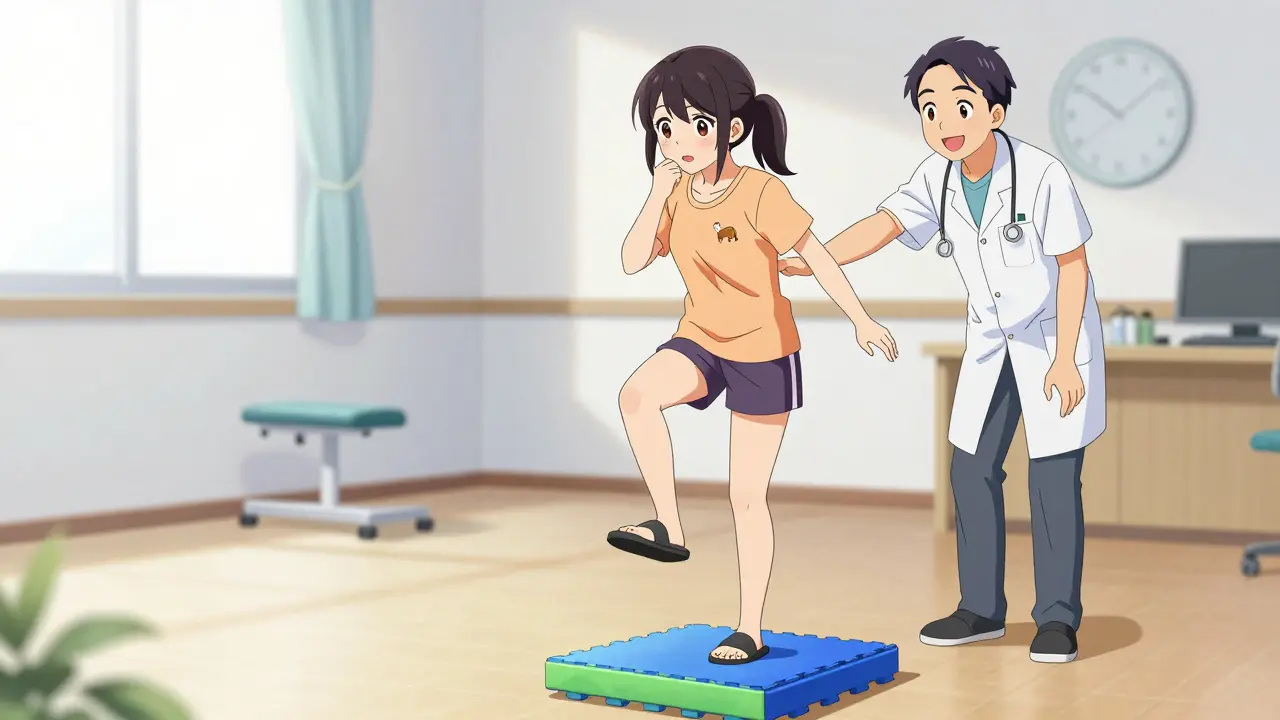
Effective Neurological Rehabilitation is rarely a quick fix. It's a marathon that requires a multidisciplinary team, usually consisting of physical therapists, occupational therapists, and speech-language pathologists. A gold-standard protocol generally follows a three-phase approach:- Phase 1: Static Balance (Weeks 1-4). The focus here is on staying still while the world moves around you. This involves balance training and "dual-task" challenges-like trying to balance on one foot while naming as many animals as you can.
- Phase 2: Dynamic Gait (Weeks 5-8). Once you're steady, you move to walking. This involves navigating obstacles and learning how to recover your balance after a trip or a nudge.
- Phase 3: Community Integration (Weeks 9-12). This is where the rubber meets the road. You practice walking in real-world environments, like crowded malls or uneven grass, focusing heavily on fall prevention.
High-Tech Tools and Emerging Treatments
We're seeing a shift toward using technology to bridge the gap in care. Some high-end centers use the CAREN system (Computer Assisted Rehabilitative Environment), which is essentially a giant motion-base platform that simulates real-world environments. It’s expensive, but it increases patient engagement by 28% because it feels more like a game than a medical treatment. For those who can't access these centers, wearable tech is becoming a lifeline. The Cerebello device is a recent breakthrough that provides real-time tremor suppression through neuromodulation. In trials, this helped users improve their upper limb function by 32%. Additionally, some clinics are now combining physical therapy with cerebellar transcranial direct current stimulation (ctDCS), which uses mild electrical currents to stimulate the brain, resulting in significantly better SARA scores than therapy alone.
The Mental and Financial Hurdle
It's a mistake to treat ataxia as just a physical problem. About 70% of patients deal with executive function deficits-struggles with planning, organizing, and multitasking. This is often called "cerebellar cognitive affective syndrome." If your therapist doesn't understand that your struggle to follow a complex exercise routine might be a neurological symptom and not a lack of effort, the therapy will likely fail. Then there's the money. In the US, specialized sessions can cost between $120 and $250. While insurance often covers the basics, many patients hit a "visit limit" just as they start seeing real progress. This financial wall is why home exercise programs and aquatic therapy have become so popular; swimming provides natural buoyancy that reduces the fear of falling, making it one of the highest-rated activities for patient satisfaction.Practical Tips for Better Outcomes
If you or a loved one are starting this journey, don't just settle for any therapist. Look for someone with specialized training, such as a CRED-certified (Cerebellar Rehabilitation and Evaluation Dynamics) therapist. These professionals understand that the goal isn't just "strength," but "stability." Keep these rules of thumb in mind:- Prioritize consistency over intensity. Doing 20 minutes of targeted balance work every day is better than one three-hour session a week.
- Use biofeedback. Whether it's a mirror or a wearable sensor, seeing your movement in real-time helps your brain correct the error.
- Advocate for a multidisciplinary approach. If you have slurred speech (dysarthria), a physical therapist can't help you; you need a speech-language pathologist to work on the timing of your breath and vocal cords.
Can ataxia be completely cured?
It depends on the cause. Acquired ataxia caused by things like vitamin B12 deficiency or certain toxins can sometimes be fully reversed if the cause is treated. However, for hereditary forms like Friedreich's ataxia, there is currently no cure. In these cases, rehabilitation focuses on slowing the loss of function and maximizing independence.
Why does swimming help with ataxia?
Water provides buoyancy, which removes the constant fear of a hard fall. This allows patients to practice balance and coordination movements that would be too dangerous on land. The resistance of the water also provides a constant form of biofeedback, helping the brain recognize where the body is in space.
What is the SARA score?
The Scale for the Assessment and Rating of Ataxia (SARA) is a clinical rating scale used by neurologists and therapists to quantify the severity of ataxia. It tracks eight items, including speech, stance, gait, and limb coordination. A decrease in the score indicates improvement in motor control.
How often should I do rehabilitation therapy?
Standard intensive protocols typically involve 3 to 5 sessions per week, each lasting 60 to 90 minutes. For the best results, this should be paired with a daily home exercise program to maintain the gains made during professional sessions.
Are there any exercises I should avoid?
Avoid generic high-intensity constraint-induced movement therapy if you have cerebellar ataxia, as evidence suggests it can actually worsen coordination for many patients. Always work with a therapist who specializes in neurorehabilitation to ensure the movements are appropriate for your specific type of ataxia.
The emphasis on task-specific training is such a game changer for a lot of people. I've seen so many folks get discouraged by standard PT when they really just need to practice the actual movements of their daily life. It's all about those small, functional wins that build confidence over time.
Task-specific training is just a fancy word for common sense.
There is a profound irony in the way we treat the cerebellum. We spend our lives refining our movements through a subconscious dance of neurons, yet when that dance is disrupted, we try to fix it with rigid, clinical protocols. Perhaps the real recovery isn't just about regaining the movement, but about accepting the new rhythm of one's own body. The integration of technology like the CAREN system suggests we are trying to simulate reality to escape a reality that has become frightening. It makes me wonder if the psychological adaptation is actually more critical than the physical one, as the mind's perception of stability is often more important than the objective measurement of balance.
The whole 'three-phase approach' smells like a corporate blueprint designed to keep you paying for twelve weeks of sessions. It's an arbitrary timeline for a biological process that varies from person to person. Why are we pretending that a human brain follows a calendar? It's just another way to systematize something that is fundamentally chaotic.
The financial breakdown is absolutely appalling!!! Who decided that $250 is a reasonable cost for a session??? It's predatory... just predatory!!! This is why so many families just give up before they even start!!!
I find it quite exhausting that the author assumes everyone has the luxury of a multidisciplinary team. For those of us actually dealing with the crushing weight of a degenerative condition, reading about 'gold-standard protocols' just highlights how out of touch these guides are with the actual struggle of existing in a body that doesn't cooperate.
Funny how we're told to use 'wearable tech' and 'neuromodulation' suddenly. I bet these devices are just another way to collect biometric data on our neurological weaknesses. They call it a 'breakthrough' but it's likely just a way to make us dependent on a subscription service for our own balance. The 'unknown' cause of ILOCA is probably just a cover for something they aren't telling us about environmental toxins.
Who cares about these expensive US machines? 🙄 India has amazing traditional methods and holistic approaches that work way better than some fancy motion-base platform! We don't need your 'high-tech' when we have real wisdom! 🇮🇳💪
It is wonderful to see so many different perspectives here. While we all have different ways of healing, the common goal is simply to help people regain their independence and dignity.
The sheer audacity of suggesting swimming is a 'top-rated activity' is hilarious. Some of us actually have standards for our rehabilitation and prefer elite, specialized clinics over a public pool 🙄💅✨
You must push through the financial barriers and demand the best care! Do not let a visit limit stop you from reclaiming your life! Fight the insurance companies and get the specialized therapy you deserve!
I must insist that you all maintain a rigorous home exercise program without fail! Consistency is the only path to success and any deviation from the protocol is a failure of will! You must be aggressive in your pursuit of stability!